Question 47 UFIV02 - Assistant Engineer - UFIV
Using the oil chart provided in the illustration for guidance, what would be the recommended straight weight petroleum oil to use in a main engine speed control governor on your fishery research vessel, if the governor is to remain in the acceptable operating range and the governor oil operating temperature may drop as low as 40oF? Illustration MO-0161
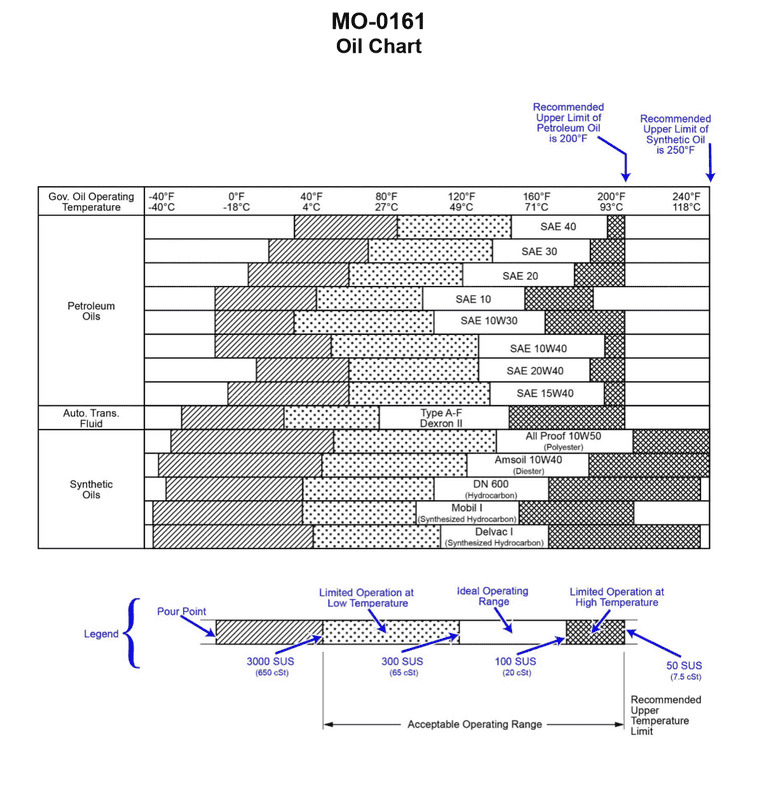
The Correct Answer is A ### Explanation for Option A (SAE 10) The question asks for the recommended straight weight petroleum oil to use in a main engine speed control governor, ensuring the oil remains in the acceptable operating range when the governor oil operating temperature may drop as low as $40^\circ\text{F}$. To determine the correct oil, we must consult the provided oil chart (Illustration MO-0161, which typically relates oil viscosity (SAE weight) to ambient or operating temperature ranges). Standard temperature-viscosity charts for engine oil indicate the minimum ambient or operating temperature that an oil grade can safely handle while maintaining fluidity and lubrication. Referring to a standard SAE Straight Weight Oil Selection Chart: * **SAE 10** typically covers the temperature range of $0^\circ\text{F}$ up to approximately $60^\circ\text{F}$ or $90^\circ\text{F}$ (depending on the specific chart design). Crucially, SAE 10 is designed to operate effectively at temperatures well below $40^\circ\text{F}$. * Since the minimum required operating temperature is $40^\circ\text{F}$, **SAE 10** is the lightest grade (lowest viscosity) that safely covers this low temperature while also providing adequate viscosity for the governor's function at higher temperatures within the governor's acceptable range. Choosing a heavier oil (like SAE 20, 30, or 40) might cause sluggish operation or cavitation at $40^\circ\text{F}$. Therefore, SAE 10 is the recommended choice to ensure the governor remains within the acceptable operating range down to $40^\circ\text{F}$. ### Explanations for Incorrect Options **B) SAE 20:** SAE 20 is a heavier grade of oil, typically recommended for minimum operating temperatures around $32^\circ\text{F}$ or $40^\circ\text{F}$ and above. While it might technically operate at $40^\circ\text{F}$, it is close to the lower limit of its effective range. For control systems like governors, which require quick response and light loads, a heavier oil like SAE 20 would provide unnecessary drag and could lead to sluggish response or potentially cause operational issues if the temperature slightly drops below $40^\circ\text{F}$ (or if the oil is already on the colder side of $40^\circ\text{F}$). SAE 10 is preferred for control systems that experience low temperatures. **C) SAE 30:** SAE 30 is significantly heavier than necessary. It is typically intended for minimum operating temperatures above $40^\circ\text{F}$ or $50^\circ\text{F}$. Using SAE 30 at $40^\circ\text{F}$ would result in excessive viscosity, leading to sluggish governor response, increased internal drag, potential cavitation, and difficulty maintaining the acceptable operating range. **D) SAE 40:** SAE 40 is a high-viscosity oil intended for use in high ambient or operating temperatures (e.g., $80^\circ\text{F}$ and above). It would be far too thick at $40^\circ\text{F}$ and would severely impede the proper operation and responsiveness of the speed control governor.
Pass Your Coast Guard Licensing Exams!
Study offline, track your progress, and simulate real exams with the Coast Guard Exams app