Question 26 UFIV02 - Assistant Engineer - UFIV
The fishing industry seiner to which you are assigned has an engine as shown in the illustration. What statement concerning air box and exhaust manifold pressure is true, if the engine is running at rated speed? Illustration MO-0224
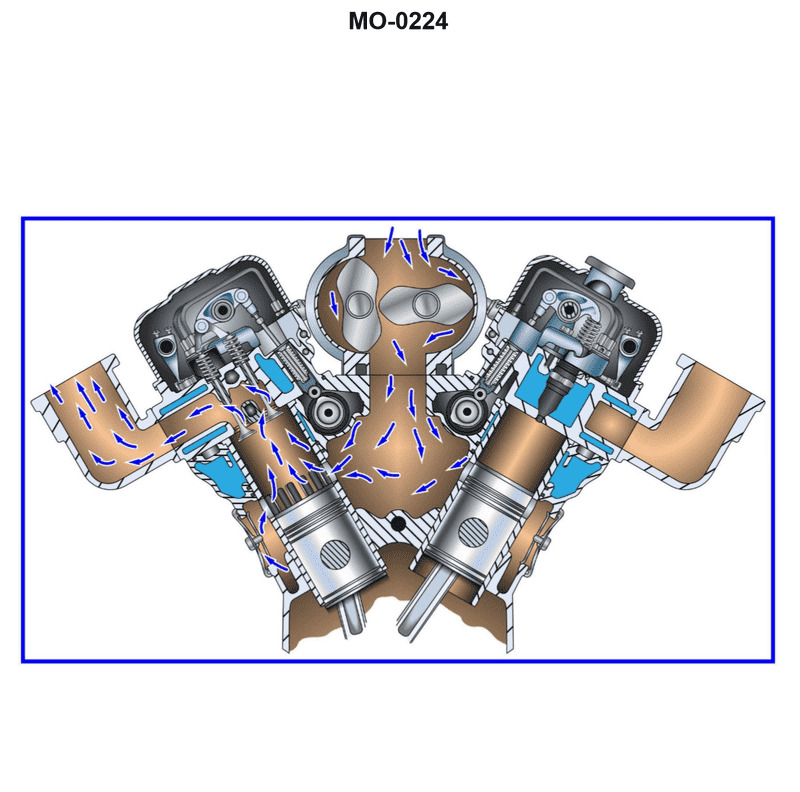
The Correct Answer is A ### 2. Why Option A is Correct Option A states: "The exhaust manifold pressure will be lower than the air box pressure." This statement is correct based on the fundamental operating principles of most high-power marine diesel engines, especially two-stroke cycle engines common in large seiners (though the principle applies strongly to four-stroke turbocharged engines as well, the "air box" typically refers to the scavenging air plenum in two-stroke engines). 1. **Requirement for Scavenging:** In a diesel engine (particularly two-stroke engines, which use the air box pressure directly for clearing the cylinder), fresh air must be introduced into the cylinder to push out the residual exhaust gases (scavenging). 2. **Pressure Differential:** To ensure air flows *into* the cylinder from the air box and *out* of the cylinder into the exhaust manifold, there must be a positive pressure differential favoring the inlet side. The pressure in the air box (scavenging pressure) must be consistently higher than the pressure in the exhaust manifold. 3. **Engine Operation:** If the air box pressure did not exceed the exhaust pressure, effective scavenging could not occur. Exhaust gases would remain in the cylinder, severely reducing combustion efficiency, power output, and potentially causing overheating or engine damage. Therefore, the engine's turbocharger and/or blower are designed to maintain $P_{Air Box} > P_{Exhaust}$. ### 3. Why Other Options Are Incorrect **B) The exhaust manifold pressure will be higher than the air box pressure.** If the exhaust manifold pressure ($P_{Exhaust}$) were higher than the air box pressure ($P_{Air Box}$), exhaust gases would flow backward into the cylinder and potentially into the air box when the exhaust valves/ports are open during scavenging. This condition prevents efficient gas exchange, stops combustion, and would cause the engine to immediately lose power or stall. **C) The exhaust manifold pressure will be equal to the air box pressure.** If the pressures were equal, there would be no pressure gradient to drive the scavenging process. Exhaust gases would stagnate in the cylinder, leading to poor charging efficiency and reduced engine performance. **D) There is no predictable, consistent relationship between the exhaust manifold and air box pressures.** The relationship is highly predictable and engineered. Maintaining a specific, consistent pressure differential ($P_{Air Box}$ being higher than $P_{Exhaust}$) is crucial for the proper operation, power production, and efficiency of any turbocharged or blower-scavenged diesel engine running at rated speed.
Pass Your Coast Guard Licensing Exams!
Study offline, track your progress, and simulate real exams with the Coast Guard Exams app