Question 37 UFIV02 - Assistant Engineer - UFIV
The fishing seiner to which you are assigned has a pneumatic propulsion control system as shown in the illustration. When the mechanical slave remote control station is being used to control propulsion, what is the direct result of positioning the control lever in the ahead direction? Illustration MO-0168
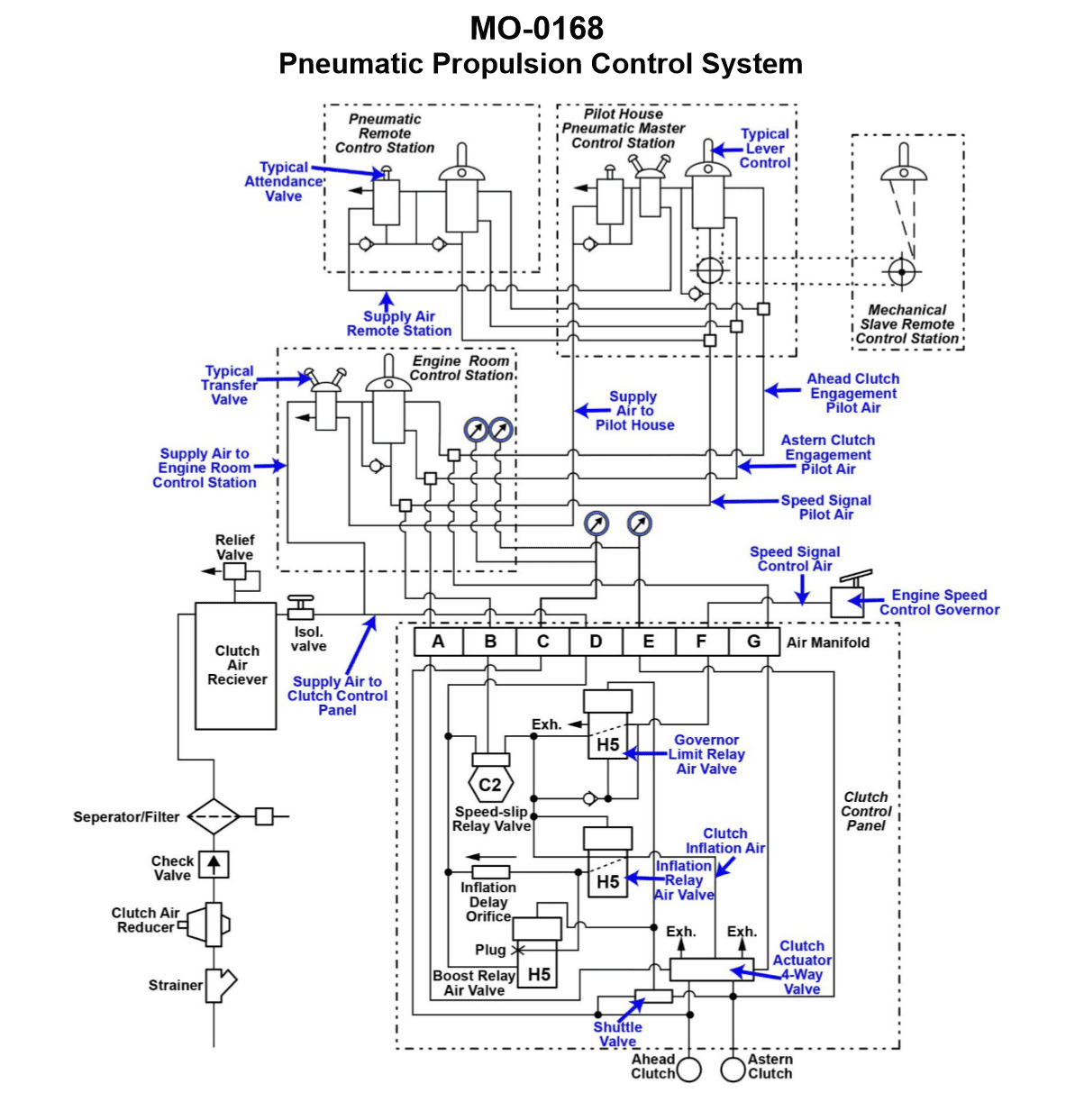
The Correct Answer is B **Explanation of Correct Answer (B):** Option B describes the typical mechanism for operating a pneumatic propulsion control system when using a mechanical slave remote control station (often found in secondary control locations like the flying bridge or aft deck). In this configuration, the mechanical slave station does not directly interface with the engine room components. Instead, it is mechanically linked (usually via chains, cables, or rods) to the **master pneumatic control station** located in the pilot house (or main bridge). Moving the lever on the slave station mechanically repositions the control valve spool within the pilot house master station. This action then initiates the pneumatic sequence: the master station's control valve directs compressed air to the engine room components (like the clutch actuator's 4-way control valve), causing the clutch to engage for ahead propulsion. This hierarchical structure ensures that all control inputs route through the primary pneumatic controller. **Explanation of Incorrect Options:** **A) Movement of the mechanical slave remote control station lever directly shifts the clutch actuator 4-way control valve to the ahead direction by the action of a chain or cable.** * This is incorrect because the slave station is typically remote from the engine room and the clutch actuator. Propulsion control systems use pneumatic pressure to shift the clutch control valves, not long runs of mechanical linkage (chain or cable) directly from a remote station to the clutch valve, especially over the distances involved on a seiner. **C) Movement of the mechanical slave remote control station lever directly shifts the engine room control station lever control valve spool by the action of a chain or cable which results in pneumatic shifting of the clutch actuator 4-way control valve to the ahead direction.** * While the clutch actuator is in the engine room, this configuration bypasses the main control station (the Pilot House Master). Mechanical slave stations are usually linked to the primary master station (Pilot House) to maintain centralized control and interlock logic, rather than running mechanical linkages all the way to a separate engine room control station valve spool. **D) Movement of the mechanical slave remote control station lever directly shifts the pneumatic remote control station lever control valve spool by the action of a chain or cable which results in pneumatic shifting of the clutch actuator 4-way control valve to the ahead direction.** * This option uses the ambiguous term "pneumatic remote control station." While the mechanical slave is technically remote, the specific station it is linked to is the primary **master station** (Pilot House Master Control Station). Option B provides the most accurate identification of the component being mechanically actuated—the pilot house master control station—which then generates the necessary pneumatic signal.
Pass Your Coast Guard Licensing Exams!
Study offline, track your progress, and simulate real exams with the Coast Guard Exams app