Question 29 UFIV02 - Assistant Engineer - UFIV
The freshwater cooling systems serving the main engines of your uninspected fishing industry vessel are of the type shown in the illustration. What statement accurately describes the characteristics of the freshwater cooling circuit? Illustration MO-0137
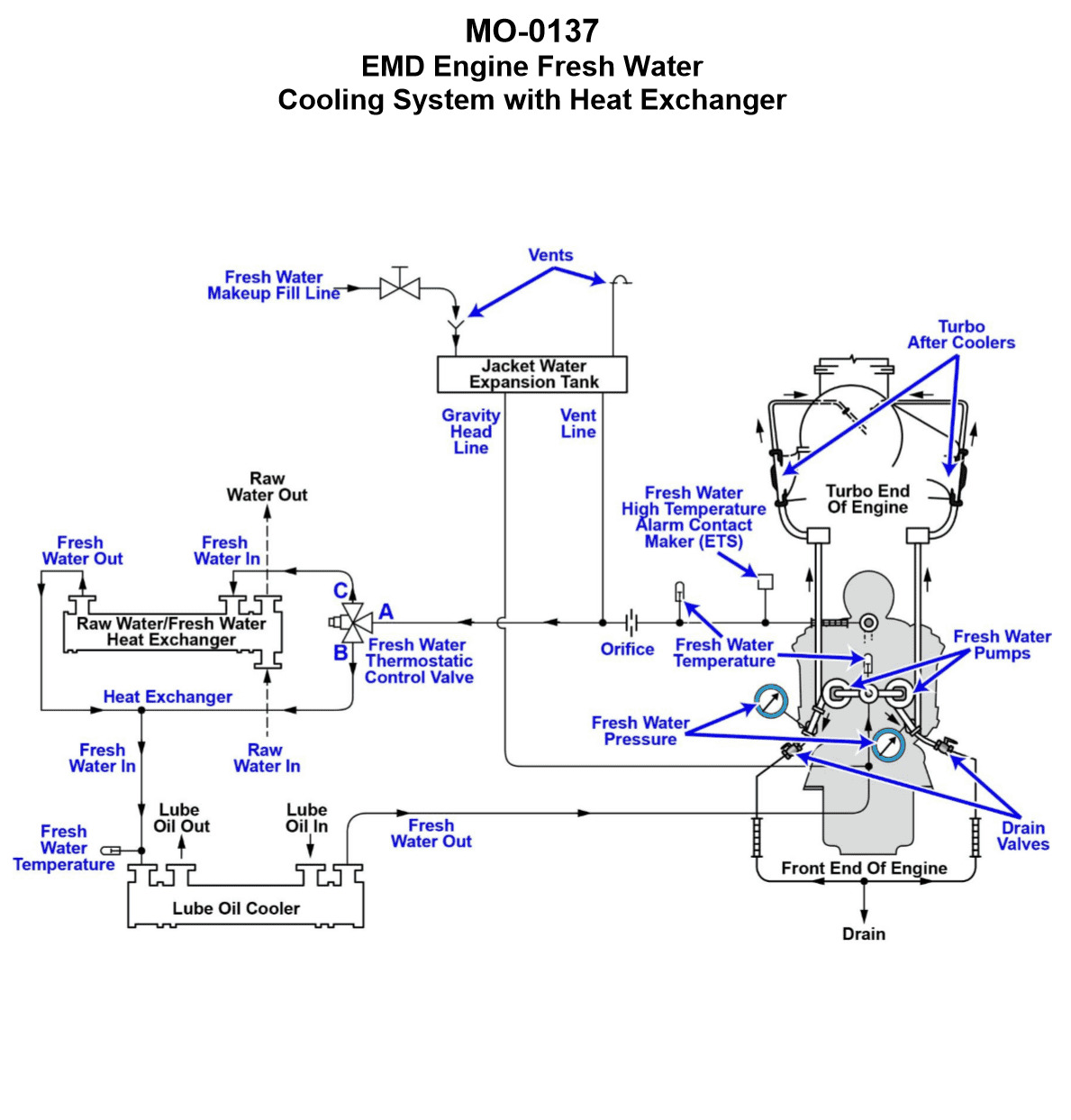
The Correct Answer is B **Explanation for Option B (Correct Answer):** 1. **Vented System:** Freshwater cooling systems on most small and medium-sized marine engines (like those found on uninspected fishing vessels) operate as vented systems. This means they are open to the atmosphere, typically through an overflow or vent line connected to the expansion tank (or header tank). This design allows the system to remain at atmospheric pressure (or very near it) and prevents excessive pressure buildup. 2. **3-Way Thermostatic Control Valve:** Marine and stationary diesel engines often utilize a **3-way thermostatic control valve** (or mixing valve) for temperature regulation. This valve directs the flow of hot freshwater coming from the engine. It has three ports: one inlet from the engine, one outlet to the cooler (heat exchanger), and one bypass outlet back to the engine. By modulating the mix of cooled water and bypassed hot water, it maintains the engine within its optimal operating temperature range. This is the standard, robust control method for larger closed cooling circuits in marine environments, distinguishing them from simple automotive setups. **Explanation for Incorrect Options:** * **A) The freshwater circuit is a vented system using an automotive type 2-way thermostatic control valve for temperature control.** * While the system is vented, a standard automotive 2-way thermostat (which simply blocks flow until a set temperature is reached) is generally not used for precise temperature control in larger marine systems. Marine systems typically require the constant flow provided by a 3-way mixing valve to prevent thermal shock and manage larger heat loads. * **C) The freshwater circuit is a pressurized system using an automotive type 2-way thermostatic control valve for temperature control.** * This is incorrect because small vessel freshwater circuits are typically vented (not highly pressurized), and they generally rely on 3-way valves, not 2-way automotive types, for cooling control. * **D) The freshwater circuit is a pressurized system using a stationary/marine type 3-way thermostatic control valve for temperature control.** * While the use of the 3-way thermostatic valve is correct for this application, the premise that the system is highly pressurized is incorrect. Marine closed cooling systems on smaller vessels utilize a header tank vented to the atmosphere, meaning they are non-pressurized (or "vented"). Pressurized systems are more common on very large, high-horsepower installations where higher operating temperatures are needed.
Pass Your Coast Guard Licensing Exams!
Study offline, track your progress, and simulate real exams with the Coast Guard Exams app