Question 16 UFIV02 - Assistant Engineer - UFIV
A diesel generator set on your fishing industry factory ship has a simplex lube oil strainer of the type shown in the illustration, situated on the discharge side of the lube oil pump. At a specified engine rpm and lube oil temperature, you notice that the inlet pressure is increasing and the outlet pressure is decreasing, resulting in an unacceptable pressure drop. What should be done? Illustration MO-0057
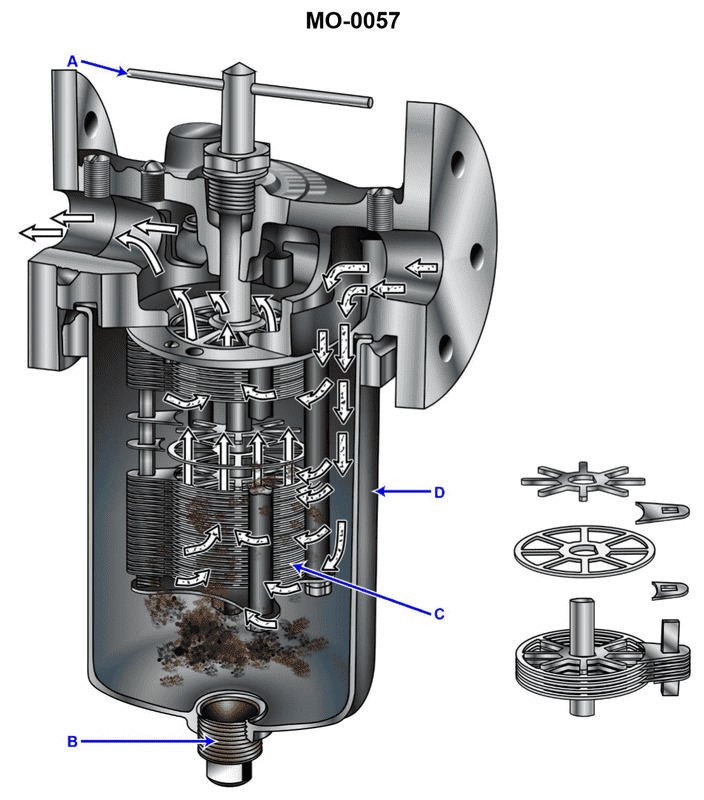
The Correct Answer is B **Explanation for Option B (Correct Answer):** The scenario describes a rapidly increasing pressure drop across a simplex lube oil strainer (an increasing inlet pressure and decreasing outlet pressure), which indicates that the filter element (disk stack C) is becoming clogged with dirt and debris. The illustration depicts a type of self-cleaning edge-type (or 'Auto-Klean') strainer common in marine lube oil systems. These strainers are specifically designed to be cleaned while the system remains operational (i.e., while the engine is running and oil is flowing). The cleaning mechanism involves rotating the cleaning handle (A), which causes scraper blades or combs (fixed relative to the housing) to pass through the filter gaps of the rotating disk stack (C). This action shears the accumulated dirt off the disk stack. Rotating the handle "one or more full turns" ensures that all filtering surfaces are thoroughly cleaned, restoring the oil flow and normalizing the pressure drop. **Explanation of Why Other Options Are Incorrect:** * **A) While the engine is running, the drain plug (B) should be carefully loosened to drain the sludge from the strainer sump.** * Draining the sludge from the sump (B) removes heavy contaminants that have settled out, which is a routine maintenance task. However, the immediate and primary cause of a *rapidly increasing pressure drop* is the blockage of the fine filtration elements (C). While draining the sump helps overall cleanliness, it will not sufficiently clear the blocked disk stack to immediately resolve the unacceptable pressure drop while the engine is running. Furthermore, loosening the drain plug while under pressure could result in a significant oil leak hazard. * **C) While the engine is running, the cleaning handle (A) should be rotated one-half turn to remove the accumulated dirt from the disk stack (C).** * While the principle (rotating handle A) is correct, rotating the handle only one-half turn (180 degrees) is generally insufficient for edge-type strainers. To ensure the scraper combs pass completely through the entirety of the filter gaps and dislodge all accumulated debris from all surfaces of the disk stack, a full 360-degree rotation (or multiple turns) is required. * **D) The drain plug (B) is removed to drain the sludge from the strainer sump, but the engine must be stopped to perform this operation.** * This option addresses draining the sump (B), which, as discussed, is not the immediate solution for the clogged disk stack (C) causing the pressure drop. More importantly, the critical action needed—clearing the blockage via handle (A)—is specifically designed to be performed *while the engine is running* (on-stream cleaning). Stopping the engine to address a temporary blockage in this type of self-cleaning filter is unnecessary and inefficient operational practice.
Pass Your Coast Guard Licensing Exams!
Study offline, track your progress, and simulate real exams with the Coast Guard Exams app