Question 46 UFIV02 - Assistant Engineer - UFIV
The main engines on your fishing industry factory ship are fitted with speed control governors of the type shown in the illustration. What is the purpose of the compensation system, consisting of the buffer cylinder, buffer piston, buffer springs, and compensation needle valve? Illustration MO-0158
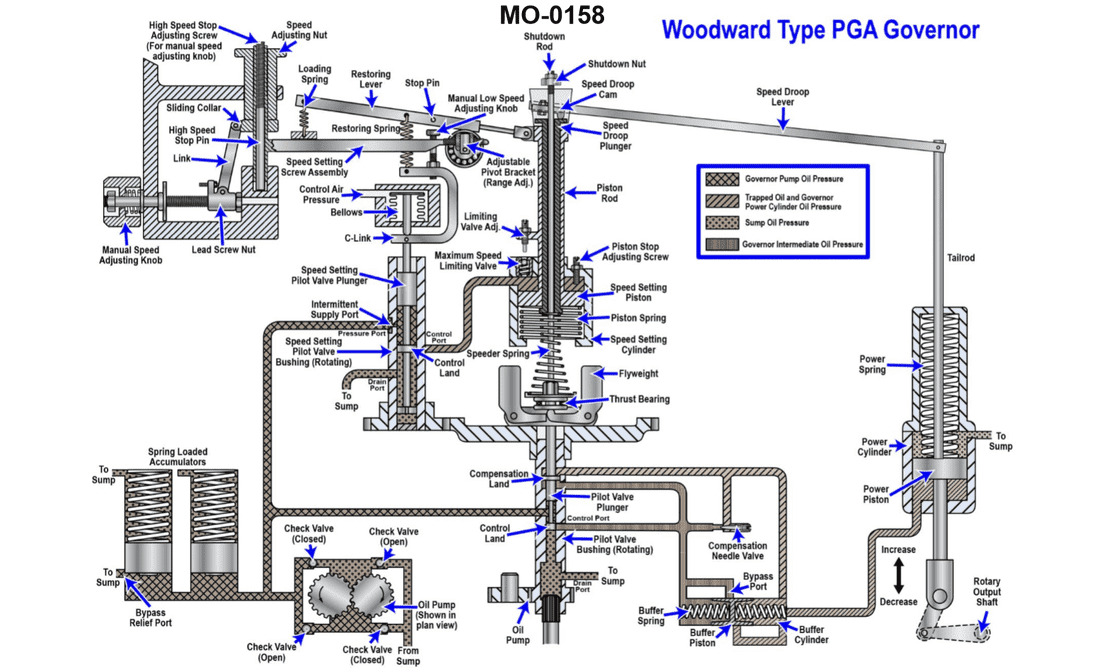
The Correct Answer is C **Explanation for Option C (Correct):** The compensation system (consisting of the buffer cylinder, buffer piston, buffer springs, and compensation needle valve) is a critical component of a speed-control governor, particularly those used on large marine engines (like those found on factory ships). Its primary function is to introduce a temporary feedback signal related to the rate of change of the speed setting (or the rate of movement of the speed-sensing mechanism). When the engine load changes, the speed governor immediately attempts to adjust the fuel rack position to restore the set speed. Without a compensation system (i.e., in a simple isochronous or dead-beat governor), this rapid correction often overshoots the required fuel setting, causing the speed to momentarily recover, then drop again, and then recover excessively, resulting in an unstable oscillation known as **hunting** (or surging). The compensation system acts as a dashpot mechanism (using oil flow restricted by the needle valve) that temporarily modifies the main speed setting linkage. This temporary modification forces the governor to quickly move the fuel rack to a temporary position necessary to handle the immediate load change, but then, as the oil slowly leaks through the needle valve, the compensation effect dissipates, and the fuel rack slowly settles to the correct **stable** position needed to maintain the set speed under the new, sustained load. This stabilization process prevents the cyclical over-correction (hunting) when the engine responds to load changes. **Explanation of Why Other Options Are Incorrect:** * **A) It senses the engine speed setting delivered from the bridge:** This is incorrect. The speed setting (or droop setting) is typically delivered mechanically or electronically to the main speed-setting lever or spring linkage of the governor. The compensation system only deals with the *dynamics* of the response, not the input setting itself. * **B) It limits engine speed to a maximum value to prevent over speeding:** This is incorrect. Maximum speed limitation is usually achieved by a separate maximum speed stop or a dedicated speed limiter spring setting integrated into the main governor mechanism, or sometimes by an entirely separate overspeed trip device. The compensation system does not set the speed limit. * **D) It senses the actual engine speed of rotation:** This is incorrect. Engine speed is sensed by the **flyweights** (or equivalent mechanism) acting against the speeder spring. The compensation system is a secondary hydraulic mechanism attached to the linkage, responding to the movement initiated by the flyweights, but it does not sense the speed directly.
Pass Your Coast Guard Licensing Exams!
Study offline, track your progress, and simulate real exams with the Coast Guard Exams app