Question 63 UFIV01 - Chief Engineer - UFIV
The fishing factory ship to which you are assigned is fitted with a totally pneumatic propulsion control system as shown in the illustration. If the astern clutch fails to engage from the engine room control station, but engages properly from all remote-control stations, which of the following system faults best accounts for these symptoms? Illustration MO-0168
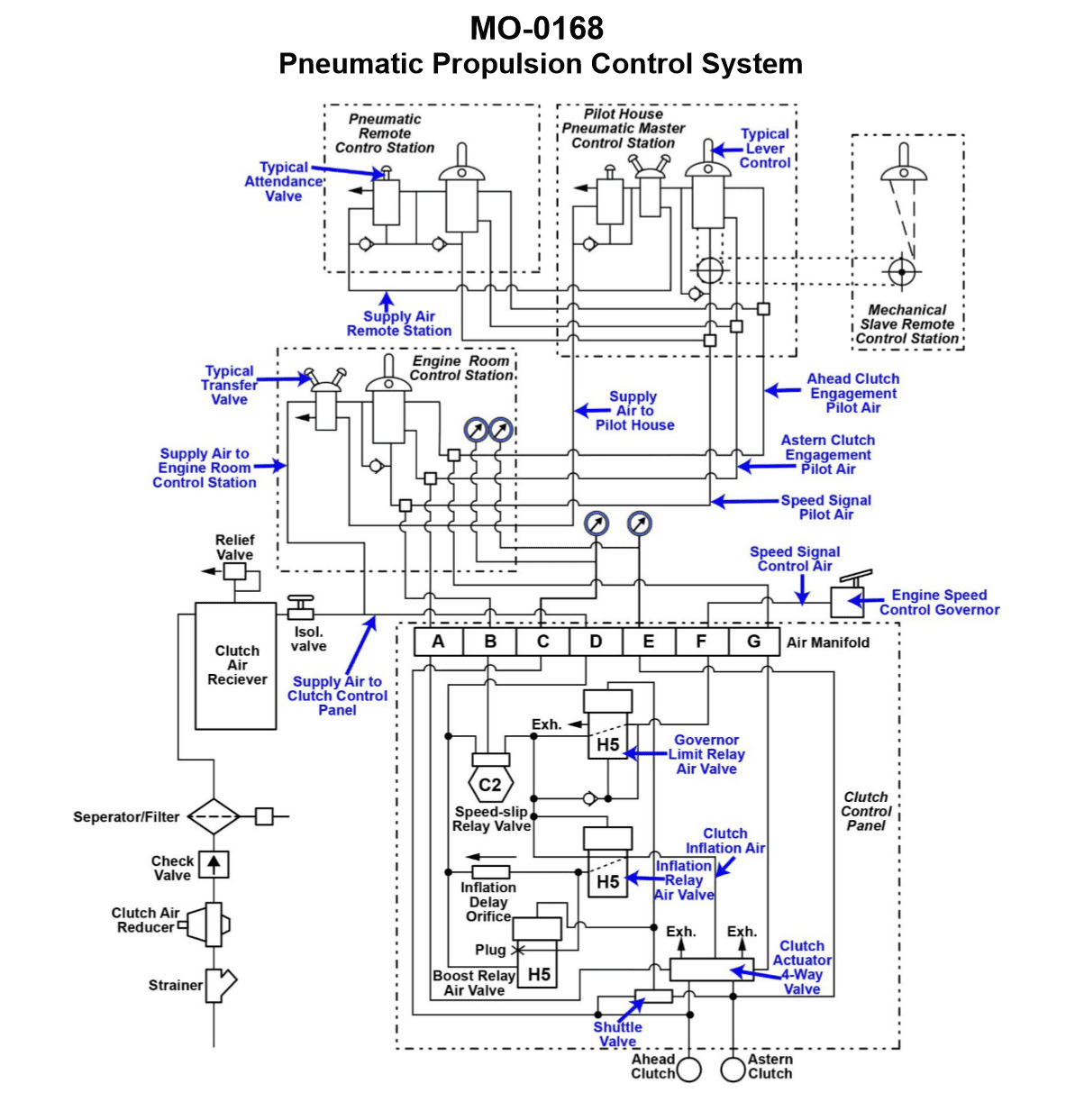
The Correct Answer is A ### Explanation of Correct Option (A) **A) The control lever at the engine room control station has a blocked astern clutch engagement pilot port.** This option accurately explains the symptoms: the astern clutch fails to engage *only* from the engine room control station (local control), but engages properly from *all remote-control stations*. In a pneumatic control system, the control lever (often a 3-way or 4-way valve) at the engine room station generates the pilot signal necessary to command the clutch to engage. If the specific pilot port responsible for sending the "astern engagement" signal is blocked, the engine room control station cannot send the pneumatic command to the main clutch actuator valve. However, since the fault is localized to the engine room station's control lever, the rest of the system, including the remote control stations (which generate their own, separate pilot signals), remains functional, allowing remote engagement to succeed. ### Explanation of Incorrect Options **B) The astern clutch engagement pilot air tubing has separated from the clutch actuator 4-way control valve at the clutch control panel.** If the main astern clutch engagement pilot tubing separated at the clutch control panel, it would prevent the astern clutch from engaging *regardless* of whether the command came from the engine room (local) or any remote station, because the critical pilot signal path to the final 4-way control valve would be severed for all inputs. The symptom states remote control works, so this is incorrect. **C) The clutch actuator 4-way control valve at the clutch control panel has a restricted astern clutch quick exhaust port opening.** A restriction in the quick exhaust port would not prevent engagement (the "shift" or "go" action). Instead, it would cause the clutch to disengage or shift slowly when moving from astern back to neutral or ahead. Since the symptom is a failure to *engage*, this is incorrect. **D) The local/remote transfer valve at the engine room control station has a blocked local port.** The local/remote transfer valve typically determines which input signal (local lever or remote station) is active. If the local port of this transfer valve were blocked, the engine room control station would be unable to send its signal through the system, which matches the symptom. However, the control lever itself (Option A) is the source of the pilot signal. In most installations, if the transfer valve blocked the local signal, it would imply a fault in the transfer mechanism *after* the lever, but Option A describes a fault at the very source of the signal (the lever's output port), which is a more fundamental and common failure point specific to the local input command generation. More importantly, blocking the *local port* of the transfer valve generally means the transfer mechanism is failing to route the local signal, but the symptoms described are typically solved by finding the blockage in the generating valve itself (the lever), making A the more precise and definitive answer regarding the source of the blocked command.
Pass Your Coast Guard Licensing Exams!
Study offline, track your progress, and simulate real exams with the Coast Guard Exams app