Question 39 UFIV01 - Chief Engineer - UFIV
A diesel generator set on your fishing industry factory ship has a simplex lube oil strainer of the type shown in the illustration, situated on the discharge side of the lube oil pump. At a specified engine rpm and lube oil temperature, you notice that the inlet pressure is increasing and the outlet pressure is decreasing, resulting in an unacceptable pressure drop. What should be done? Illustration MO-0057
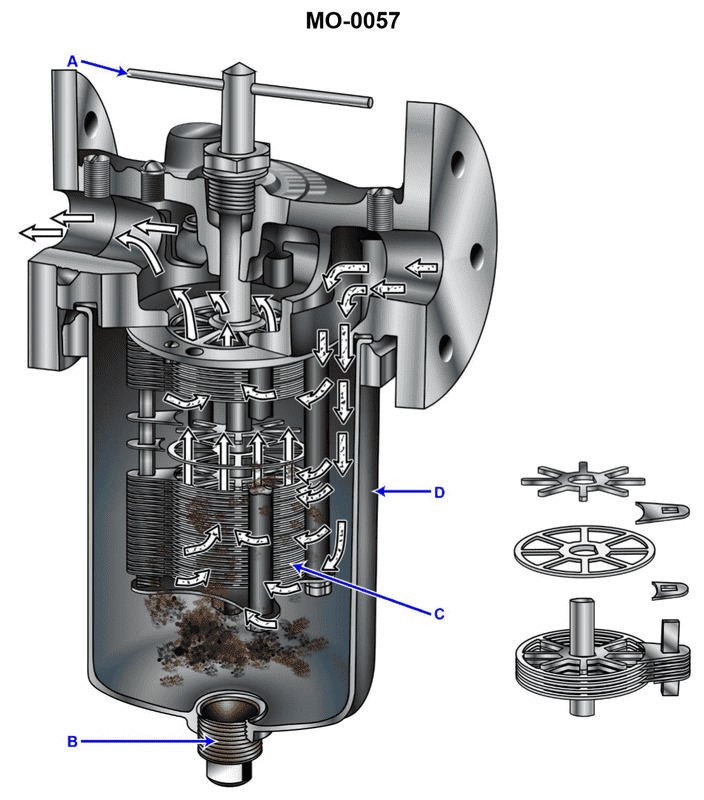
The Correct Answer is B **Explanation of Correct Option (B):** Option B is correct because the described symptoms—increasing inlet pressure and decreasing outlet pressure, leading to an unacceptable pressure drop across the strainer—indicate that the filter element (disk stack C) is clogged with particulate matter. The illustration MO-0057 typically represents a simplex back-flushing or edge-type strainer (often an Auto-Klean type) designed for continuous self-cleaning while the system is operational. The cleaning handle (A) is mechanically linked to the disk stack (C) and rotating it scrapes the accumulated dirt (sludge/particles) off the surface of the disks. This dislodged dirt falls into the sump below, immediately restoring the flow path and reducing the pressure drop. For effective cleaning and to ensure all accumulated dirt is removed, the handle should be rotated one or more full turns, as specified in standard operating procedures for this type of strainer. This procedure is specifically designed to be performed while the engine (and thus the lube oil pump) is running. **Why the Other Options are Incorrect:** * **A) While the engine is running, the drain plug (B) should be carefully loosened to drain the sludge from the strainer sump.** This is incorrect for two reasons. First, loosening the drain plug (B) while the system is under pressure would cause a catastrophic and dangerous loss of lube oil, potentially starving the engine. Second, while the sump does contain sludge, draining the sump alone does not address the primary problem, which is the clogged filtering element (C) causing the pressure drop. The element must first be cleaned (rotated via A) to dislodge the clogging material. * **C) While the engine is running, the cleaning handle (A) should be rotated one-half turn to remove the accumulated dirt from the disk stack (C).** While rotating the handle (A) is the correct action, one-half turn is typically insufficient to ensure the entire surface of the disk stack (C) has been scraped clean. Standard practice for these continuous-cleaning strainers requires one or more complete revolutions to ensure full coverage and effective removal of the accumulated debris. * **D) The drain plug (B) is removed to drain the sludge from the strainer sump, but the engine must be stopped to perform this operation.** Stopping the engine and removing the drain plug (B) would be the correct procedure for draining the sump sludge (after the filter element has been cleaned), but it is not the immediate or primary action required to resolve the unacceptable pressure drop caused by the *clogged element*. The element (C) is cleaned by rotating handle (A), and this action must be performed immediately while the engine is running to restore flow. Stopping the engine is not necessary for the immediate solution.
Pass Your Coast Guard Licensing Exams!
Study offline, track your progress, and simulate real exams with the Coast Guard Exams app