Question 55 UFIV01 - Chief Engineer - UFIV
The freshwater cooling systems serving the main engines on your fishery research vessel are arranged as shown in the illustration. If the fresh water thermostatic control valve fails in the position where 100% of the flow from flange "A" is permanently ported to flange "C" and flange "B" is permanently blocked, while starting and warming the engine with no load, what would be the resulting warm up time period? Illustration MO-0137
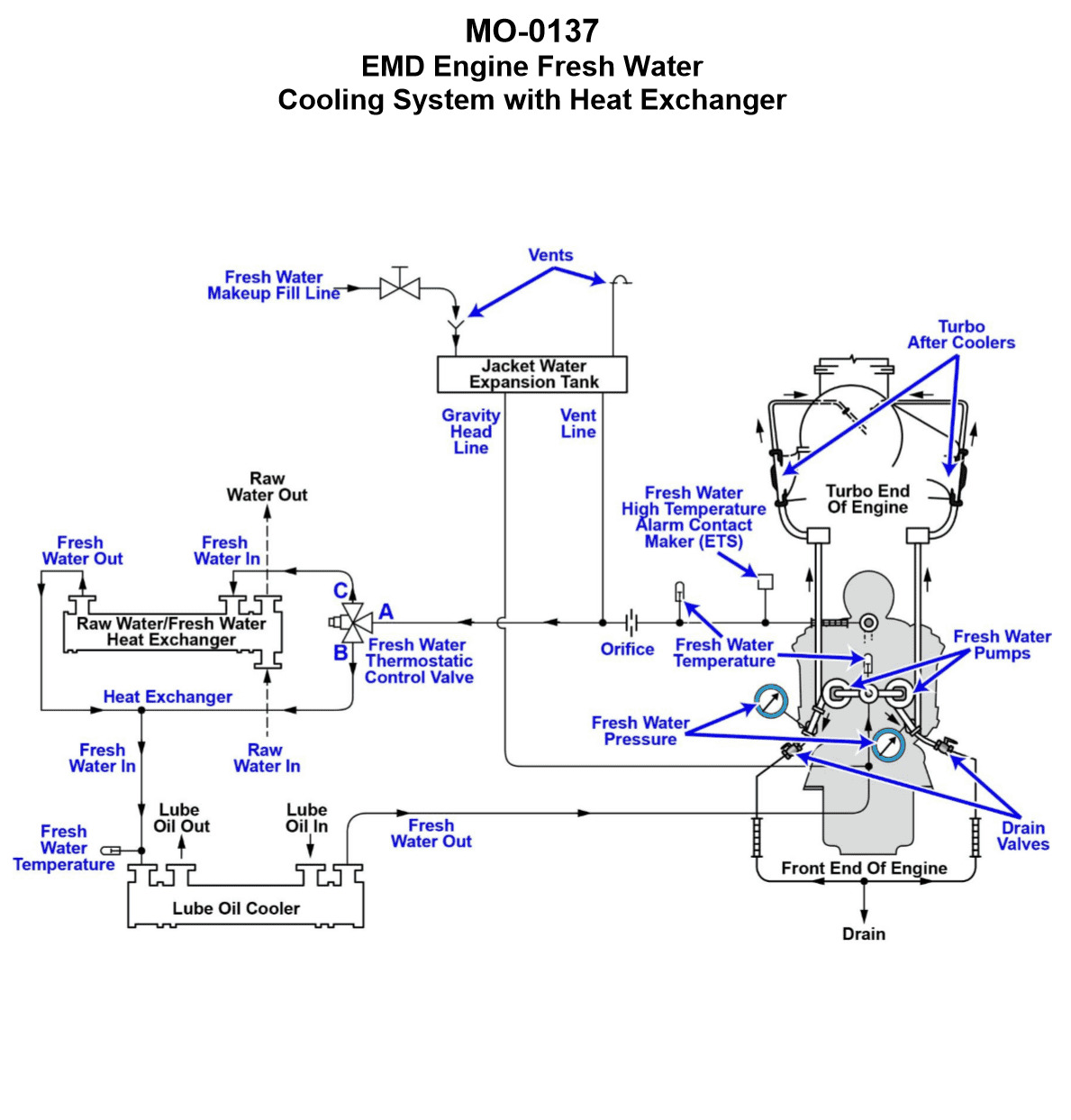
The Correct Answer is A. **Explanation for why Option A is correct:** The scenario describes the failure of a thermostatic control valve (often a three-way mixing or diverting valve) in a freshwater cooling system. 1. **System Function:** In a typical engine cooling system, the thermostatic valve regulates the temperature by diverting coolant flow. Flange "A" is the engine outlet (hot water). Flange "B" is the bypass port (returning water directly to the engine pump/inlet). Flange "C" leads to the cooler (heat exchanger). During start-up and warm-up, the valve normally directs most or all flow from "A" to "B" (bypassing the cooler) to allow the engine to reach operating temperature quickly. As the temperature rises, the valve progressively opens the path A to C (through the cooler) and closes the path A to B. 2. **Failure Mode:** The valve has failed such that 100% of the flow from flange "A" (hot coolant leaving the engine) is permanently ported to flange "C" (the cooler/heat exchanger), and flange "B" (the bypass) is permanently blocked. 3. **Result:** This failure forces all the heat generated by the engine, even during the cold start phase, to pass directly through the main cooler (seawater-cooled heat exchanger). Since the cooling system is designed to remove maximum heat via the cooler, forcing all flow through it means the heat generated by the engine (which is minimal during a no-load warm-up) is continuously and immediately removed from the system. The engine's operating temperature will rise very slowly, if at all, preventing the engine block and associated components from reaching the required minimum operating temperature efficiently. Therefore, the engine would require a much longer than normal time frame to warm up. **Explanation for why other options are incorrect:** * **B) With no load, the engine would require a relatively normal time frame to warm up:** This is incorrect. A normal warm-up relies on the bypass (port B) being open to prevent immediate heat rejection through the cooler. Since the bypass is blocked and all flow goes through the cooler, heat is continuously rejected, leading to a drastically slowed warm-up. * **C) With no load, the engine would require a much shorter than normal time frame to warm up:** This is incorrect. A shorter warm-up time would only occur if the system was failing to remove enough heat (e.g., if the valve failed with 100% bypass and 0% cooler flow, leading to overheating or a rapid temperature spike). In the described scenario, the system is rejecting maximum possible heat immediately. * **D) With no load, it is not possible to describe the time frame required to warm up the engine:** This is incorrect. Based on fundamental thermodynamics and cooling system design principles, forcing all flow through the cooler during start-up is a defined failure mode whose consequence is a significantly prolonged warm-up period.
Pass Your Coast Guard Licensing Exams!
Study offline, track your progress, and simulate real exams with the Coast Guard Exams app