Question 2 UFIV01 - Chief Engineer - UFIV
You are assigned to a fishery research vessel fitted with main propulsion diesel engines operating on the cycle represented in the polar timing diagram shown in the illustration. When do the intake valves open and close respectively? Illustration MO-0084
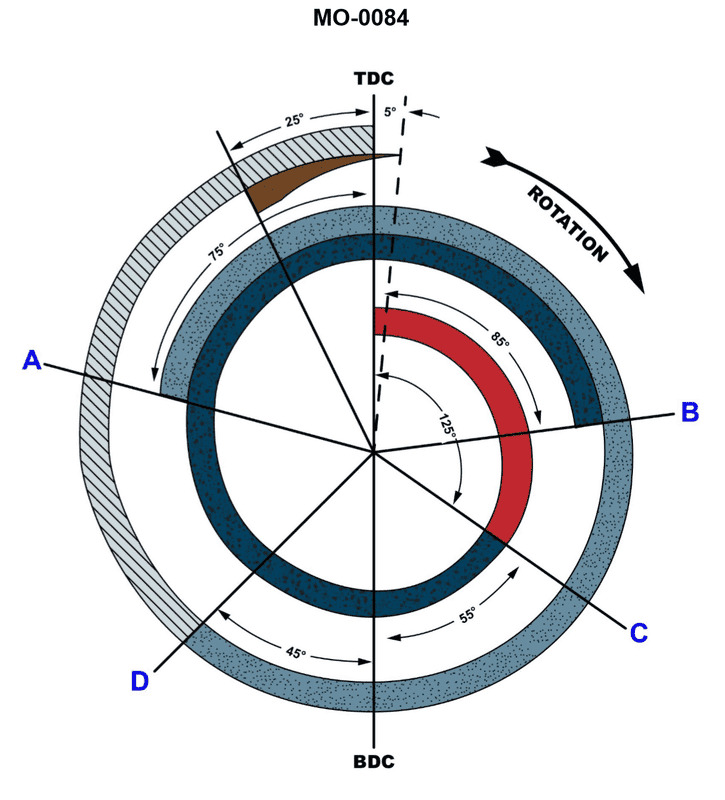
The Correct Answer is D **Explanation for why Option D is correct:** 1. **Context:** The illustration MO-0084 (a typical polar timing diagram for a four-stroke diesel engine) depicts the timing events of the valves relative to the crankshaft position. The cycle starts (TDC) with the power stroke, followed by exhaust, intake, and compression. 2. **Intake Valve Opening (IVO):** To maximize the scavenging (clearing of residual exhaust gases) and volumetric efficiency, the intake valve typically opens early, well before the piston reaches Top Dead Center (TDC) at the end of the exhaust stroke. This timing, known as valve overlap, allows the incoming fresh air to help push out the remaining exhaust gases. In standard timing diagrams for four-stroke engines, the intake valve usually opens around $75^{\circ}$ to $20^{\circ}$ before TDC (on the exhaust stroke). Option D states $75^{\circ}$ before top dead center (BTDC) on the exhaust stroke, which is a typical advanced opening timing. 3. **Intake Valve Closing (IVC):** To maximize the amount of air drawn into the cylinder (ram effect/inertia supercharging), the intake valve remains open after the piston has passed Bottom Dead Center (BDC) and has started moving upward on the compression stroke. This is called intake lag. Standard timing for intake valve closing is typically $20^{\circ}$ to $60^{\circ}$ after BDC (ABDC). Option D states $45^{\circ}$ after bottom dead center (ABDC) on the compression stroke, which is a common delayed closing timing for maximizing air charge. **Explanation for why other options are incorrect:** * **A) The intake valves open at $45^{\circ}$ after bottom dead center on the compression stroke. The intake valves close at $75^{\circ}$ before top dead center on the exhaust.** * This swaps the opening and closing events and places them incorrectly. Opening $45^{\circ}$ ABDC would severely restrict air intake. Closing $75^{\circ}$ BTDC would mean the valve closes near the beginning of the compression stroke, losing most of the air charge. * **B) The intake valves open at top dead center at the beginning of the intake stroke. The intake valves close at bottom dead center at the end of the intake stroke.** * This describes theoretical, idealized timing where the valves open and close exactly at TDC and BDC, respectively. Real engines use advanced opening (IVO before TDC) and retarded closing (IVC after BDC) to improve gas flow, scavenging, and volumetric efficiency. * **C) The intake valves open at bottom dead center at the end of the intake stroke. The intake valves close at top dead center at the beginning of the intake stroke.** * This completely reverses the function of the valve timing. The intake valve must be open during the intake stroke (TDC to BDC), not closed during it.
Pass Your Coast Guard Licensing Exams!
Study offline, track your progress, and simulate real exams with the Coast Guard Exams app