Question 1 UFIV01 - Chief Engineer - UFIV
You are assigned to an uninspected fishing industry line vessel fitted with main propulsion diesel engines operating on the cycle represented in the polar timing diagram shown in the illustration. What events or effects are represented by "II", "III", and "IV" respectively? Illustration MO-0037
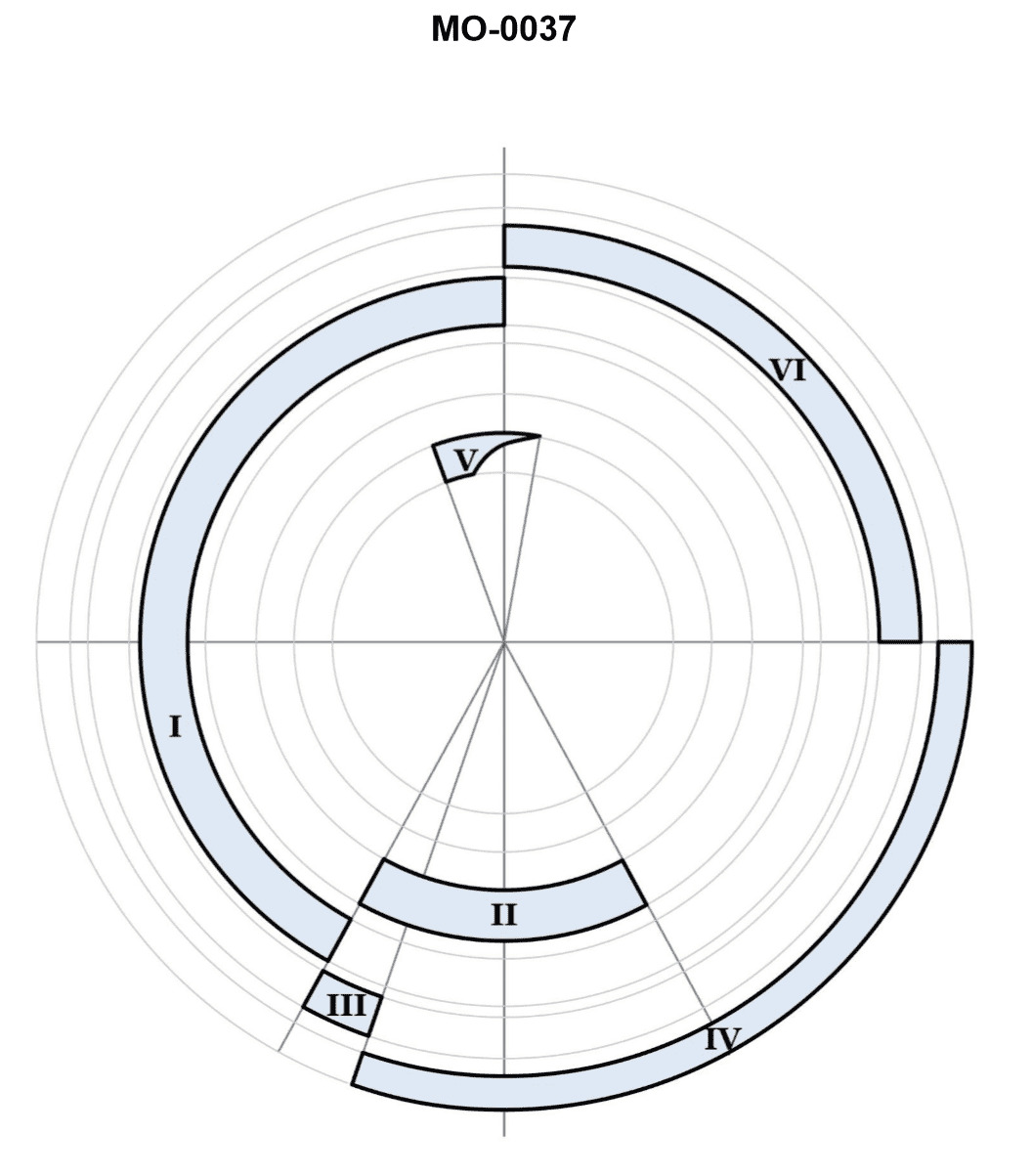
The Correct Answer is D 1. **Explanation for Option D being Correct:** * **Context:** The illustration MO-0037 depicts a polar timing diagram (or valve/port timing diagram) for a large, slow-speed, uninspected fishing industry line vessel operating with main propulsion diesel engines. These diagrams typically represent two-stroke cycle engines, which utilize scavenging and have timed port/valve openings relative to the crankshaft angle (TDC/BDC). * **"II" represents the scavenging period where the scavenging-air ports are uncovered:** In a two-stroke engine, scavenging air is introduced to push residual exhaust gases out. On the timing diagram, the scavenging ports typically open slightly before the exhaust closes, allowing pressurized air to enter the cylinder. "II" represents the initial period of flow controlled by the uncovering of the ports. * **"III" represents a supercharging effect where the cylinder pressure is boosted with the scavenging air blower:** After the scavenging process is complete (residual gases removed), the pressure of the inlet air (supplied by the blower/turbocharger) often remains higher than the atmospheric pressure or the pressure required for simple scavenging. This final boost, achieved by delaying the closure of the inlet ports/valves, is known as a supercharging effect (sometimes called 'packing'), which increases the density and amount of air trapped for combustion. "III" usually represents this overlap/boosting phase just before compression begins. * **"IV" represents the exhaust period where the exhaust valves are held open:** The exhaust process must begin before BDC (Blowdown) and continue through BDC while the piston moves upward. "IV" represents the main duration where the exhaust gases are expelled from the cylinder, controlled by the opening of the exhaust valve(s) (in uniflow scavenged engines) or the exhaust ports. 2. **Why other options are incorrect:** * **Option A is incorrect:** * It incorrectly identifies "II" as the exhaust period and "IV" as the scavenging period. The scavenging period typically precedes the compression stroke immediately and the exhaust period is much longer, starting well before BDC. Furthermore, while "III" describes a pressure loss (exhaust blowdown), the diagram typically uses "III" to indicate the boosting/supercharging effect achieved by the scavenging system after the main exhaust period is completed and the ports are still open. * **Option B is incorrect:** * It incorrectly identifies "II" as the exhaust period. "II" is situated where the scavenging ports are uncovered just before the compression stroke officially starts. While it correctly identifies "III" as supercharging and "IV" as scavenging, the labeling of "II" and "IV" is reversed compared to the standard representation of the scavenging and exhaust events on the diagram. * **Option C is incorrect:** * It incorrectly identifies "II" as the scavenging period and "IV" as the exhaust period (consistent with D), but it incorrectly identifies "III" as a pressure loss effect due to exhaust blowdown. "III" occurs *after* the blowdown (which happens much earlier, when the exhaust valve first opens) and is specifically the period where the inlet pressure is maintained or boosted to maximize the trapped air charge (supercharging).
Pass Your Coast Guard Licensing Exams!
Study offline, track your progress, and simulate real exams with the Coast Guard Exams app