Question 56 UFIV01 - Chief Engineer - UFIV
The fresh water cooling systems serving the main engines on your uninspected fishing industry vessel are arranged as shown in the illustration. If there is excessive scale build up inside the tubes of an engine's shell and tube RW/FW heat exchanger, while the engine is in operation, what would be the resulting symptoms? Illustration MO-0137
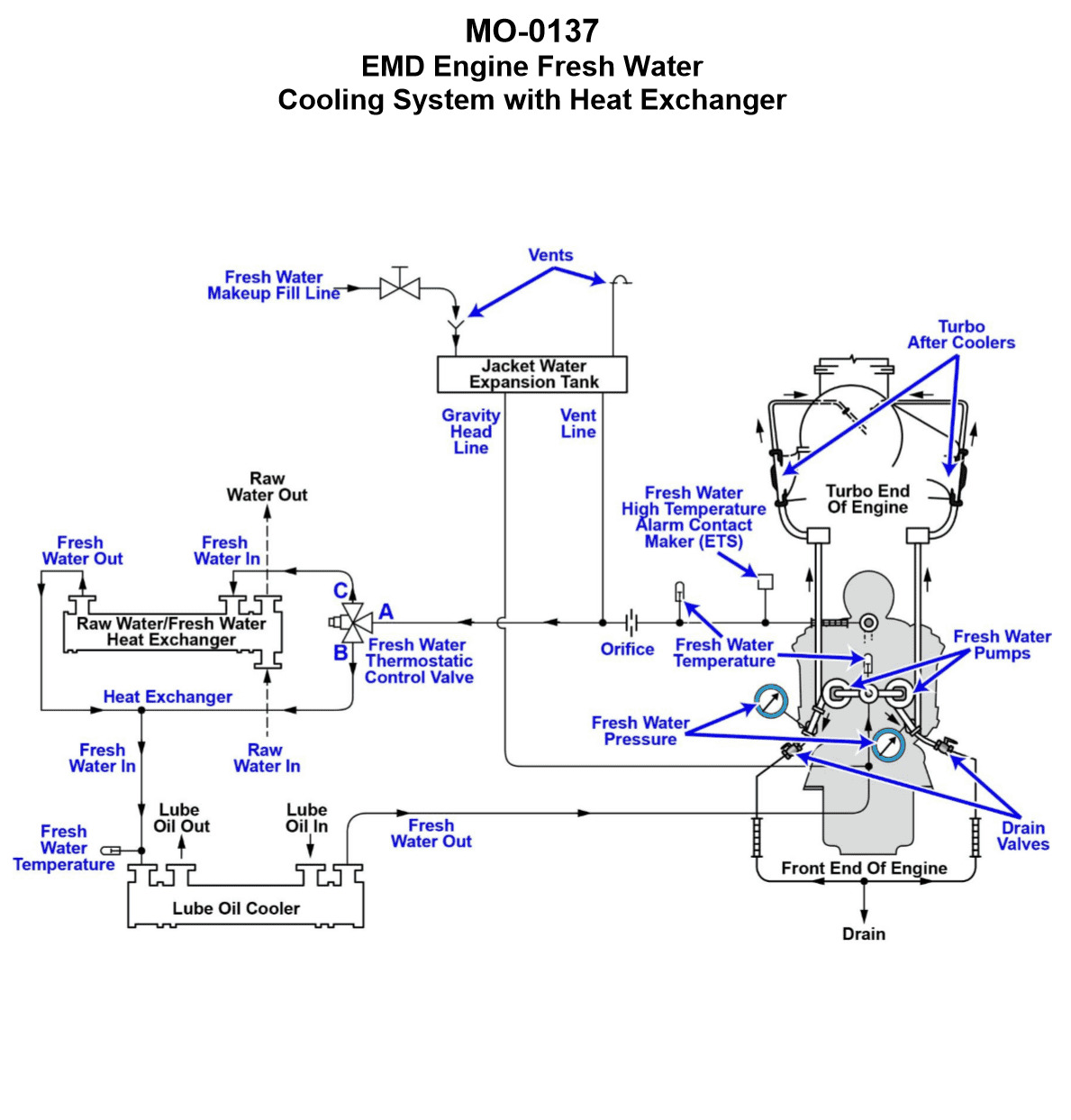
The Correct Answer is A **Why option A is correct:** Scale buildup inside the tubes of a shell and tube heat exchanger acts as an insulator, significantly reducing the overall heat transfer coefficient ($U$). In this Raw Water (RW)/Fresh Water (FW) heat exchanger, the FW system carries heat away from the engine, and the RW (seawater) absorbs that heat. 1. **Effect on Heat Transfer:** When $U$ decreases due to scaling, the efficiency of heat transfer ($Q = U \cdot A \cdot \Delta T_{LMTD}$) drops dramatically. Less heat ($Q$) is transferred from the hot FW to the cooler RW. 2. **FW Side (Engine Side):** Since less heat is removed from the FW, the temperature of the FW returning to the engine will be higher than normal, and the temperature of the FW leaving the engine will likely be unchanged (as the engine produces the same heat load). The $\Delta T$ across the heat exchanger on the FW side (the temperature drop) will be **decreased** because the hot FW isn't cooling down as much. This usually results in an **overall increase in engine jacket water temperature (overheating)**. 3. **RW Side (Seawater Side):** Since less heat ($Q$) is absorbed by the RW, the temperature difference across the heat exchanger on the RW side (the temperature rise) will also be **decreased**. The RW will enter cold and leave only slightly warmer, compared to its performance when the exchanger was clean. Therefore, the symptoms are a **decreased temperature rise on the raw water side** and a **decreased temperature drop on the fresh water side.** **Why the other options are incorrect:** * **B) A decreased temperature rise on the raw water side, and an increased temperature drop on the fresh water side:** An increased temperature drop on the FW side would indicate *more* efficient cooling, which is the opposite of what happens when scale builds up. * **C) An increased temperature rise on the raw water side, and an increased temperature drop on the fresh water side:** Both of these symptoms indicate highly *increased* heat transfer efficiency, which would only occur if the heat exchanger was exceptionally clean or oversized, not when it is scaled. * **D) An increased temperature rise on the raw water side, and a decreased temperature drop on the fresh water side:** A decreased temperature drop on the FW side is correct, but an increased temperature rise on the RW side implies that the RW is absorbing more heat, which contradicts the insulating effect of the scale.
Pass Your Coast Guard Licensing Exams!
Study offline, track your progress, and simulate real exams with the Coast Guard Exams app