Question 38 UFIV01 - Chief Engineer - UFIV
A diesel generator set on your fishing trawler has a simplex lube oil strainer of the type shown in the illustration, situated on the discharge side of the lube oil pump. At a specified engine rpm and lube oil temperature, you notice that the pressure drop becomes unacceptably high. When you rotate the cleaning handle you notice that it is extremely difficult to rotate. What should be done? Illustration MO-0057
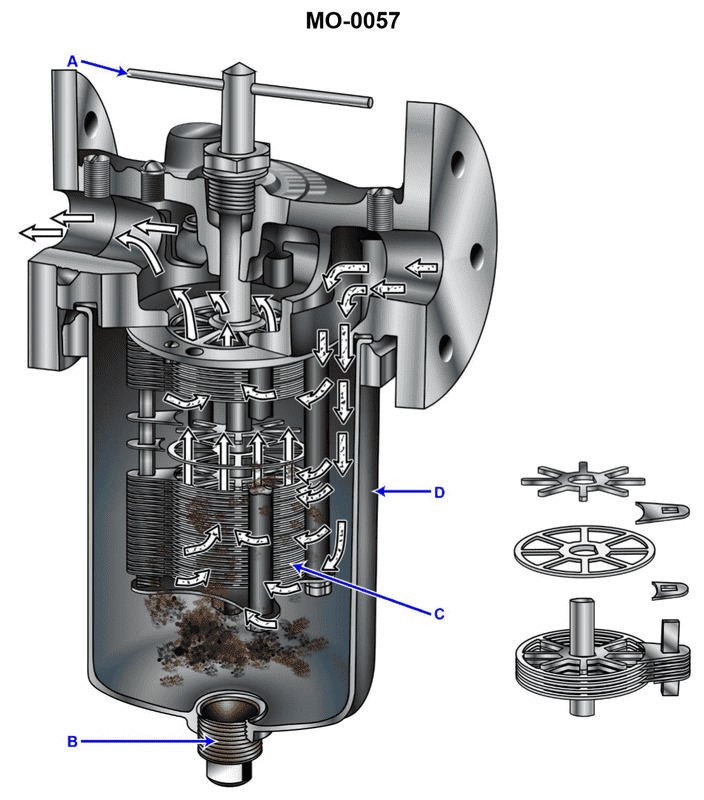
The Correct Answer is B **Explanation for Option B (Correct):** Option B is correct because the described symptoms indicate a severe fouling condition that manual rotation is failing to resolve. An unacceptably high pressure drop across the strainer at normal operating conditions means the flow passages are significantly restricted. The extreme difficulty in rotating the cleaning handle (A) indicates that the accumulated contaminants (sludge, carbon, and debris) on the disk stack (C) are packed so tightly or have hardened, binding the element and preventing the scraper blades from effectively cleaning the filter disks. When this condition occurs, simply rotating the handle is insufficient. The engine must be stopped to prevent damage due to lack of lubrication (caused by the excessive pressure drop), and the strainer element must be manually removed and cleaned, typically by soaking it in a suitable solvent (like diesel fuel or a specialized cleaning agent) to dissolve or loosen the heavy, hardened deposits before thorough rinsing and reinstallation. **Why the other options are incorrect:** * **A) No special consideration need be taken as long as the cleaning handle (A) rotates, even if it rotates with great difficulty.** This is incorrect. The difficulty in rotation, combined with the unacceptably high pressure drop, signals a dangerous condition (severe fouling) that is impeding oil flow. Ignoring this issue risks engine damage due to inadequate lubrication or bearing failure. * **C) The cleaning handle (A) should be forced to rotate, even if it requires an extender handle to produce greater rotating torque.** This is highly dangerous and incorrect practice. Forcing the rotation risks bending or breaking the internal mechanism (such as the cleaning blades or the disk stack itself) or stripping the mechanism that turns the stack. This would cause catastrophic failure of the strainer and potentially introduce metal debris into the lube oil system, leading to severe engine damage. * **D) After stopping the engine, the drain plug (B) should be removed to drain the accumulated sludge from the strainer sump.** While draining the sump (B) is a necessary step during routine maintenance to remove accumulated heavy sludge, it addresses only the contaminants that have already dropped out of the flow stream into the bottom of the casing. It will not clear the hardened, bound deposits tightly adhering to the strainer disk stack (C) which are causing the high pressure drop and the difficulty in rotation. The core issue requires cleaning the element itself.
Pass Your Coast Guard Licensing Exams!
Study offline, track your progress, and simulate real exams with the Coast Guard Exams app