Question 56 OSE02 - Assistant Engineer - OSV
The main engines on your oil platform supply vessel are fitted with speed control governors of the type shown in the illustration. If the shutdown solenoid is de-energized during normal operation, which of the following scenarios depicts the response on a safety shutdown where the shutdown plunger rod moves downward unseating the ball check valve when the shutdown solenoid energizes? Illustration MO-0170
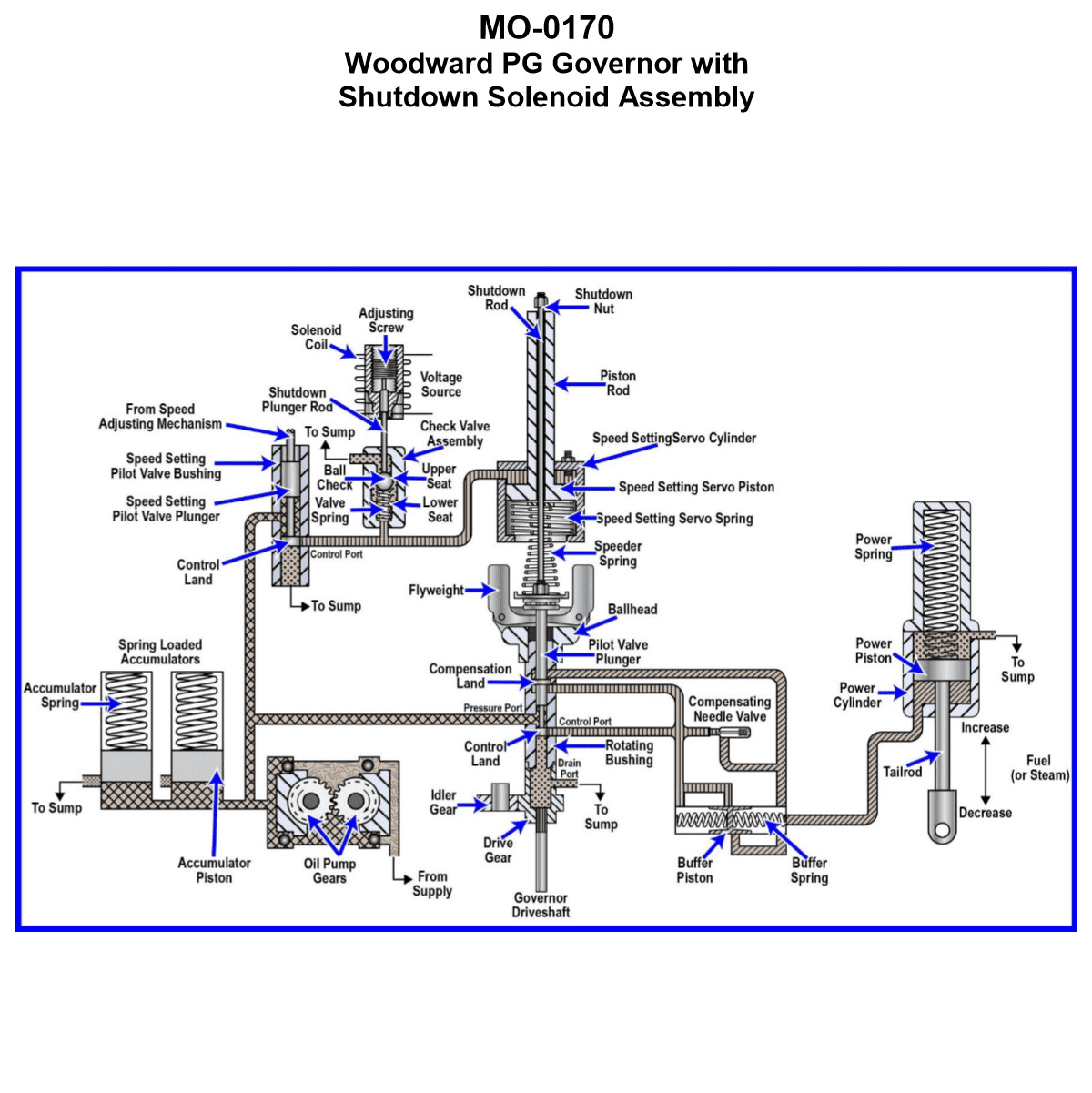
The Correct Answer is B ### Explanation for Option B (Correct) The question describes a speed control governor system and asks what happens during a safety shutdown scenario, where the shutdown solenoid *energizes* (even though the premise states it is *de-energized* during normal operation, the *safety shutdown* event itself is triggered when the solenoid *energizes*), causing the shutdown plunger rod to move downward and unseat the ball check valve. 1. **Solenoid Energizes / Plunger Moves Down:** When the solenoid energizes for a safety shutdown, the plunger rod moves downward. 2. **Ball Check Valve Unseated:** This movement unseats the ball check valve, which releases pressurized oil from the high-pressure side of the system (usually the power cylinder top chamber or the accumulator) to the sump (drain). 3. **Loss of Pressure Above Servo Piston:** This release of pressure results in a rapid drop of oil pressure acting on the top surface of the servo piston. 4. **Servo Piston Moves Upward:** Since the pressure above the piston is lost, the spring force acting beneath the servo piston (or the residual pressure on the lower side, depending on design) forces the servo piston rod rapidly **upward**. 5. **Fuel Rack / Power Cylinder Movement:** The upward movement of the servo piston rod is mechanically linked to the power cylinder (which typically controls the fuel rack or throttle). In this type of governor safety shutdown, the upward movement of the servo piston rod corresponds to the power cylinder linkages moving the fuel control mechanism to the "no fuel" position (shutdown). For most marine engine governors, the "no fuel" position means the power cylinder tail rod moves **downward** (closing the fuel rack). Therefore, during the safety shutdown, the pressurized oil is dumped, causing the servo piston rod to move **upward** and the connected power cylinder tail rod (fuel control linkage) to move **downward** to stop the engine. ### Explanation for Incorrect Options **A) The servo piston rod moves downward. The power cylinder tail rod moves upward.** This scenario describes an increase in fuel (opening the rack) which would be the opposite of a safety shutdown. A downward movement of the servo piston rod would occur if pressure was applied to its top surface, which happens during normal operation or acceleration, not during an emergency shutdown where oil is vented. **C) The servo piston rod moves downward. The power cylinder tail rod moves downward.** While a downward movement of the power cylinder tail rod corresponds to shutdown, a downward movement of the servo piston rod indicates system pressure is still retained or applied above the piston. The key action of this type of emergency shutdown system is to dump pressure, forcing the servo piston **upward** via spring force. **D) The servo piston rod moves upward. The power cylinder tail rod moves upward.** An upward movement of the power cylinder tail rod generally signifies an increase in fuel (opening the rack), which contradicts the purpose of a safety shutdown. Although the servo piston rod moves upward, the resultant motion of the power cylinder linkage must be downward to shut off the fuel.
Pass Your Coast Guard Licensing Exams!
Study offline, track your progress, and simulate real exams with the Coast Guard Exams app