Question 57 OSE02 - Assistant Engineer - OSV
The main diesel propulsion engines on your offshore supply vessel are protected with a mechanical overspeed trip mechanism similar to that shown in the illustration. Upon testing the trip setting, you discover that it is necessary to make an adjustment. Assuming that several adjustments may be necessary before the final setting is accurately achieved, what statement concerning adjustment is true? Illustration MO-0101
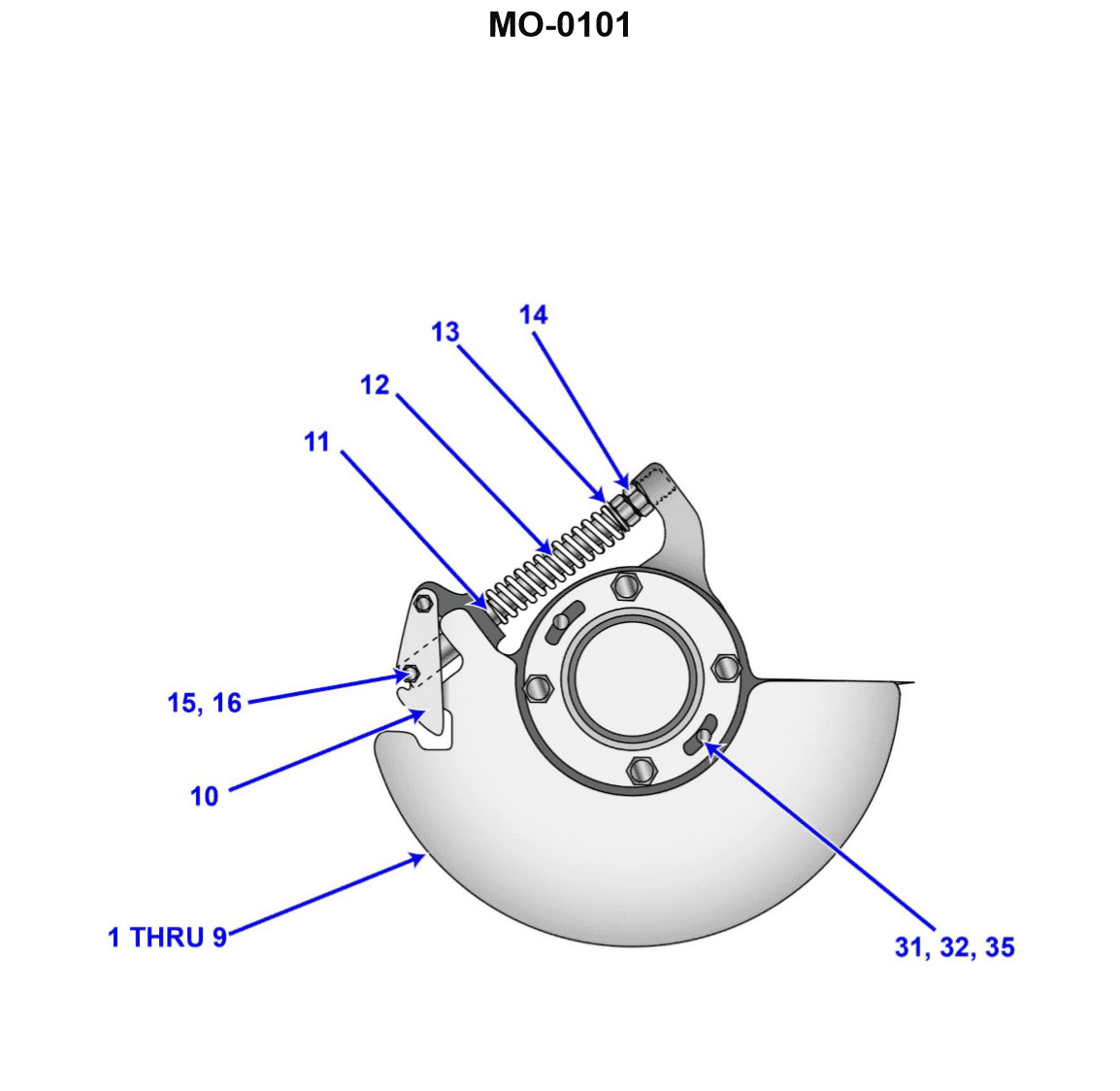
The Correct Answer is A ### Explanation of Correct Option (A) Option A is correct because it follows standard safety and maintenance procedures for adjusting critical engine protective devices like mechanical overspeed trips: 1. **Engine Must Be Stopped:** Adjusting the internal mechanisms (like spring tension or weights) of a mechanical overspeed trip while the engine is running is extremely dangerous and often physically impossible. The trip mechanism is typically located on the camshaft or fuel pump drive train and involves moving parts operating at high speeds. To access and safely turn the adjusting screw/bolt without risking injury or damage to the mechanism, the engine must be stationary (stopped). 2. **Locknut Must Be Retightened After Each Adjustment:** The locknut secures the adjusting screw or bolt in its precise position, preventing vibrations during engine operation from causing the setting to drift. Since achieving the correct setting often requires multiple adjustments (test, stop, adjust, secure, test again), the locknut must be tightened *after every single adjustment* to ensure that the setting remains fixed for the subsequent test run. Failing to secure the locknut means the adjusted setting is unreliable and the mechanism could fail catastrophically during the next run, or the vibration could cause the setting to change during the test itself. ### Explanation of Incorrect Options **B) To adjust the overspeed trip, the engine must be stopped AND the locknut must be retightened only after the final adjustment.** *Incorrect.* While the engine must be stopped, failing to retighten the locknut after each intermediate adjustment makes the setting unstable and renders the subsequent test runs meaningless and potentially dangerous, as the adjustment screw could move under vibration. **C) To adjust the overspeed trip, the engine must be running AND the locknut must be retightened only after the final adjustment.** *Incorrect.* The engine must be stopped to safely access and manipulate the adjusting mechanism. Additionally, securing the locknut only at the end is unsafe and leads to inaccurate testing. **D) To adjust the overspeed trip, the engine must be running AND the locknut must be retightened after each adjustment.** *Incorrect.* It is a fundamental safety and practical requirement that the engine must be stopped to perform the adjustment itself.
Pass Your Coast Guard Licensing Exams!
Study offline, track your progress, and simulate real exams with the Coast Guard Exams app