Question 5 OSE02 - Assistant Engineer - OSV
The offshore oil spill response vessel to which you are assigned is fitted with main propulsion diesel engines of the type shown in the illustration. In terms of valve operating gear, cylinder liner type, and connecting rod type, what statement is true? Illustration MO-0227
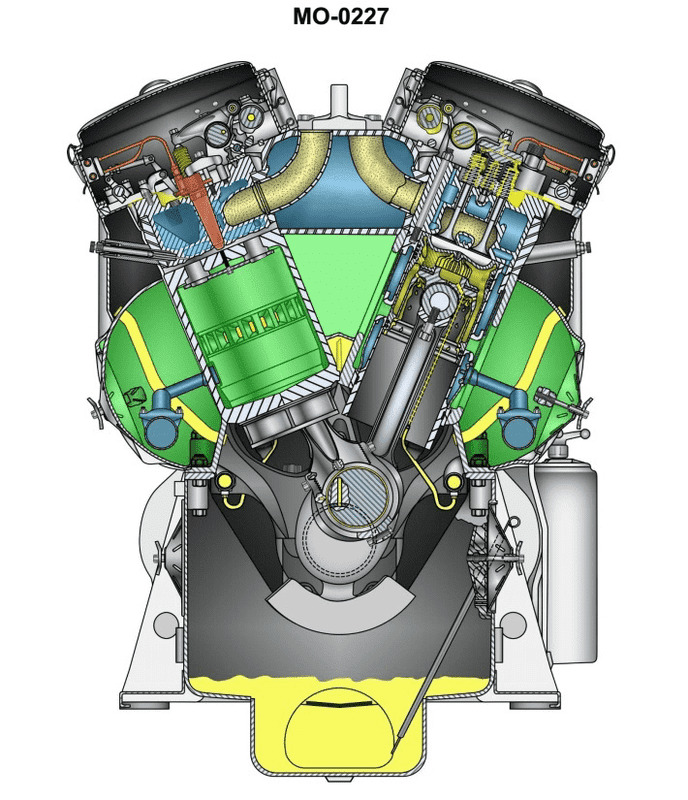
The Correct Answer is D **Explanation for Option D (Correct Answer):** 1. **Overhead Cam (OHC) Engine:** Large, modern, medium-speed diesel engines (like those typically used for main propulsion on offshore vessels, often based on designs like Wärtsilä, MaK, or Pielstick) generally utilize an overhead camshaft arrangement. This design allows for more precise valve timing and higher performance compared to a long pushrod system, especially in large bore engines. The illustration (MO-0227, typically representing a four-stroke medium-speed diesel) would show the camshaft positioned high near the cylinder head or operating directly on the valve levers. 2. **Jacketed Cylinder Liners (Dry Liners):** In high-performance, large marine engines, jacketed liners (often referred to as 'dry' liners in the context of being housed within a separate coolant jacket block structure) are commonly used. While simpler engines use 'wet' liners (where the coolant directly touches the outside of the liner), complex medium-speed engines often integrate the liner into a cylinder jacket or head assembly that bolts onto the engine frame. The term "jacketed cylinder liners" in this context refers to the robust design where the cooling water passages are integral to the liner housing or block structure, providing better structural stability and sealing integrity required for high pressures and loads. 3. **Hinged-Strap, Fork-and-Blade Connecting Rods:** This type of connecting rod configuration is characteristic of Vee-type (V-configuration) multi-cylinder engines, which are standard for medium-speed main propulsion diesels due to their compactness and power density. * **Fork-and-Blade:** One cylinder bank (the "fork" rod) has a split big end bearing housing that straddles the crankpin, while the rod from the opposing bank (the "blade" rod) seats centrally between the two halves of the fork rod's bearing, sharing a single crankpin. * **Hinged-Strap:** This refers to the design of the big end (crankpin end) bearing cap, which is often hinged or obliquely split to allow the rod to be withdrawn through the narrow confines of the cylinder liner and bore during overhaul, a necessary feature for large medium-speed engines. **Explanation of Incorrect Options:** * **A) This is a pushrod operated overhead valve engine, with wet cylinder liners and hinged-strap, fork-and-blade connecting rods.** * **Incorrect:** While the rod type (hinged-strap, fork-and-blade) is correct for a Vee engine, modern, large medium-speed engines are rarely pushrod operated (OHC is preferred). Furthermore, while "wet" liners exist, "jacketed" liners (in this specific context referring to the robust, fixed cooling design typical of these engines) are a more accurate descriptor for high-output propulsion machinery. * **B) This is an overhead cam engine, with wet cylinder liners, and marine-type connecting rods.** * **Incorrect:** "Marine-type connecting rods" usually refers to the three-piece assembly (rod, foot, and separate bearing cap) found in large two-stroke crosshead engines, not the high-speed, Vee-type configuration (fork-and-blade) typical of the four-stroke trunk piston engines used for medium-speed propulsion. The term "wet cylinder liners" is also less precise than "jacketed" for these high-performance engines. * **C) This is a pushrod operated overhead valve engine, with jacketed cylinder liners and conventional connecting rods.** * **Incorrect:** The engine type is typically OHC, not pushrod. More critically, using "conventional connecting rods" (meaning side-by-side arrangement on the crankpin) would only apply if the engine was an inline configuration. Since medium-speed propulsion engines are usually Vee-type for compactness, they require the specialized fork-and-blade rod configuration.
Pass Your Coast Guard Licensing Exams!
Study offline, track your progress, and simulate real exams with the Coast Guard Exams app