Question 19 OSE02 - Assistant Engineer - OSV
A diesel generator set on your offshore supply boat has a simplex lube oil strainer of the type shown in the illustration, situated on the discharge side of the lube oil pump. At a specified engine rpm and lube oil temperature, you notice that the pressure drop becomes unacceptably high. When you rotate the cleaning handle you notice that it is extremely difficult to rotate. What should be done? Illustration MO-0057
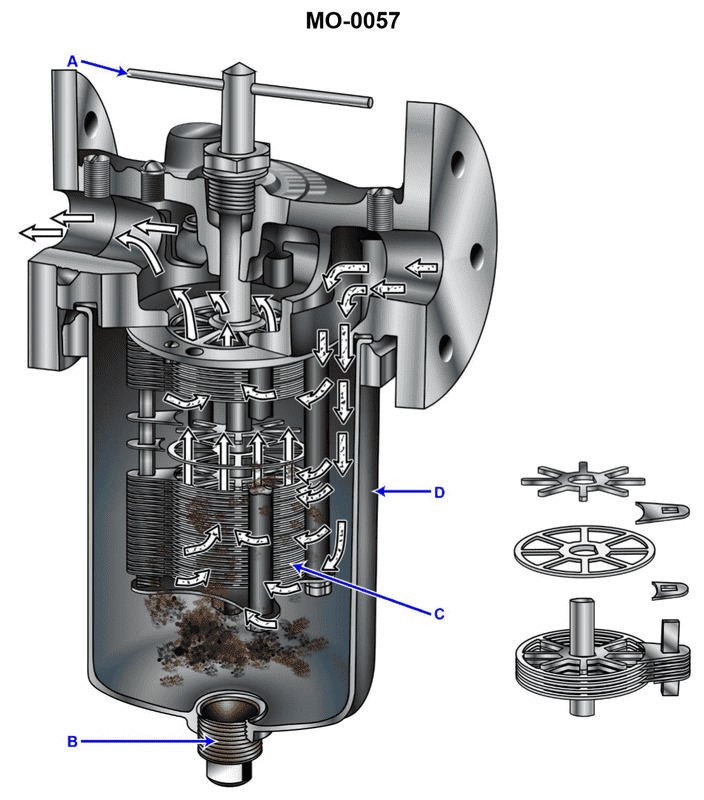
The Correct Answer is B **Explanation for Option B (Correct):** The problem describes two key symptoms in a simplex lube oil strainer: 1. **Unacceptably high pressure drop:** This indicates the strainer element is severely clogged, restricting flow. 2. **Cleaning handle (A) is extremely difficult to rotate:** This type of strainer (often a metal edge or self-cleaning disc filter) is cleaned by rotating the element (disk stack, C) against fixed scraper blades. If rotation is extremely difficult, it means the collected solids and sludge have hardened or built up into a heavy, compacted mass on the disc stack, jamming the mechanism. Forcing the handle (Option A) risks damaging the internal components (the stack, the scrapers, or the handle linkage). Since the standard rotational cleaning procedure is failing due to heavy, solidified deposits, the engine must be stopped, and the only effective way to restore functionality is to remove the jammed strainer element (C) and soak it in a suitable solvent (like diesel or specific degreasers) to dissolve and break up the compacted sludge, allowing the deposits to be safely removed. **Explanation of Incorrect Options:** **A) The cleaning handle (A) should be forced to rotate, even if it requires an extender handle to produce greater rotating torque.** This is dangerous and highly discouraged. Forcing a jammed mechanism significantly increases the risk of mechanical failure, such as bending the cleaning blades (scrapers) or distorting the disc stack (C). This damage could render the strainer ineffective or necessitate costly, complex repairs. **C) After stopping the engine, the drain plug (B) should be removed to drain the accumulated sludge from the strainer sump.** Draining the sump (B) is standard maintenance for removing sludge and sediment that collects at the bottom of the housing. While useful, it only addresses the material that has fallen out of the main filtration element (C). It will not solve the primary problem: the solidified, compacted sludge jamming the rotating filter stack, which is the cause of the high pressure drop and the difficulty in rotating the cleaning handle. **D) No special consideration need be taken as long as the cleaning handle (A) rotates, even if it rotates with great difficulty.** This is incorrect. The symptoms (high pressure drop and extremely difficult rotation) clearly indicate an abnormal and severe clogging condition. Ignoring this situation (taking "no special consideration") means the filter is barely functioning, risking damage to the lube oil system (due to excessive pressure drop and lack of filtration), and potentially damaging the strainer mechanism itself if the handle is continually forced. The high difficulty in rotation is the 'special consideration' that indicates manual, deep cleaning is required.
Pass Your Coast Guard Licensing Exams!
Study offline, track your progress, and simulate real exams with the Coast Guard Exams app