Question 34 OSE02 - Assistant Engineer - OSV
The oil platform construction support vessel to which you are assigned has main diesel engines fitted with intake and exhaust systems as shown in the illustration. If the main engine is running under a heavy load at maximum rpm, which pressure would ordinarily be negative? Illustration MO-0180
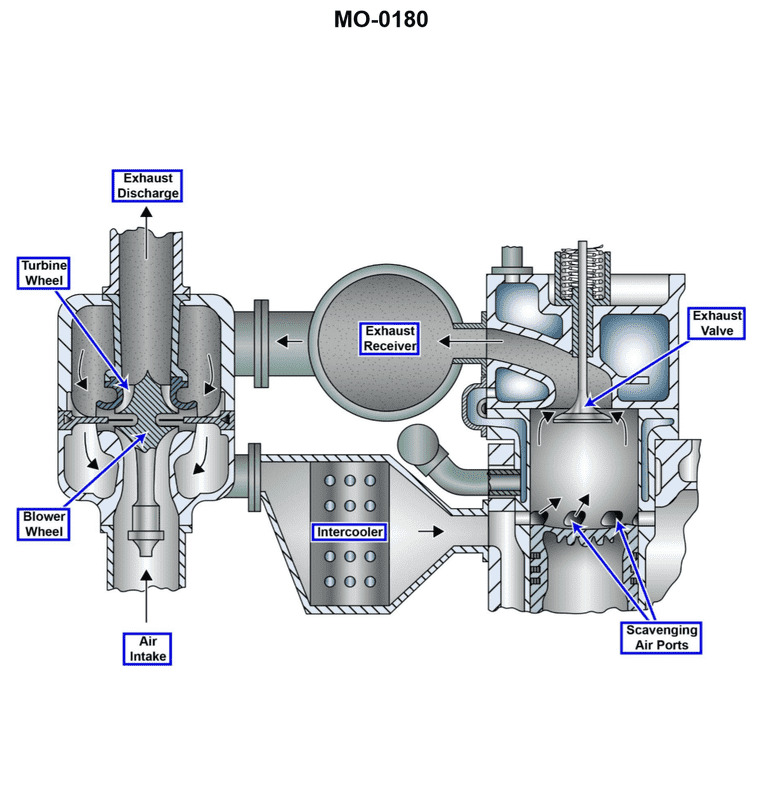
The Correct Answer is A ### Explanation for Option A (Air intake) Option A refers to the pressure measured in the ductwork or filter housing leading into the turbocharger compressor (the very start of the engine's intake system). 1. **High Flow Rate:** Under heavy load and maximum RPM, the turbocharger is drawing the maximum possible volume of air into the engine. 2. **Restriction:** Despite large intake ducts, all systems (filters, vanes, bends, and ducting) present some resistance (restriction) to this massive flow of air. 3. **Suction Effect:** The high velocity and volume of air being "sucked" through the restrictive path by the compressor creates a pressure drop relative to the ambient atmosphere outside the vessel. This pressure drop registers as a negative gauge pressure (a slight vacuum). Therefore, the air intake pressure is typically the only pressure point in the entire intake and exhaust system that registers below atmospheric pressure (negative). ### Explanation for Incorrect Options **B) Exhaust receiver:** The exhaust receiver (or manifold) contains the hot exhaust gases *before* they enter the turbocharger turbine. For the turbocharger to operate effectively and generate adequate boost pressure, the pressure here must be significantly higher than atmospheric pressure and higher than the charge air pressure (C). This pressure is highly **positive**. **C) Air box:** The air box (or scavenge air manifold/charge air manifold) contains the air *after* it has been compressed by the turbocharger and cooled by the intercooler. This highly compressed air, known as "boost air," is essential for filling the cylinders and scavenging exhaust gases. This pressure is highly **positive** (often tens of PSIG). **D) Exhaust discharge to stack:** This location measures the exhaust pressure *after* the gases have passed through the turbocharger turbine. Although much lower than the pressure in the exhaust receiver (B), the pressure must still be slightly **positive** to overcome the friction, height, and stack back pressure to ensure the gases exit the funnel freely. If this pressure were negative, the engine would be drawing ambient air back down the stack.
Pass Your Coast Guard Licensing Exams!
Study offline, track your progress, and simulate real exams with the Coast Guard Exams app