Question 6 OSE02 - Assistant Engineer - OSV
The multi-purpose offshore supply vessel to which you are assigned is fitted with main propulsion diesel engines of the type shown in the illustration. In terms of valve operating gear, cylinder liner type, and connecting rod type, what statement is true? Illustration MO-0192
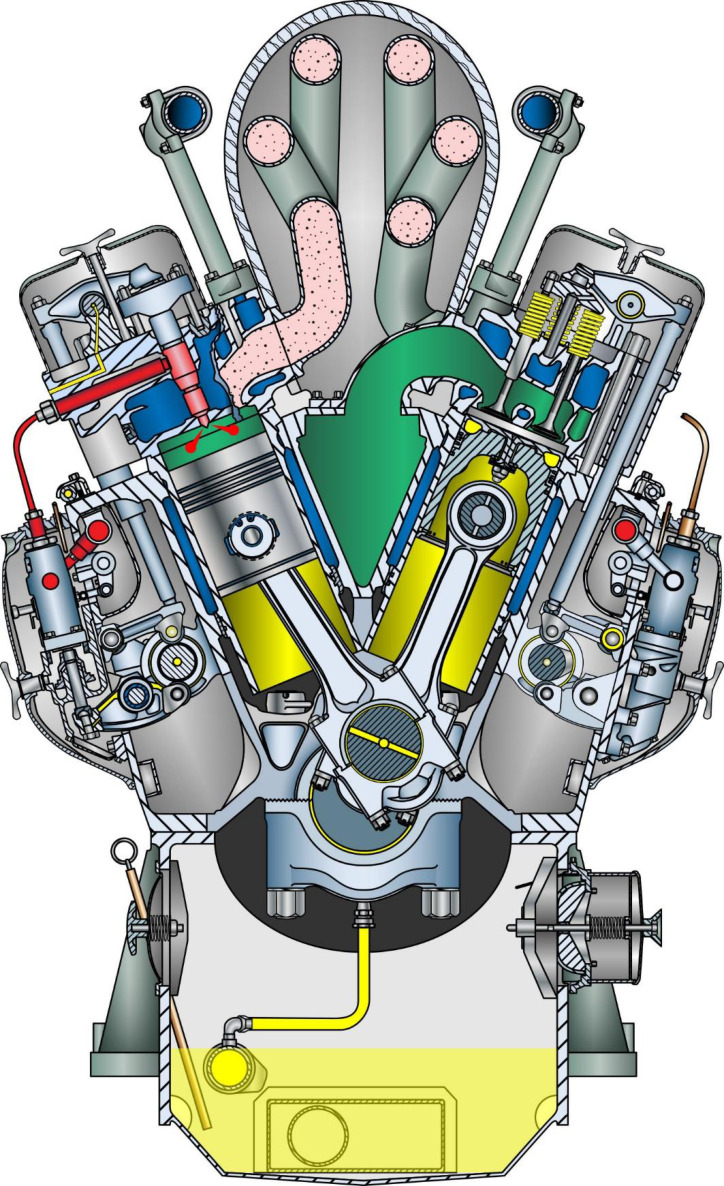
The Correct Answer is A. **Explanation for Option A (Correct):** Option A describes a common configuration for medium-speed marine diesel engines often used in offshore supply vessels (OSVs), which are typically four-stroke trunk piston engines. 1. **Pushrod Operated Overhead Valve Engine:** The illustration (MO-0192, which typically depicts a common medium-speed four-stroke engine like a MaK, Wärtsilä, or similar) generally shows the camshaft located in the engine block (low or mid-level). This location requires **pushrods and rocker arms** to transmit the motion to the valves in the cylinder head, defining it as a pushrod operated overhead valve (OHV) engine, not an overhead cam (OHC) engine. 2. **Wet Cylinder Liners:** Medium-speed four-stroke engines almost universally employ **wet cylinder liners**. A wet liner is directly exposed to the cooling water jacket on its outer surface, ensuring efficient heat transfer. (Note: "Jacketed" is not a standard, precise term in this context; wet or dry is preferred.) 3. **Conventional Connecting Rods:** These engines typically utilize **conventional (or straight) connecting rods** attached directly to the trunk piston. Unlike very large two-stroke crosshead engines, they do not use marine-type (fork and blade) or articulated rods unless they are of a specific V-configuration, but the standard in-line or V-engine trunk piston design uses the conventional rod type. **Explanation of Incorrect Options:** **B) This is a pushrod operated overhead valve engine, with jacketed cylinder liners and articulated connecting rods.** * **Incorrect:** While it is a pushrod OHV engine, the term "jacketed cylinder liners" is vague, and more importantly, **articulated connecting rods** are specific to certain V-engines (like some large Wärtsilä or Pielstick models) where one rod drives the crank directly and the adjacent cylinder rod pivots off the first (master rod). This is not the *standard* configuration implied by a general engine illustration unless specified, making the conventional rod (Option A) the more universally true description. **C) This is an overhead cam engine, with wet cylinder liners and conventional connecting rods.** * **Incorrect:** This engine type is typically **not** an overhead cam (OHC) engine. The camshaft is usually located lower in the block, requiring pushrods to operate the valves. **D) This is an overhead cam engine, with jacketed cylinder liners and marine-type connecting rods.** * **Incorrect:** This engine is not an OHC engine. Furthermore, **marine-type connecting rods** (which are typically defined as the separate piston rod/crosshead assembly used in two-stroke crosshead engines) are not used in trunk piston engines like the one typically found on an OSV.
Pass Your Coast Guard Licensing Exams!
Study offline, track your progress, and simulate real exams with the Coast Guard Exams app