Question 41 OSE02 - Assistant Engineer - OSV
The freshwater cooling systems serving the main engines of your offshore supply vessel are of the type shown in the illustration. What statement accurately describes the characteristics of the freshwater cooling circuit? Illustration MO-0137
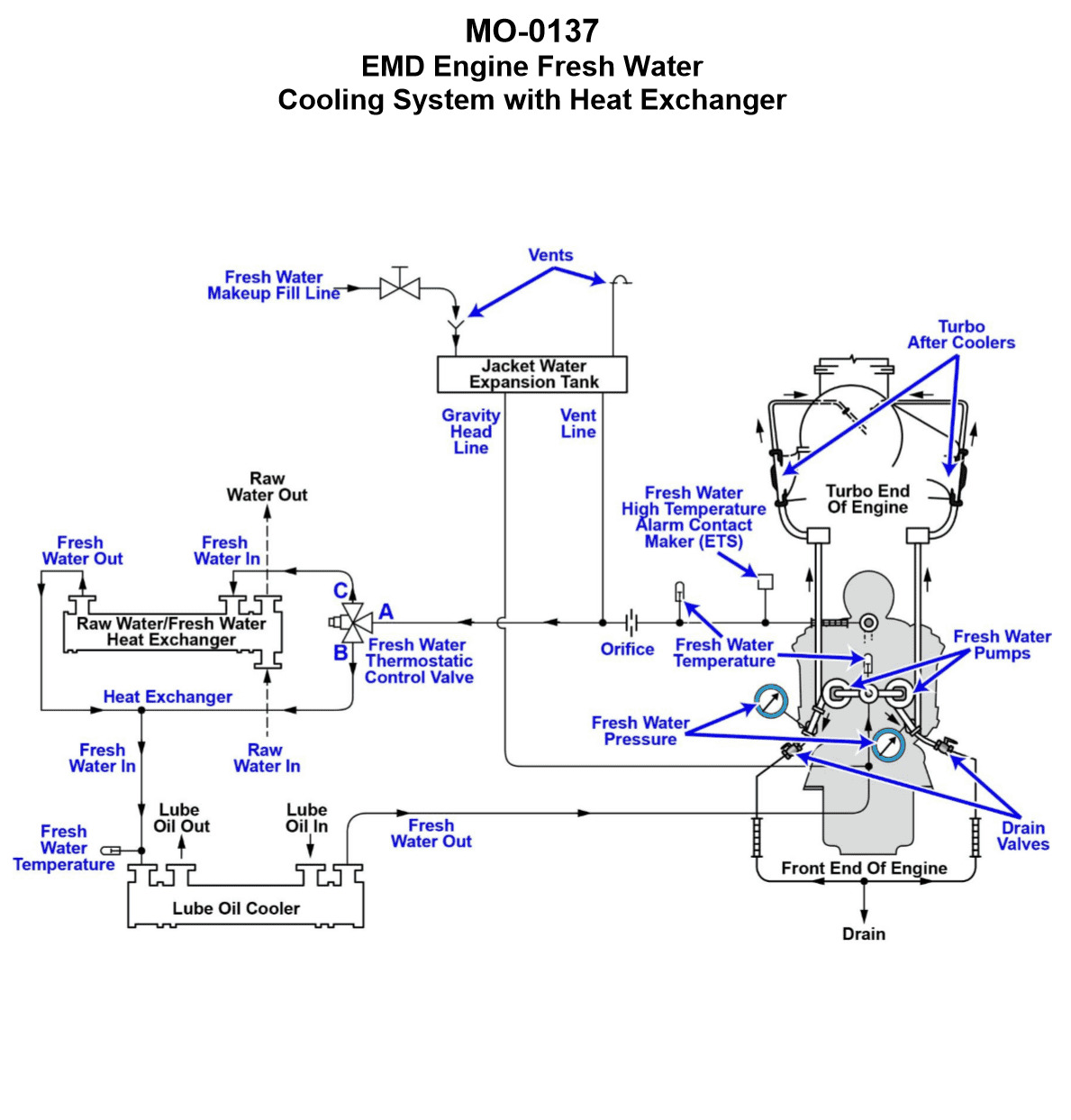
The Correct Answer is C **Explanation for Option C (Correct):** Option C accurately describes the typical characteristics of the jacket water cooling system (freshwater circuit) found on marine diesel engines, particularly those used in offshore supply vessels. 1. **Vented System:** Marine engine cooling systems often employ a "vented" or open expansion tank (header tank) positioned above the engine. This tank serves multiple purposes: providing a reserve volume, accommodating thermal expansion, and allowing air and steam to vent to the atmosphere, thereby maintaining the system pressure close to atmospheric (non-pressurized, or "vented"). 2. **Stationary/Marine Type 3-Way Thermostatic Control Valve:** Temperature regulation in large marine diesel engine cooling systems is achieved using a **3-way diverting or mixing valve**. This valve continuously modulates the flow of freshwater, directing a portion of the hot water either back into the engine (bypassing the cooler) or through the heat exchanger (cooler). The 3-way design is standard for precise temperature control in stationary and marine applications, unlike the simpler 2-way valves often found in automotive systems. **Explanation of Incorrect Options:** * **A) The freshwater circuit is a vented system using an automotive type 2-way thermostatic control valve for temperature control.** * *Incorrect because:* While the system is typically vented, marine/stationary systems use a 3-way valve for temperature control, not a 2-way automotive type. * **B) The freshwater circuit is a pressurized system using a stationary/marine type 3-way thermostatic control valve for temperature control.** * *Incorrect because:* While the 3-way valve is correct, the system is generally **vented** (open expansion tank) rather than operating under high pressure maintained by a pressure cap or regulating valve, which defines a "pressurized system." * **D) The freshwater circuit is a pressurized system using an automotive type 2-way thermostatic valve for temperature control.** * *Incorrect because:* The system is typically vented, and a 3-way valve (not a 2-way valve) is used for robust temperature control.
Pass Your Coast Guard Licensing Exams!
Study offline, track your progress, and simulate real exams with the Coast Guard Exams app