Question 23 OSE01 - Chief Engineer - OSV
The freshwater cooling systems serving the main engines on your general-purpose supply vessel are arranged as shown in the illustration. If coolant drain valves are inadvertently opened during engine operation, what combination set of symptoms would most likely result? Illustration MO-0138
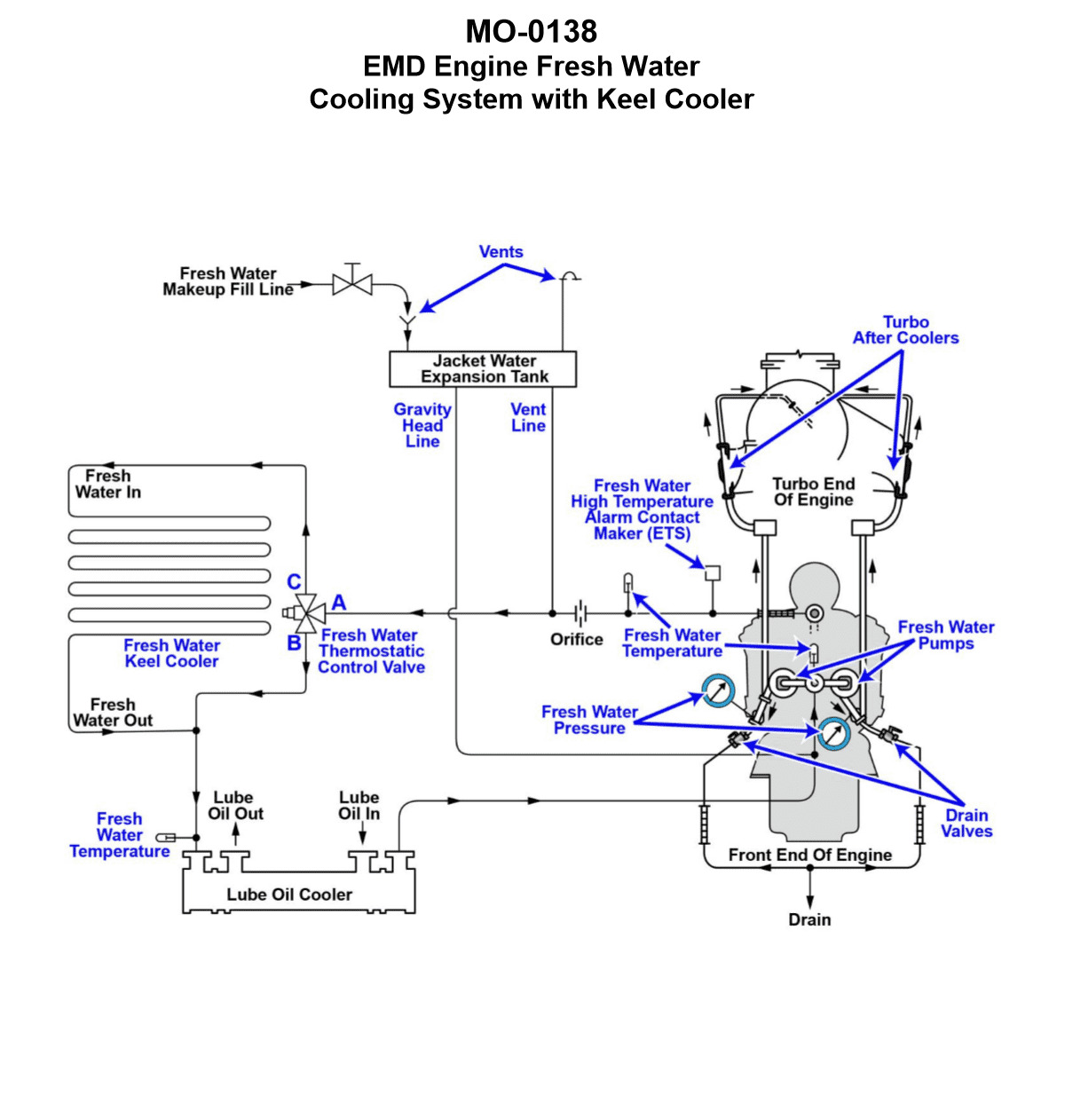
The Correct Answer is B ### 2. Explanation of Why Option B is Correct **Option B: Low level in the jacket water expansion tank. High freshwater outlet temperature from the engine. Low freshwater pump(s) discharge pressure.** When coolant drain valves are inadvertently opened during engine operation, the closed cooling system immediately loses volume under pressure. This leads to the following sequence of events: 1. **Low level in the jacket water expansion tank:** The expansion tank serves as the system's reservoir. As coolant actively drains out through the open valves, the total volume of fluid in the system decreases rapidly, resulting in a low level indication in the expansion tank. 2. **Low freshwater pump(s) discharge pressure:** Opening a drain constitutes a significant leak or bypass in the system piping. This reduces the hydraulic resistance against which the pump is operating. A centrifugal pump operating against significantly reduced system resistance (or experiencing cavitation/drawing air as the level drops) will produce a much lower discharge pressure (head). 3. **High freshwater outlet temperature from the engine:** The low system volume and reduced pump pressure lead to a severe reduction in the circulation rate of coolant through the engine jacket passages. If heat is not effectively removed by circulating coolant, the engine heat will be absorbed by the stagnant or slow-moving water, causing the engine's jacket water outlet temperature to rise rapidly (overheating). ### 3. Explanation of Why Other Options are Incorrect **A) Low level in the jacket water expansion tank. Low freshwater outlet temperature from the engine. Low freshwater pump(s) discharge pressure.** * This option is incorrect because the predicted temperature is wrong. Loss of coolant flow inevitably causes engine overheating, resulting in a **High** freshwater outlet temperature, not a low one. **C) High level in the jacket water expansion tank. High freshwater outlet temperature from the engine. High freshwater pump(s) discharge pressure.** * This option is incorrect on two counts. The level would be **Low** (due to draining), not high. The pressure would be **Low** (due to the leak reducing system resistance), not high. **D) Low level in the jacket water expansion tank. High freshwater outlet temperature from the engine. High freshwater pump(s) discharge pressure.** * This option is incorrect because the predicted pump pressure is wrong. An open drain drastically reduces system resistance and volume, leading to a **Low** pump discharge pressure, not a high one.
Pass Your Coast Guard Licensing Exams!
Study offline, track your progress, and simulate real exams with the Coast Guard Exams app