Question 24 OSE01 - Chief Engineer - OSV
The freshwater cooling systems serving the main engines on your OSV are arranged as shown in the illustration. If the fresh water thermostatic control valve fails in the position where 100% of the flow from flange "A" is permanently ported to flange "B" and flange "C" is permanently blocked, while starting and warming the engine with no load, what would be the resulting warm up time period? Illustration MO-0137
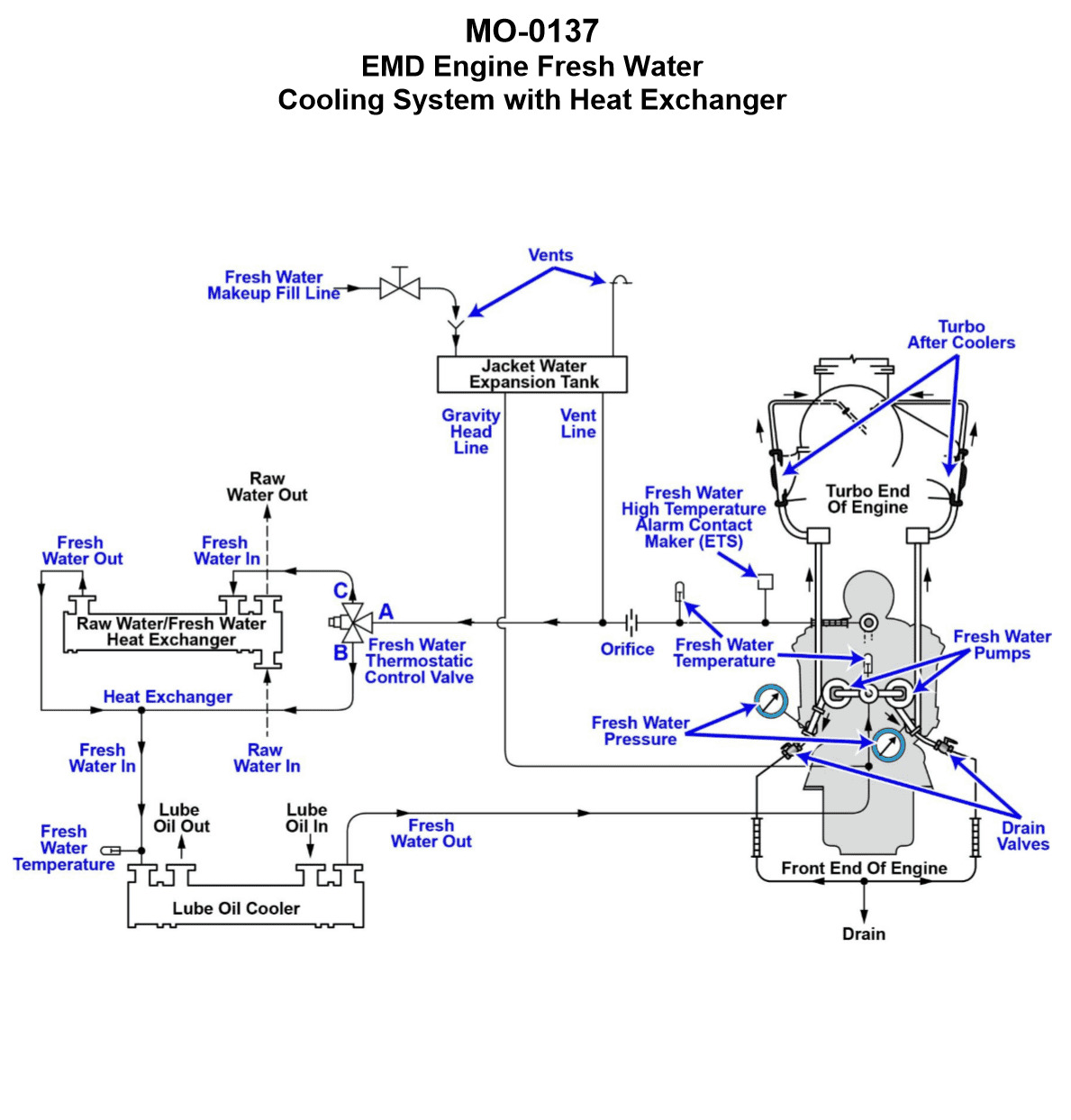
The Correct Answer is D **Explanation for Option D (Correct Answer):** The question describes a failure scenario where the fresh water thermostatic control valve fails, permanently porting 100% of the flow from the engine's outlet (flange "A") to the engine's inlet (flange "B"), while completely blocking flow to the radiator/heat exchanger (flange "C"). This configuration results in the cooling fresh water being 100% recirculated through the engine jacket without being cooled by the external system (radiator or heat exchanger). This is effectively a closed-loop recirculation, bypassing the primary cooling mechanism. During engine startup and warming up with **no load**, the engine is producing minimal waste heat. Since the valve has failed in the **recirculation/bypass position**, the limited heat generated by the engine is retained entirely within the closed cooling system loop. Because the heat is being retained and is not being actively rejected to the environment (or seawater), the temperature of the cooling water will rise rapidly and efficiently, leading to a relatively **normal or even slightly faster** warm-up period until the desired operating temperature is reached. The warm-up phase is characterized by retaining heat, which this failure mode achieves perfectly. **Explanation of Why Other Options Are Incorrect:** * **A) With no load, it is not possible to describe the time frame required to warm up the engine.** This is incorrect. While precise timing depends on specific engine parameters, the mechanism of heat retention (100% recirculation) clearly defines the system's behavior, allowing for a qualitative description of the warm-up period (i.e., normal to fast). * **B) With no load, the engine would require a much longer than normal time frame to warm up.** This is incorrect. A longer warm-up time occurs when heat is aggressively rejected, such as if the thermostat failed wide open, sending 100% of the flow through the heat exchanger even when cold. Since the thermostat failed in the *recirculation* position, heat retention is maximized, minimizing warm-up time. * **C) With no load, the engine would require a much shorter than normal time frame to warm up.** While the warm-up period might be slightly accelerated due to perfect recirculation (no heat loss to the environment through the cooling system), labeling it "much shorter" is typically an overstatement for standard operational procedures. A **relatively normal** time frame (D) is the most accurate description because the time is dictated more by the engine's idle heat generation rate than by small changes in circulation efficiency. Furthermore, once the engine warms up, this failure will lead to immediate overheating. However, during the specific *warm-up* phase, heat retention is high, resulting in a functionally normal warm-up time.
Pass Your Coast Guard Licensing Exams!
Study offline, track your progress, and simulate real exams with the Coast Guard Exams app