Question 65 OSE01 - Chief Engineer - OSV
The freshwater cooling systems serving the main engines of your offshore supply vessel are of the type shown in the illustration. What statement accurately describes the characteristics of the freshwater cooling circuit? Illustration MO-0137
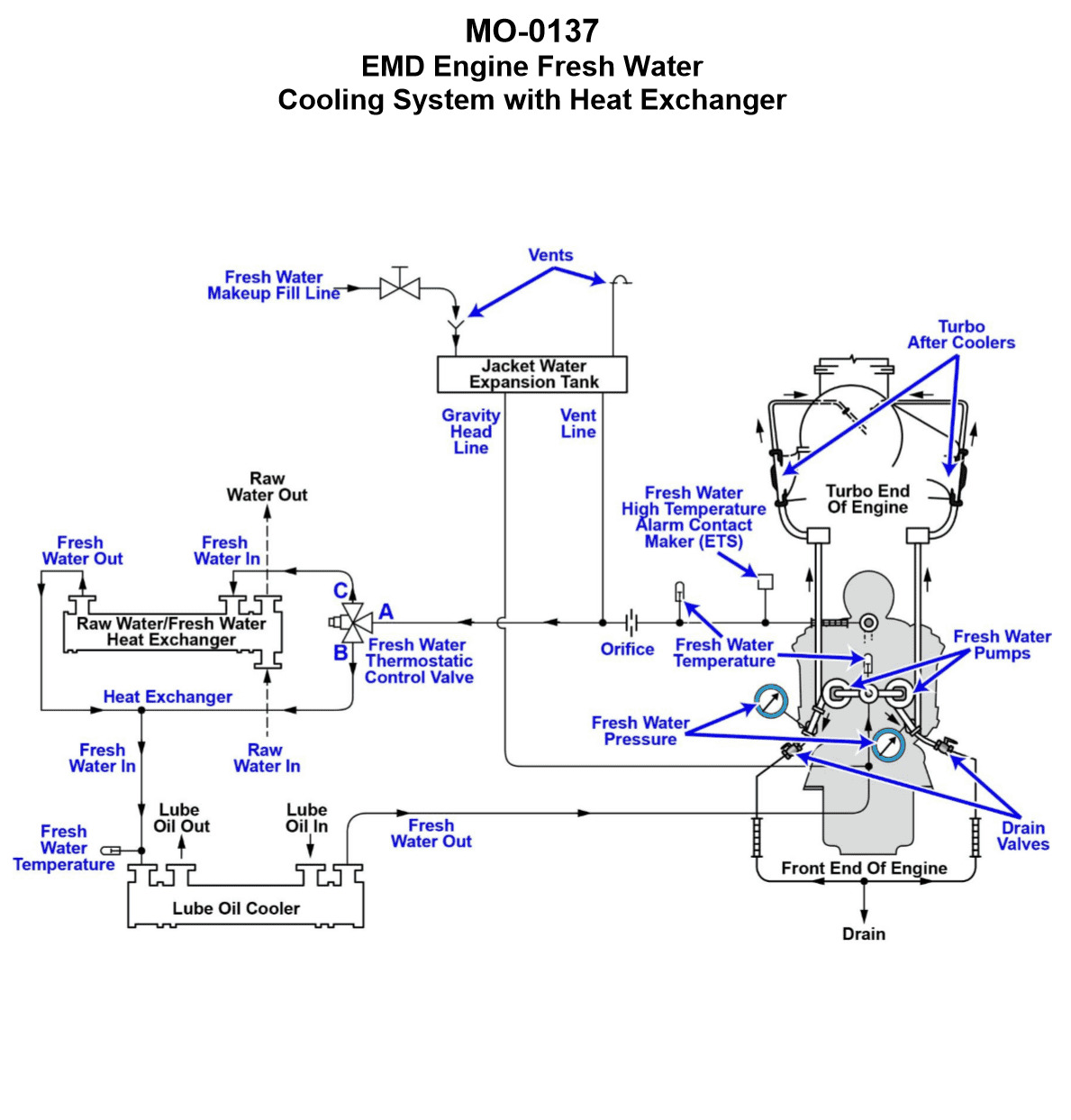
The Correct Answer is D **Explanation for Option D (Correct):** The typical freshwater cooling system serving main engines on offshore supply vessels (OSVs) or similar marine installations is generally designed as a **vented system**. Vented systems are open to the atmosphere (usually via an expansion tank or header tank), which allows for easy escape of air and steam and simplifies system maintenance and filling. Engine cooling circuits in marine applications primarily rely on a **3-way thermostatic control valve (or blending valve)** for temperature regulation. This stationary/marine type valve constantly mixes a portion of the hot water returning from the engine with cold water drawn from the keel cooler or plate heat exchanger bypass loop before sending it back to the engine. This method provides precise and stable temperature control, which is essential for large diesel engines. **Why the other options are incorrect:** * **A) The freshwater circuit is a pressurized system using a stationary/marine type 3-way thermostatic control valve for temperature control.** * **Incorrect:** While a 3-way valve is used, marine engine cooling systems are typically non-pressurized (vented) to the expansion tank to simplify design, handle thermal expansion, and manage air/steam separation. Highly pressurized systems are generally reserved for smaller, sealed automotive or auxiliary applications. * **B) The freshwater circuit is a pressurized system using an automotive type 2-way thermostatic control valve for temperature control.** * **Incorrect:** This system description is wrong on both counts. Marine systems are typically vented, and they use 3-way valves for blending, not 2-way valves (which simply open or close the flow path to the radiator/heat exchanger). * **C) The freshwater circuit is a vented system using an automotive type 2-way thermostatic control valve for temperature control.** * **Incorrect:** While the system is typically vented, it does not use an automotive-type 2-way valve. The stability and thermal mass requirements of large marine engines necessitate the use of a stationary/marine type 3-way blending valve for accurate temperature control.
Pass Your Coast Guard Licensing Exams!
Study offline, track your progress, and simulate real exams with the Coast Guard Exams app