Question 64 OSE01 - Chief Engineer - OSV
The offshore supply vessel to which you are assigned has diesel generators fitted with injectors with the operating principle as shown in the illustration. What statement is true concerning the metering principle used in this system? Illustration MO-0146
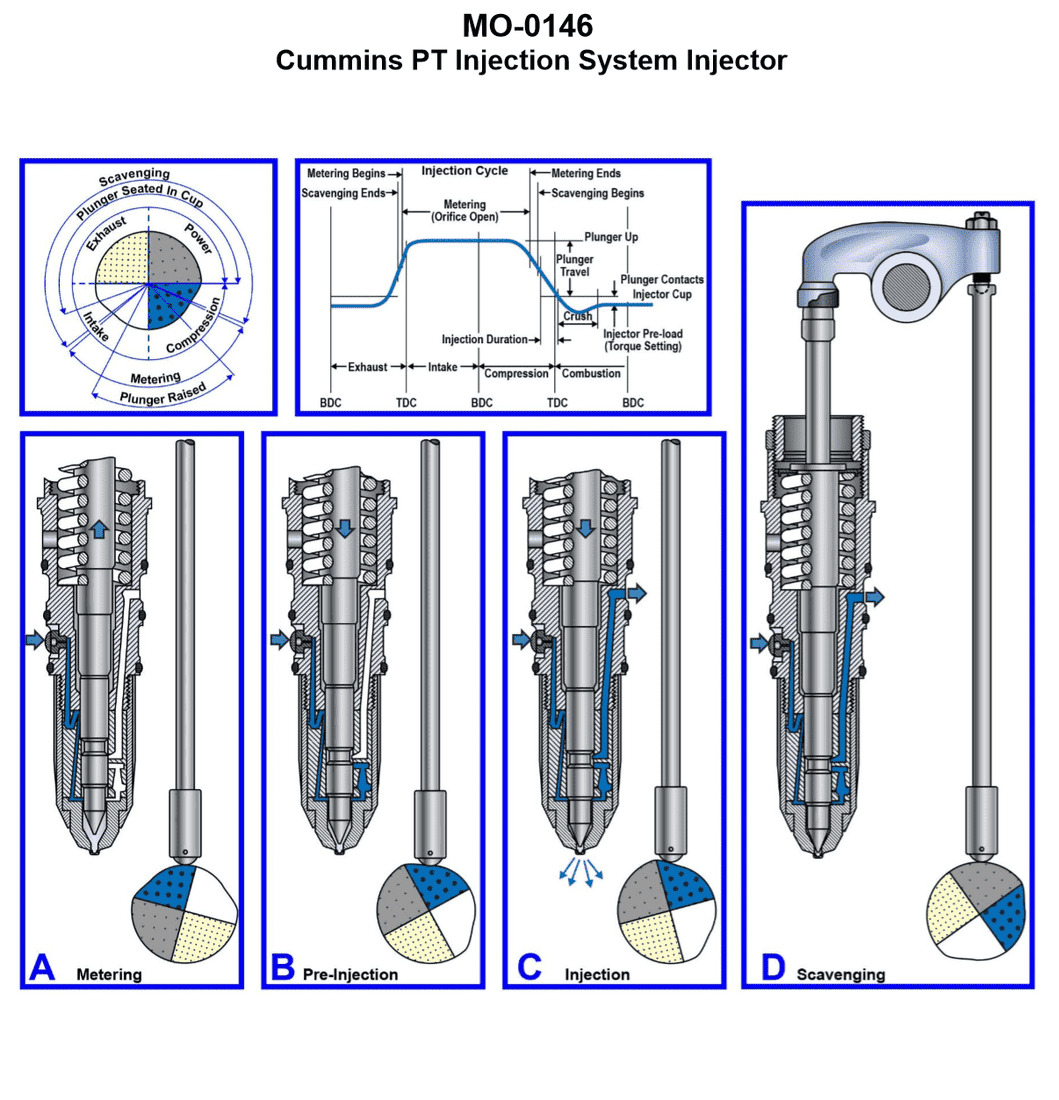
The Correct Answer is B **Explanation of why option B is correct:** Option B states: "The amount of fuel injected is dependent upon the pressure of the inlet fuel to the injector and the length of time the orifice is open during metering." This statement accurately describes the metering principle used in modern, high-pressure, electronically controlled fuel injection systems, such as Common Rail (CR) or certain types of Electronic Unit Injectors (EUI), where metering is often volumetric and time-based. 1. **Pressure:** The injection system maintains a high pressure in the fuel line (or common rail). The higher the inlet pressure to the injector, the greater the mass flow rate of fuel through the nozzle orifice per unit of time (flow rate is proportional to the square root of pressure difference). 2. **Time (Length of Orifice Opening):** The Engine Control Unit (ECU) controls a solenoid valve within the injector. This solenoid determines the duration (pulse width) for which the nozzle needle is lifted (the orifice is open). The longer the time the nozzle is open, the greater the volume of fuel that is delivered into the cylinder. Therefore, the injected quantity is a direct function of the hydraulic pressure pushing the fuel and the electrical timing signal controlling the duration of the injection event. *** **Explanation of why the other options are incorrect:** **A) The amount of fuel injected is dependent upon the cylinder compression pressure and the cylinder compression temperature.** * *Incorrect:* Compression pressure and temperature are critical factors influencing the **combustion process** (e.g., ignition delay and thermal efficiency), but they do not determine the **quantity** of fuel metered and physically supplied by the injector mechanism. The injector meters fuel based on the engine load demand signaled to the ECU, independent of instantaneous cylinder conditions. **C) The amount of fuel injected is dependent upon the distance of plunger travel.** * *Incorrect:* Dependence on plunger travel (or effective stroke) describes the metering principle of older, mechanical injection pumps (like conventional jerk pumps or mechanical unit injectors) where a helix on the plunger determined the cutoff point. Modern electronically controlled systems rely on **solenoid timing** (Option B), not variable mechanical plunger travel, for metering. **D) The amount of fuel injected depends upon the injector pre-load torque setting.** * *Incorrect:* Injector pre-load torque primarily controls the sealing integrity of the injector assembly or sets the internal mechanical pressure (pop pressure) required to lift the nozzle needle. It is a maintenance specification that influences injection pressure onset, but it does not determine the volumetric quantity of fuel metered and delivered per stroke.
Pass Your Coast Guard Licensing Exams!
Study offline, track your progress, and simulate real exams with the Coast Guard Exams app