Question 69 OSE01 - Chief Engineer - OSV
The platform supply vessel to which you are assigned has a pneumatic propulsion control system as shown in the illustration. What statement is true concerning transfer of control? Illustration MO-0168
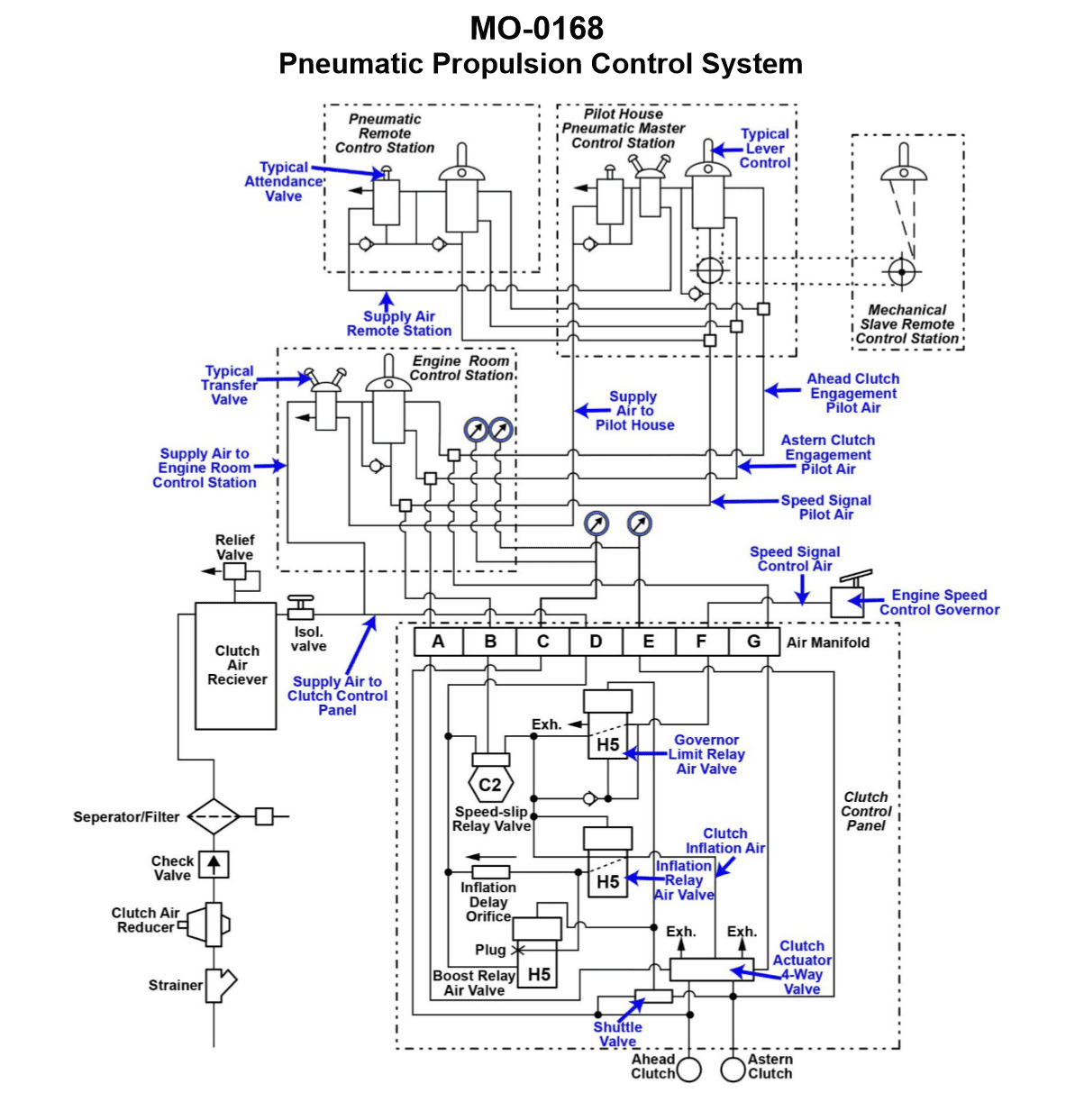
The Correct Answer is B **Explanation for Option B (Correct):** In standard marine propulsion control systems, especially those utilizing pneumatic controls, the primary location for maneuvering the vessel is the pilot house (bridge). However, the engine room contains the machinery and the main control station for supervision, startup, shutdown, and emergency operation. When control authority is transferred, it must be done at the station that currently holds control or at the central control point (usually the Engine Room Control Station, ERCS). The Engine Room Control Station (ERCS) typically houses the master transfer valve. This valve is crucial because it acts as the gatekeeper, allowing authorized personnel in the engine room to take control (usually for maintenance, testing, or emergencies) or release control back to the pilot house, or vice versa. Therefore, the transfer valve at the engine room control station manages the authority switch between the primary remote station (pilot house) and the local/supervisory station (engine room). **Explanation for Other Options (Incorrect):** * **A) The transfer valve at the pilot house pneumatic master control station is used to transfer control of propulsion from the pilot house master control station to the engine room control station or vice versa.** * This is incorrect because while the pilot house holds control, the physical mechanism (the transfer valve) that switches control authority between the two main stations (Pilot House and Engine Room) is almost always located and manipulated in the Engine Room Control Station (ERCS). The pilot house usually only has an indication of who holds control, not the actual transfer mechanism itself. * **C) The transfer valve at the pneumatic remote-control station is used to transfer control of propulsion from the pneumatic remote-control station to the mechanical slave remote control station or vice versa.** * This is incorrect. The system generally involves a Master Control (Pilot House) and a Local Control (Engine Room). A "mechanical slave remote control station" is not a standard control authority point to which primary pneumatic control is transferred. Transfer is fundamentally about switching authority between the bridge and the engine room. * **D) The transfer valve at the pilot house pneumatic master control station is used to transfer control of propulsion from the pilot house master control station to the mechanical slave remote control station or vice versa.** * This is incorrect for two reasons: 1) The transfer valve for the main stations is located in the ERCS, not the pilot house, and 2) Control is not typically transferred to a "mechanical slave remote control station."
Pass Your Coast Guard Licensing Exams!
Study offline, track your progress, and simulate real exams with the Coast Guard Exams app