Question 65 DDE01 - Designated Duty Engineer - Unlimited HP
The main engines on your ocean-going tug are fitted with speed control governors of the type shown in the illustration. What is the purpose of the compensation system, consisting of the buffer cylinder, buffer piston, buffer springs, and compensation needle valve? Illustration MO-0158
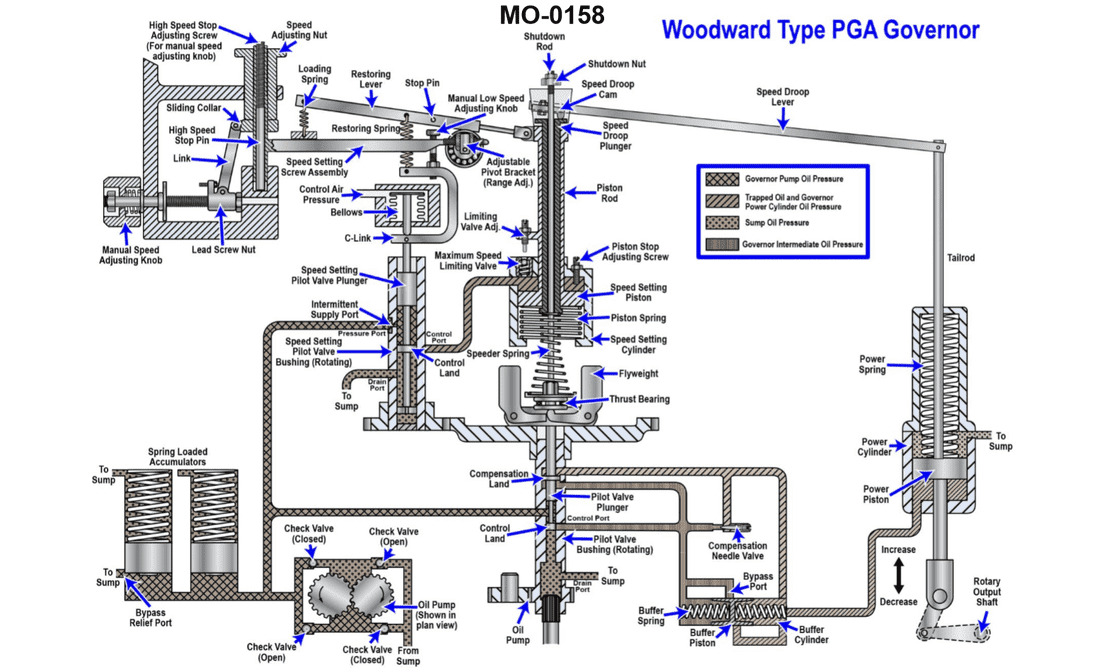
The Correct Answer is A **Explanation for A (Correct Option):** Option A states that the compensation system prevents engine hunting when responding to load changes. This is the primary function of the temporary speed droop (compensation) mechanism found in isochronous or near-isochronous speed governors (such as hydraulic governors of the type typically used on large marine engines, often illustrated by diagrams similar to MO-0158, representing designs like those by Woodward or similar manufacturers). When a load change occurs, the governor immediately moves the fuel racks (or fuel control) to adjust the fuel delivery. If the governor were purely isochronous (seeking a fixed speed) without compensation, this correction would often overshoot the target speed, causing the governor to reverse the correction excessively. This continuous cycle of overcorrection and reversal is known as "hunting" or oscillation. The compensation system (buffer cylinder, piston, springs, and needle valve) introduces a temporary negative feedback signal (a temporary speed droop). When the main piston moves to change the fuel setting, it simultaneously pressurizes the buffer system, temporarily moving the compensating pilot valve or lever. This temporary feedback signal rapidly biases the governor back towards the set speed after the initial large movement, dampening the rapid initial response. As the oil slowly leaks back across the compensation needle valve (which controls the damping rate), the system gradually returns to its true isochronous setting, effectively stabilizing the engine speed without oscillation (hunting). **Explanation for Incorrect Options:** **B) It senses the actual engine speed of rotation.** Incorrect. Engine speed is sensed by the **flyweights** (centrifugal weights) assembly, which converts the rotational speed into a vertical displacement acting upon the pilot valve. The compensation system is a stabilizing mechanism acting on the pilot valve feedback, not the initial speed sensing element. **C) It senses the engine speed setting delivered from the bridge.** Incorrect. The desired speed setting from the bridge (or control room) is typically transmitted via a mechanical linkage, hydraulic pressure, or electric motor (speed setting motor) that adjusts the **position of the speeder spring** (or equivalent linkage) acting against the flyweights. The compensation system does not handle the input signal. **D) It limits engine speed to a maximum value to prevent over speeding.** Incorrect. While the governor as a whole limits speed, the **maximum speed limiting function** is usually performed by a separate mechanical adjustment (maximum speed stop) or a dedicated hydraulic circuit that physically limits the upward travel of the speeder spring or fuel rack position. The compensation system is purely for dynamic stability (anti-hunting) during normal operation and load changes, not for setting static maximum limits.
Pass Your Coast Guard Licensing Exams!
Study offline, track your progress, and simulate real exams with the Coast Guard Exams app