Question 47 DDE01 - Designated Duty Engineer - Unlimited HP
The ship-docking tug to which you are assigned has main engines fitted with injectors similar to those shown in the illustration. What statement is true concerning the operating principle of this type of injector? Illustration MO-0151
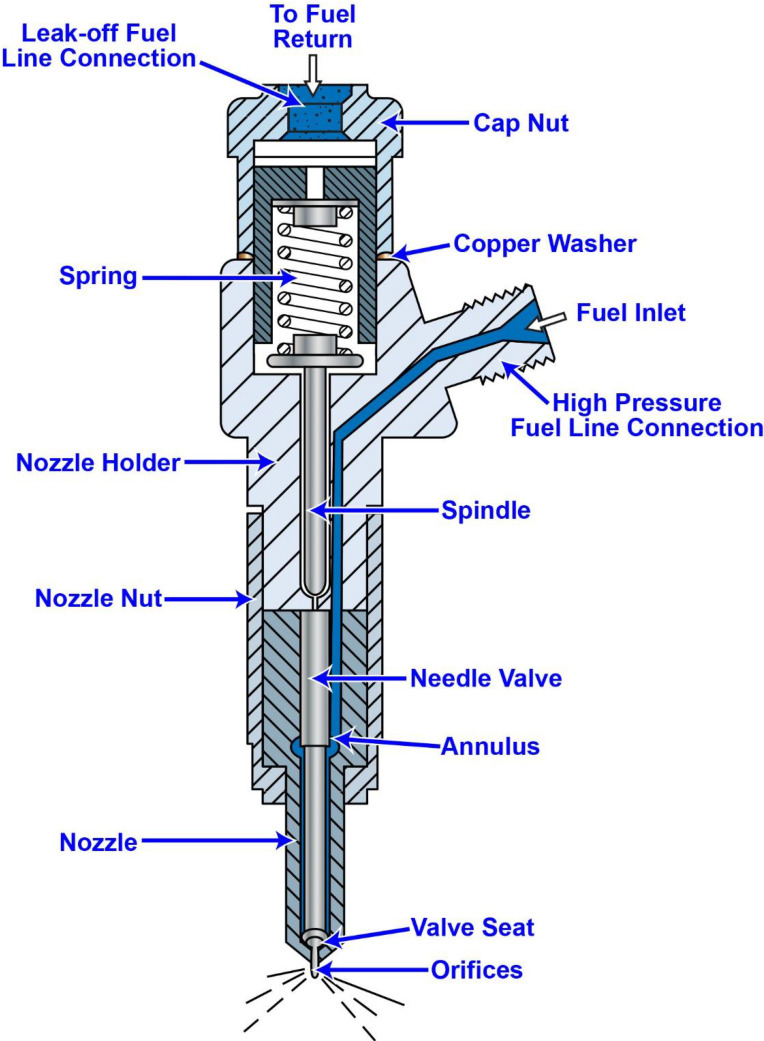
The Correct Answer is D **Explanation for Option D (Correct):** Option D is correct because it accurately describes the forces acting upon the needle valve within a typical constant-pressure or jerk-pump type diesel engine fuel injector (like the one implied by the scenario). 1. **Fuel pressure within the annulus (Opening Force):** High-pressure fuel, supplied by the fuel pump, fills the chamber (annulus) directly above the injector tip and below the needle valve shoulder. This high-pressure fuel exerts an upward force on the needle valve shoulder, pushing the valve off its seat (opening the valve) so that fuel can be sprayed into the combustion chamber. Therefore, fuel pressure is the *opening force*. 2. **Compression load on the spring (Closing Force):** A heavy compression spring is positioned above the needle valve assembly. This spring is pre-loaded to exert a constant downward force on the needle valve. This force holds the needle firmly on its seat, preventing fuel injection until the fuel pressure builds up high enough to overcome the spring load. Therefore, the compression load on the spring is the primary *closing force*. **Explanation of Incorrect Options:** * **A) The fuel pressure within the annulus and the compression load on the spring are both needle valve closing forces.** This is incorrect. As explained above, the high fuel pressure is the force designed to *open* the valve for injection, not close it. * **B) The fuel pressure within the annulus is a needle valve closing force, the compression load on the spring is a needle valve opening force.** This reverses the roles of both components. Fuel pressure opens the valve, and spring load closes it. * **C) The fuel pressure within the annulus and the compression load on the spring are both needle valve opening forces.** This is incorrect. The spring's function is specifically to keep the valve closed until injection timing is reached, making it the closing force.
Pass Your Coast Guard Licensing Exams!
Study offline, track your progress, and simulate real exams with the Coast Guard Exams app