Question 46 DDE01 - Designated Duty Engineer - Unlimited HP
Suppose the diesel generator set drive engines are of the type shown in the illustration on your towing vessel. Assuming the engine is naturally aspirated, within an individual cylinder in terms of piston stroke and position, under what circumstances are the intake and exhaust valves both open? Illustration MO-0163
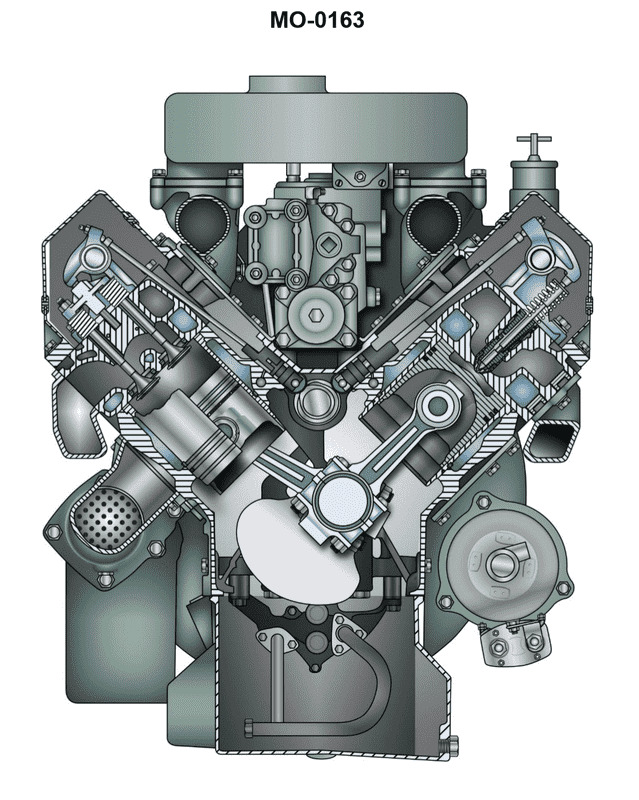
The Correct Answer is A ### Explanation for Option A (Correct) Option A is correct because it describes the event known as **Valve Overlap** (or Cam Overlap) in a four-stroke internal combustion engine cycle. * **Valve Overlap** is a design feature where both the intake valve and the exhaust valve are held open simultaneously for a brief period. * This overlap occurs around **Top Dead Center (TDC)** as the piston completes the **exhaust stroke** and begins the **intake stroke**. * **Purpose (for a naturally aspirated engine):** The primary goal of valve overlap is to utilize the momentum of the exiting exhaust gases (scavenging effect) to help draw the fresh air/fuel mixture into the cylinder, improving volumetric efficiency and clearing residual exhaust gases. This scavenging effect is crucial for maximizing engine performance, even in naturally aspirated (non-turbocharged) designs. ### Why Other Options Are Incorrect **B) When the piston is at top dead center (TDC) transitioning from the compression stroke to the power stroke.** * **Incorrect:** At this point (TDC, just before ignition), both the intake and exhaust valves must be tightly closed to contain the highly compressed charge necessary for combustion. **C) When the piston is at bottom dead center (BDC) transitioning from the power stroke to the exhaust stroke.** * **Incorrect:** At BDC following the power stroke, the exhaust valve opens to release the burned gases, while the intake valve remains closed. There is no simultaneous opening of both valves at this point; only the exhaust valve is beginning to open. **D) When the piston is at bottom dead center (BDC) transitioning from the intake stroke to the compression stroke.** * **Incorrect:** At this point (BDC), the intake valve has just closed (or is closing) to seal the fresh air charge within the cylinder, and the exhaust valve remains closed. The cylinder must be sealed for compression to occur.
Pass Your Coast Guard Licensing Exams!
Study offline, track your progress, and simulate real exams with the Coast Guard Exams app