Question 21 DDE01 - Designated Duty Engineer - Unlimited HP
The salvage tug to which you are assigned has main engines fitted with intake and exhaust systems as shown in the illustration. Assume that the vacuum between the air filter and the turbocharger blower inlet is 12" of water column (negative with respect to atmospheric pressure) when the engine is running at 50% of maximum, continuous rated load. What will happen to the suction vacuum when the load is increased to 100% of maximum continuous rated load? Illustration MO-0076
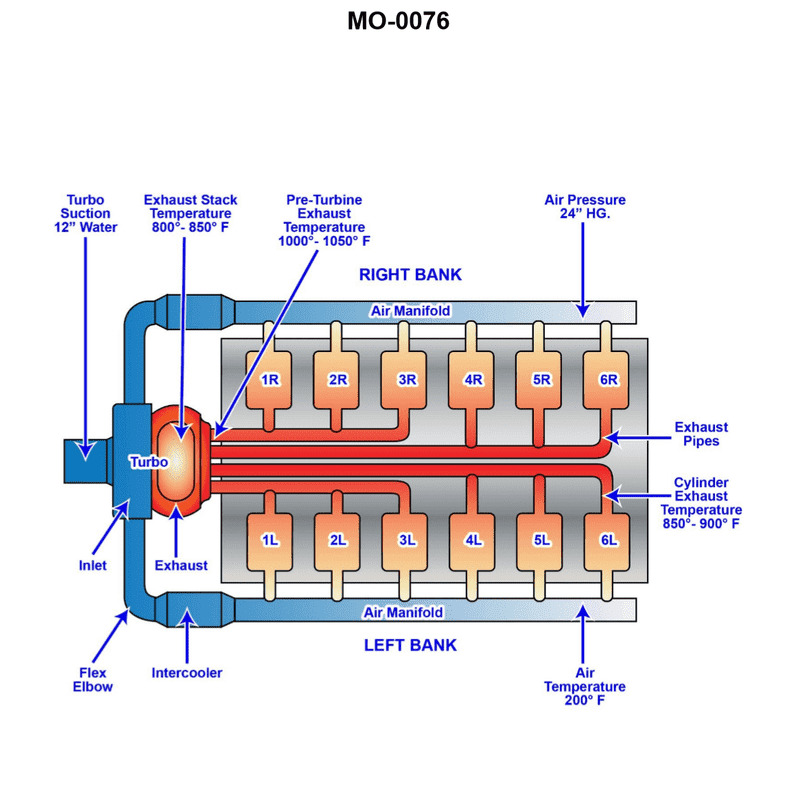
The Correct Answer is B **Explanation for Option B (Correct Answer):** The suction vacuum measured between the air filter and the turbocharger blower inlet is caused by the resistance to airflow through the intake system (primarily the air filter) as the turbocharger draws air into the engine. 1. **Increased Load Requires More Air:** When the engine load increases from 50% to 100% of maximum continuous rated load, the engine requires a proportionally larger mass flow rate of air for combustion. To maintain the correct air-fuel ratio at higher power output, the turbocharger must spin faster and draw in significantly more air. 2. **Increased Resistance:** As the volumetric flow rate (speed) of air increases through the fixed restrictions of the intake system (especially the air filter media), the pressure drop across that restriction increases. This relationship is governed by fluid dynamics principles, where the pressure drop is roughly proportional to the square of the flow velocity (or flow rate). 3. **Increased Vacuum:** Since the vacuum reading is a measure of the pressure drop (negative pressure relative to the atmosphere) required to pull the necessary air through the filter, increasing the required airflow rate inevitably leads to a larger pressure drop, meaning a deeper (higher magnitude) vacuum reading (e.g., changing from 12" to maybe 20" or more of water column negative). **Why Other Options Are Incorrect:** * **A) No change in the depth of vacuum will occur (reading the same inches of water column negative with respect to atmospheric pressure).** This is incorrect because maintaining the same vacuum reading at 100% load would imply that the air filter/intake system resistance did not increase despite a major increase in the required airflow. This violates the fundamental laws of fluid flow through a restriction. * **C) The depth of vacuum will decrease (reading less inches of water column negative with respect to atmospheric pressure).** This is incorrect. A decrease in vacuum would only occur if the required airflow decreased (which happens when the engine load decreases) or if the restriction in the intake path were somehow reduced (e.g., cleaning the filter), neither of which is the case when load increases. * **D) A loss of vacuum will occur (now reading inches of water column positive with respect to atmospheric pressure).** This is incorrect. A positive pressure reading in the intake duct before the turbocharger would mean air is being forced into the system. Since the turbocharger is drawing air in (suction) and not pushing it out, and the duct is open to atmospheric pressure via the air filter, the pressure must remain negative (vacuum) relative to the atmosphere, even at maximum load.
Pass Your Coast Guard Licensing Exams!
Study offline, track your progress, and simulate real exams with the Coast Guard Exams app