Question 49 CEL02 - Chief Engineer - Limited (Alt)
What does the circuit shown in the illustration represent? Illustration EL-0091
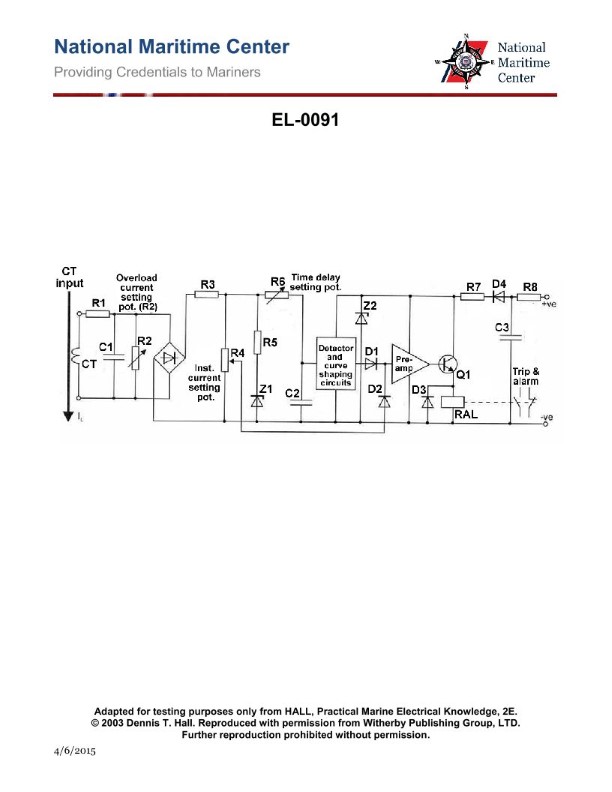
The Correct Answer is D ### Explanation of Option D (Electronic Overload Relay) The illustration (EL-0091, which depicts a standard electronic protection circuit) represents an **electronic overload relay (EOLR)**. 1. **Function:** An EOLR is a protective device used primarily in motor control circuits to monitor the current flowing to the load. If the current exceeds a pre-set threshold for a specified duration (time delay), the circuit activates a trip signal. 2. **Circuit Characteristics:** EOLR diagrams typically show specialized input circuitry (such as current sensing transformers or shunts) connected to signal conditioning, filtering, comparison circuits (often utilizing operational amplifiers), and timing logic. The output section usually involves a small relay or triac that controls a contactor coil, thereby disconnecting the power to the motor. This entire architecture is dedicated to continuous current monitoring and delayed protection, defining an EOLR. ### Explanation of Incorrect Options **A) function generator:** A function generator is used to produce various waveforms (sine, square, triangle) for testing and signal purposes. While it uses similar electronic components (oscillators, integrators, comparators), its primary role is signal creation, not industrial power monitoring and protection. **B) voltage regulator:** A voltage regulator is designed to maintain a constant output voltage despite fluctuations in the input voltage or changes in load current. Its focus is on stabilizing power output, not measuring load current across three phases (typically) for protective tripping. **C) oscillator:** An oscillator is a circuit designed to produce a repetitive electronic signal without external input. While oscillators are often small parts *within* a complex device like an EOLR (e.g., for timing), the entire circuit shown would be far too complex and contain too many dedicated protection features (current sensors, trip output) to be classified simply as a general oscillator.
Pass Your Coast Guard Licensing Exams!
Study offline, track your progress, and simulate real exams with the Coast Guard Exams app