Question 48 CEL02 - Chief Engineer - Limited (Alt)
As shown in figure "A" of the illustration, under what conditions will the thyristor conduct? Illustration EL-0154
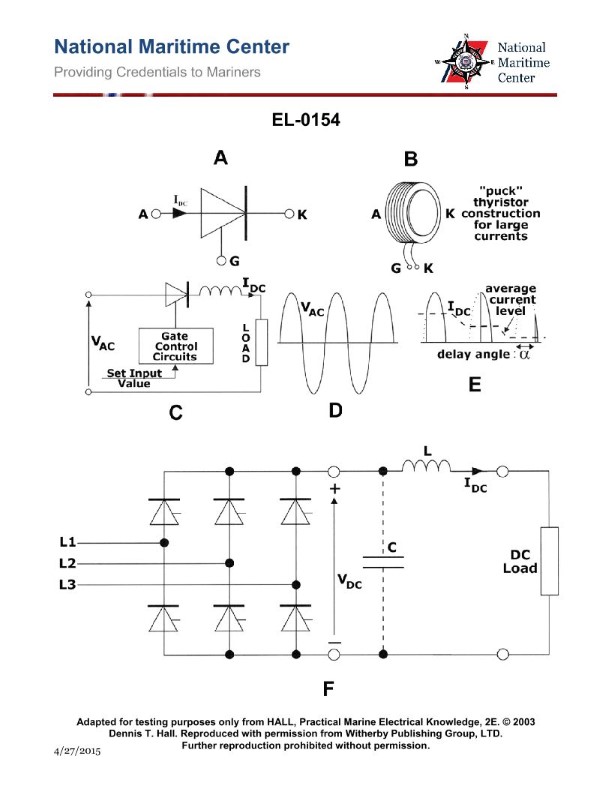
The Correct Answer is A. **Explanation for Option A (Correct):** A Thyristor (Silicon Controlled Rectifier - SCR) is a three-terminal semiconductor device (Anode, Cathode, Gate) used primarily as a switch. For the thyristor to transition from the non-conducting (OFF) state to the conducting (ON) state, two simultaneous conditions must be met: 1. **Forward Bias:** The anode must be positive with respect to the cathode ($V_{AK} > 0$). This ensures the device is properly biased to allow current flow once triggered. 2. **Triggering:** A small, momentary positive voltage (pulse) must be applied to the gate terminal relative to the cathode ($V_G > 0$). This pulse injects charge carriers that initiate the latching action, causing the thyristor to conduct heavily, even after the gate pulse is removed. Therefore, the condition "when the anode is more positive than the cathode and when the gate is briefly pulsed with a voltage more positive than the cathode" correctly describes how a standard thyristor is triggered into conduction. **Why other options are incorrect:** * **B) when the anode is more negative than the cathode and when the gate is briefly pulsed with a voltage more positive than the cathode:** If the anode is negative relative to the cathode (reverse bias), the thyristor is effectively blocked and will not conduct, regardless of any positive gate signal (unless the reverse breakdown voltage is exceeded). * **C) when the anode is more negative than the cathode and when the gate is briefly pulsed with a voltage more negative than the cathode:** Reverse bias prevents conduction, and a negative gate pulse relative to the cathode generally tries to keep the device off or is irrelevant to triggering in this state. * **D) when the anode is more positive than the cathode and when the gate is briefly pulsed with a voltage more negative than the cathode:** While the device is forward-biased (Anode positive), applying a negative gate pulse does not trigger conduction; it may even increase the holding current required to keep the device conducting. A positive pulse is necessary to trigger the standard thyristor.
Pass Your Coast Guard Licensing Exams!
Study offline, track your progress, and simulate real exams with the Coast Guard Exams app