Question 1 CEL02 - Chief Engineer - Limited (Alt)
In figure "B" of the illustrated circuit, if the resistance of R1 is 10 ohms, R2 is 10 ohms, and R3 is 10 ohms, what is the total resistance? Illustration EL-0032
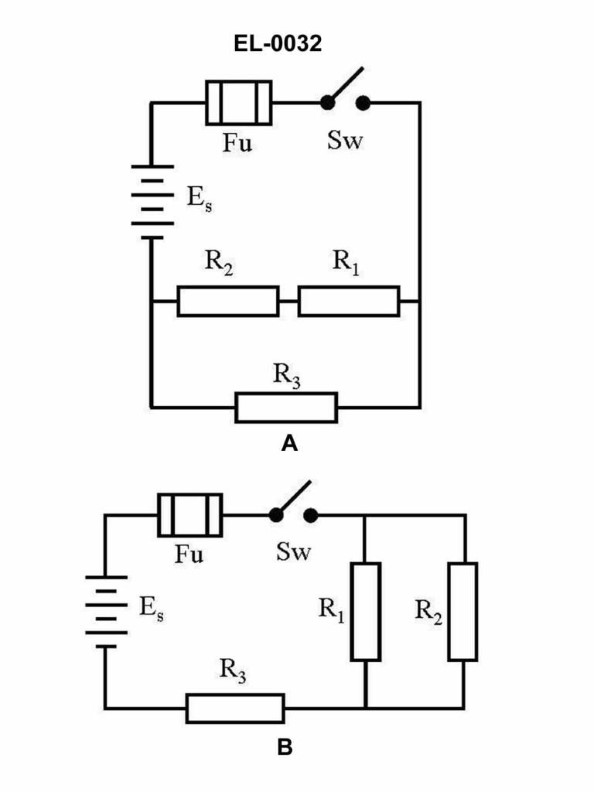
The Correct Answer is A ### 1. Explanation for Option A (15 ohms) The circuit described in figure "B" (Illustration EL-0032, typically representing a combined series-parallel circuit) shows that resistors $R_2$ and $R_3$ are connected in parallel, and this parallel combination is connected in series with resistor $R_1$. **Given Values:** $R_1 = 10 \text{ ohms}$ $R_2 = 10 \text{ ohms}$ $R_3 = 10 \text{ ohms}$ **Step 1: Calculate the equivalent resistance of the parallel combination ($R_{p}$) for $R_2$ and $R_3$.** The formula for two resistors in parallel is: $$R_p = \frac{R_2 \times R_3}{R_2 + R_3}$$ Substituting the values: $$R_p = \frac{10 \text{ ohms} \times 10 \text{ ohms}}{10 \text{ ohms} + 10 \text{ ohms}}$$ $$R_p = \frac{100 \text{ ohms}^2}{20 \text{ ohms}}$$ $$R_p = 5 \text{ ohms}$$ **Step 2: Calculate the total resistance ($R_{total}$).** The total resistance is the sum of $R_1$ (series resistor) and the equivalent parallel resistance ($R_p$): $$R_{total} = R_1 + R_p$$ $$R_{total} = 10 \text{ ohms} + 5 \text{ ohms}$$ $$R_{total} = 15 \text{ ohms}$$ Therefore, the total resistance is 15 ohms. ### 2. Explanation for Why Other Options are Incorrect **B) 20 ohms:** This value would be correct if $R_1$ and $R_2$ were in series ($R_1 + R_2 = 10 + 10 = 20 \text{ ohms}$) and $R_3$ was ignored, or if $R_1$ were in series with the parallel combination of two 20-ohm resistors. It does not reflect the correct calculation for the given circuit. **C) 25 ohms:** This value suggests an incorrect calculation, possibly if $R_1$ (10 $\Omega$) were in series with a parallel combination that somehow resulted in 15 $\Omega$. There is no standard arrangement of these three 10 $\Omega$ resistors that yields 25 ohms. **D) 30 ohms:** This value would be the total resistance only if all three resistors ($R_1$, $R_2$, and $R_3$) were connected in **series** ($R_{total} = R_1 + R_2 + R_3 = 10 + 10 + 10 = 30 \text{ ohms}$). Since the circuit in Figure "B" includes a parallel segment ($R_2$ and $R_3$), this option is incorrect.
Pass Your Coast Guard Licensing Exams!
Study offline, track your progress, and simulate real exams with the Coast Guard Exams app