Question 11 UFIV01 - Chief Engineer - UFIV
The uninspected fishing trawler to which you are assigned is fitted with main propulsion diesel engines of the type shown in the illustration. In terms of valve operating gear, cylinder liner type, and connecting rod type, what statement is true? Illustration MO-0005
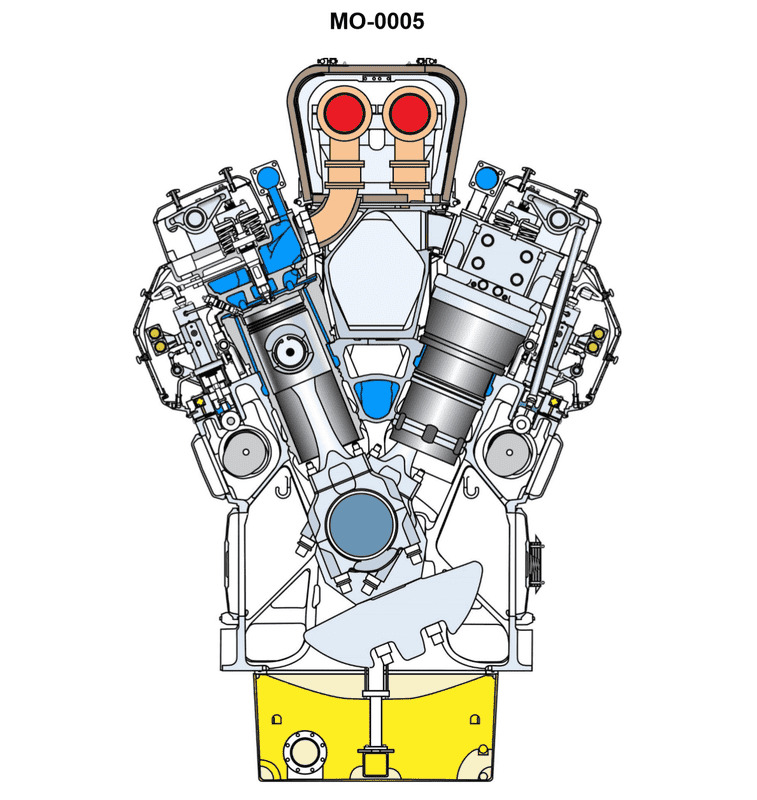
The Correct Answer is B **Explanation for Option B (Correct):** Option B states that the engine is a pushrod operated overhead valve engine, with wet cylinder liners and conventional connecting rods. This description is characteristic of common medium-speed, heavy-duty marine propulsion diesel engines often found in fishing trawlers (like the one implied by Illustration MO-0005, which typically depicts a standard four-stroke marine diesel). 1. **Pushrod Operated Overhead Valve Engine:** Most engines of this size and type utilize a camshaft located lower in the engine block (often near the crankshaft), using pushrods and rocker arms to operate the valves in the cylinder head. This configuration is simpler and more robust for medium-speed applications than complex overhead camshaft (OHC) designs (Options C and D). 2. **Wet Cylinder Liners:** Wet liners are surrounded directly by the engine coolant. This design allows for better heat transfer and easier replacement during major overhauls, making them standard for large, continuously rated marine diesels. 3. **Conventional Connecting Rods:** Conventional connecting rods (typically single-piece forged steel rods with bolted big-end caps) are standard for medium-speed, trunk-piston engines where the rod connects the piston directly to the crankshaft journal. They are contrasted with articulated or marine-type connecting rods, which are used in much larger crosshead engines or specialized V-engines. Since the engine depicted is a standard trunk-piston diesel suitable for a trawler, conventional rods are used. **Explanation for Incorrect Options:** **A) This is a pushrod operated overhead valve engine, with jacketed cylinder liners and articulated connecting rods.** * **Incorrect Feature: Jacketed Cylinder Liners:** Jacketed liners are typically synonymous with "dry liners," which are pressed into the block and cooled indirectly. Wet liners are standard for this application. * **Incorrect Feature: Articulated Connecting Rods:** Articulated rods are a specific design used primarily in V-type engines or some large engines where a master rod connects the piston and a slave rod pivots off the master rod. Conventional connecting rods are standard for in-line engines of this type. **C) This is an overhead cam engine, with wet cylinder liners and conventional connecting rods.** * **Incorrect Feature: Overhead Cam (OHC):** While OHC engines exist in marine applications, pushrod designs are generally more common, robust, and cost-effective for medium-speed marine trunk-piston diesels of this size. OHC is characteristic of higher-speed or smaller engines. **D) This is an overhead cam engine, with jacketed cylinder liners and marine-type connecting rods.** * **Incorrect Feature: Overhead Cam (OHC):** As explained for C, pushrod operation is more likely. * **Incorrect Feature: Jacketed Cylinder Liners:** Wet liners are standard. * **Incorrect Feature: Marine-type Connecting Rods:** "Marine-type" connecting rods (also called crosshead connecting rods) are specific to very large, slow-speed two-stroke engines that utilize a crosshead mechanism to separate the piston side loads from the connecting rod. The engine described (suitable for a fishing trawler) is a medium-speed trunk-piston engine, which uses conventional rods.
Pass Your Coast Guard Licensing Exams!
Study offline, track your progress, and simulate real exams with the Coast Guard Exams app