Question 62 OSE01 - Chief Engineer - OSV
The offshore supply vessel to which you are assigned has diesel generators fitted with fuel injectors of the type shown in figure "2" of the illustration. What statement is true concerning this type of injector? Illustration MO-0150
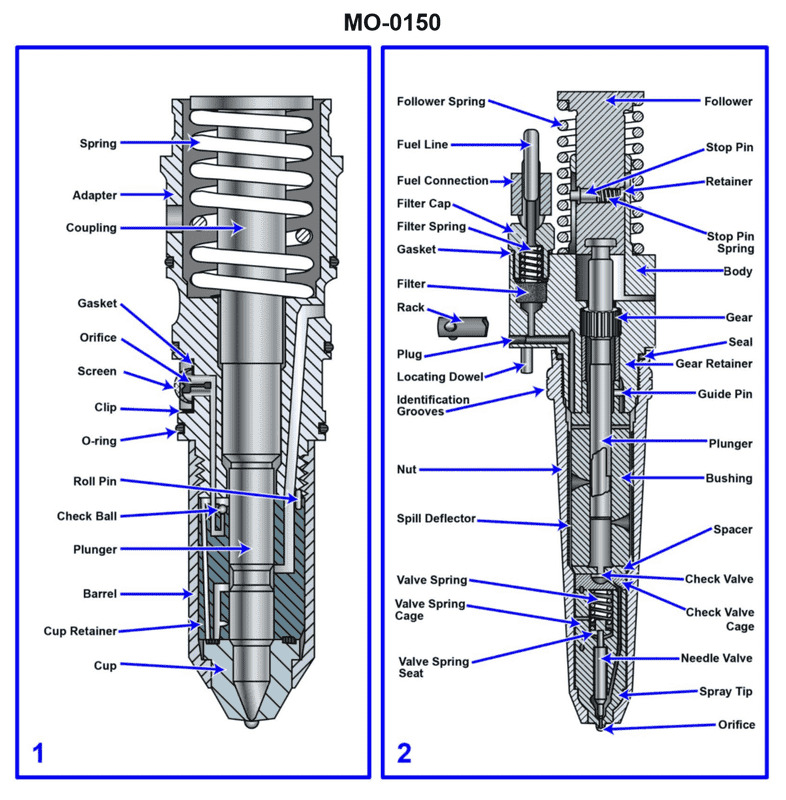
The Correct Answer is D **Explanation for Option D (Correct Answer):** 1. **Closed Type Injector:** Fuel injectors used in modern high-speed or medium-speed diesel engines (like those typically found on an offshore supply vessel) are almost universally of the **closed type**. A closed-type injector features a spring-loaded needle valve (or check valve) located immediately behind the nozzle tip. This valve remains closed until the fuel pressure supplied by the injection pump (or unit injector) reaches a predetermined opening pressure. This design ensures highly precise timing and atomization, prevents combustion gasses from backing up into the fuel line (blowback), and avoids dribbling of fuel into the cylinder. 2. **Port and Helix Metering:** The term "port and helix metering" describes the mechanism used by the high-pressure fuel pump (which is connected to, or integrated with, this type of injector) to regulate the quantity of fuel delivered per stroke. This mechanism, common in jerk-pump systems (like Bosch-type pumps or inline pumps), uses a plunger with a specially shaped inclined groove (the helix or scroll). As the pump rack is moved, the plunger is rotated, changing the point at which the helix uncovers the spill port, thus controlling the effective pumping stroke and, consequently, the volume of fuel injected. This is a characteristic feature associated with mechanical injection systems supplying closed-type nozzles. Therefore, the injector shown, which represents a standard, mechanically operated high-pressure diesel injector, is a closed type injector served by a pumping system that uses port and helix metering. **Explanation of Why Other Options Are Incorrect:** * **A) The injector is of the open type and features pressure-time metering.** * **Incorrect (Open Type):** Open-type injectors are obsolete. They lack a needle valve, meaning fuel pressure is maintained primarily by the pump and the line, leading to poor atomization and risk of dribbling. * **Incorrect (Pressure-Time Metering):** Pressure-time metering is characteristic of modern common rail or some hydraulically actuated electronic unit injectors (like certain types of EUI/HEUI systems), not the standard mechanical jerk-pump system implied by the port and helix mechanism. * **B) The injector is of the closed type and features pressure-time metering.** * **Incorrect (Pressure-Time Metering):** While the injector is correctly identified as closed type, the metering method described ("pressure-time") does not match the mechanical metering system (port and helix) typically associated with this configuration of pump/injector technology. * **C) The injector is of the open type and features port and helix metering.** * **Incorrect (Open Type):** Injectors served by precision high-pressure pumps utilizing port and helix metering must be of the closed type to handle the high pressures and ensure proper cutoff and atomization. Open injectors cannot function effectively with modern metering methods.
Pass Your Coast Guard Licensing Exams!
Study offline, track your progress, and simulate real exams with the Coast Guard Exams app