Question 57 OSE01 - Chief Engineer - OSV
The main diesel propulsion engines on your offshore supply vessel are protected with a mechanical overspeed trip mechanism similar to that shown in the illustration. Upon testing the trip setting, you discover that it is necessary to make an adjustment. Assuming that several adjustments may be necessary before the final setting is accurately achieved, what statement concerning adjustment is true? Illustration MO-0101
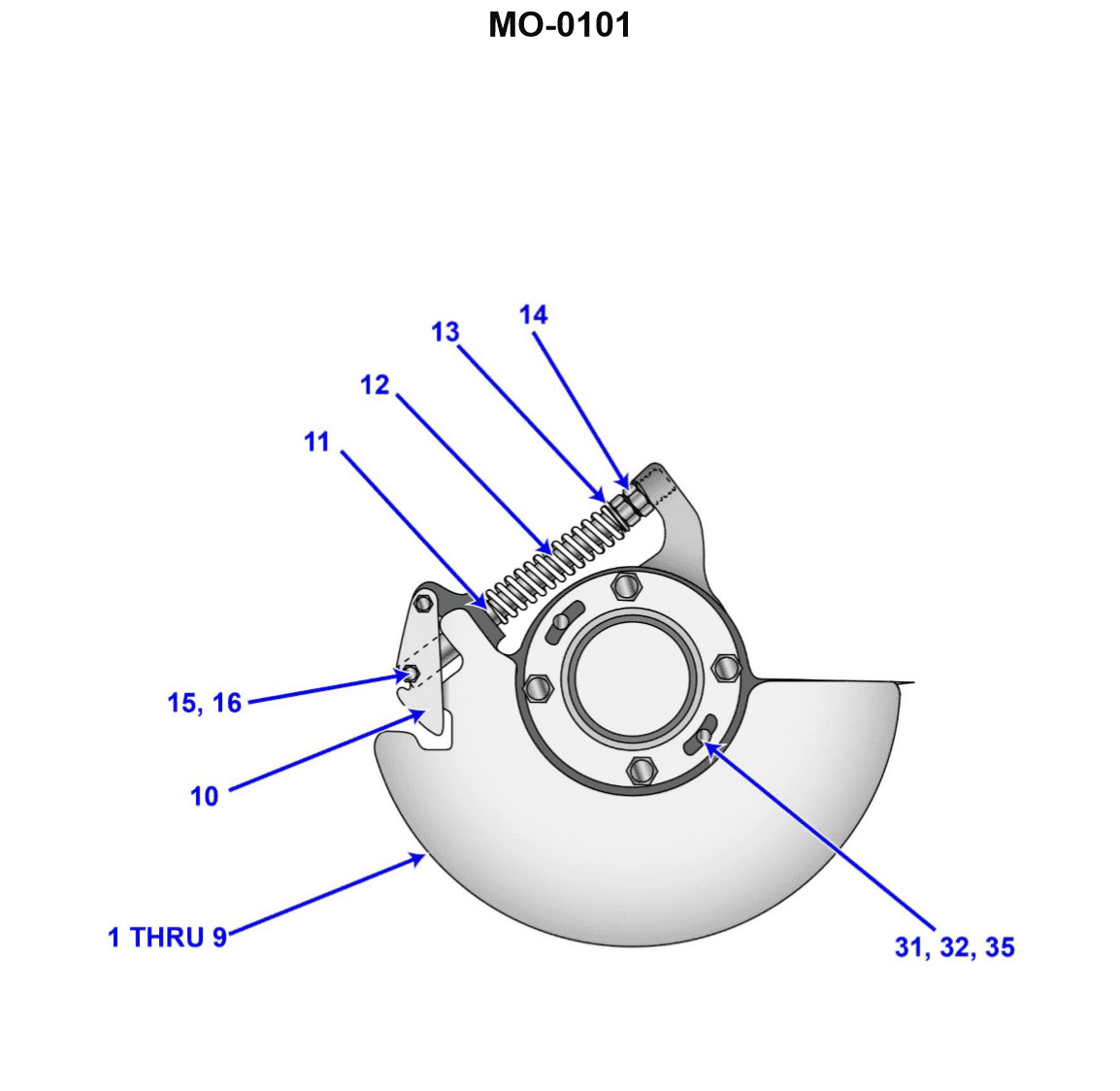
The Correct Answer is A. **Explanation of why Option A is correct:** 1. **Engine Must Be Stopped:** Mechanical overspeed trip mechanisms (like those using flyweights, springs, and levers) are sensitive components usually housed in a casing connected to the engine's camshaft or crankshaft drive. Making any physical adjustment (turning screws or moving linkages) while the engine is running is extremely dangerous, difficult to do accurately, and risks damaging the delicate mechanism or causing an unintended engine shutdown at an unpredictable moment. Standard procedure for adjusting internal governor or trip mechanisms requires the engine to be secured (stopped, turned off, and locked out if possible). 2. **Locknut Must Be Retightened After Each Adjustment:** After making an adjustment to the setting screw or bolt that changes the spring tension or lever position (which dictates the trip speed), the associated locknut *must* be immediately retightened. This is critical because the mechanism is about to be tested (by restarting the engine and raising the speed). If the locknut is left loose, engine vibration and rotational forces will cause the adjustment screw to move, making the setting inaccurate or causing the mechanism to fail or trip prematurely during the test run. Since the question states that "several adjustments may be necessary," the engine must be stopped, an adjustment made and locked, the engine restarted and tested, and then, if further adjustment is needed, the engine must be stopped again, the locknut loosened, the adjustment made and relocked, and the engine restarted for the next test. **Why the other options are incorrect:** * **B) To adjust the overspeed trip, the engine must be running AND the locknut must be retightened only after the final adjustment.** This is incorrect because adjusting internal mechanical mechanisms while the engine is running is hazardous and imprecise. Furthermore, failing to retighten the locknut after each adjustment risks severe misalignment or component movement during the high-speed testing phase. * **C) To adjust the overspeed trip, the engine must be stopped AND the locknut must be retightened only after the final adjustment.** While the first part (engine must be stopped) is correct, the second part (retightening the locknut only after the final adjustment) is incorrect. The locknut must be secured after *every* adjustment made while the engine is stopped, just before the engine is restarted for the next test run. * **D) To adjust the overspeed trip, the engine must be running AND the locknut must be retightened after each adjustment.** This is incorrect because the adjustment procedure requires the engine to be stopped for safety and accuracy.
Pass Your Coast Guard Licensing Exams!
Study offline, track your progress, and simulate real exams with the Coast Guard Exams app