Question 1 OSE01 - Chief Engineer - OSV
You are assigned to an OSV fitted with main propulsion diesel engines operating on the cycle represented in the polar timing diagram shown in the illustration. When do the exhaust valves open and close respectively? Illustration MO-0084
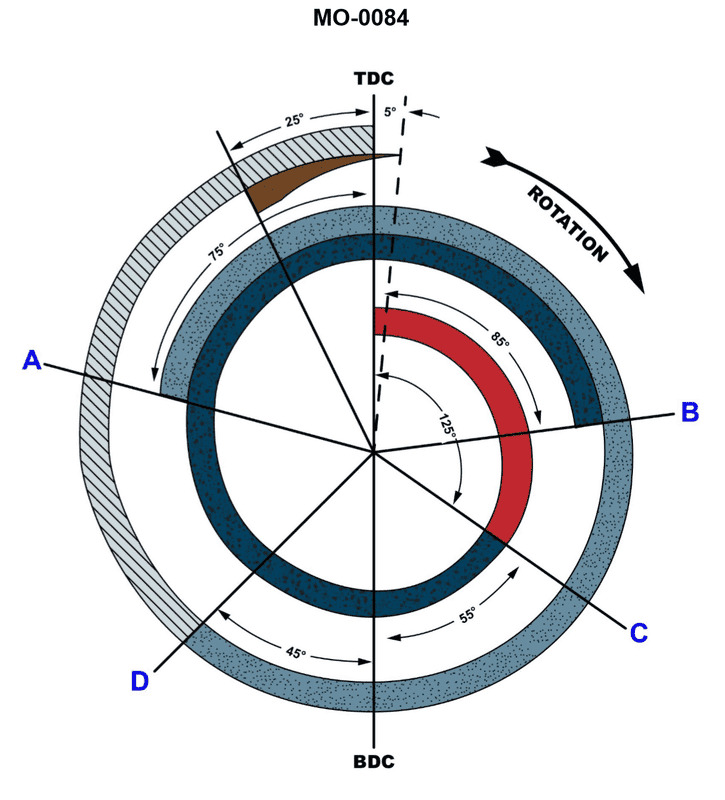
The Correct Answer is A ### 2. Why Option A is Correct Option A describes the characteristic advanced opening and retarded closing required for efficient operation in a modern four-stroke diesel engine. The timing events are: * **Exhaust Valves Open:** **$55^{\circ}$ before bottom dead center (BDC) on the power stroke.** * This is known as advanced opening (or blowdown). The exhaust valve is opened early (before the piston reaches BDC) while the cylinder pressure is still high enough to rapidly expel the spent gases. This ensures that cylinder pressure drops significantly before the exhaust stroke begins, reducing the work required by the piston to push the gases out. * **Exhaust Valves Close:** **$85^{\circ}$ after top dead center (TDC) on the intake stroke.** * This is known as retarded closing. The valve remains open well into the beginning of the intake stroke. This late closing (along with advanced intake valve opening) creates a period of overlap around TDC. For high-speed or supercharged engines, this long overlap period (85° in this case is aggressive/long) is critical for effective scavenging—the incoming fresh air helps to push the remaining exhaust gases out, maximizing volumetric efficiency and cooling the cylinder head. The values ($55^{\circ}$ advanced opening and $85^{\circ}$ retarded closing) correspond precisely to the specific timings often shown in the standard polar timing diagram (MO-0084) for such engines. ### 3. Why Other Options Are Incorrect **B) The exhaust valves open at bottom dead center at the beginning of the exhaust stroke. The exhaust valves close at top dead center at the end of the exhaust stroke.** * **Incorrect:** This describes the theoretical, ideal timing (often shown in simple thermodynamics diagrams), but not the actual timing of a functioning engine. Actual engines require advanced opening (before BDC) and retarded closing (after TDC) to ensure full scavenging and maximum power output. **C) The exhaust valves open at top dead center at the end of the exhaust stroke. The exhaust valves close at bottom dead center at the beginning of the exhaust stroke.** * **Incorrect:** This reverses the timing and sequence. The exhaust valves must open near BDC (end of power stroke) and close near TDC (end of exhaust stroke/start of intake stroke). **D) The exhaust valves open at $85^{\circ}$ after top dead center on the intake stroke. The exhaust valves close at $55^{\circ}$ before bottom dead center on the power stroke.** * **Incorrect:** This swaps the opening and closing events. $85^{\circ}$ ATDC is the closing point (overlap), not the opening point. $55^{\circ}$ BTDC is the opening point (blowdown), not the closing point.
Pass Your Coast Guard Licensing Exams!
Study offline, track your progress, and simulate real exams with the Coast Guard Exams app