Question 2 OSE01 - Chief Engineer - OSV
You are assigned to an OSV fitted with main propulsion diesel engines operating on the cycle represented in the polar timing diagram shown in the illustration. In consideration of the direction of rotation, what combustion cycle event occurs from point "A" to point "D"? Illustration MO-0084
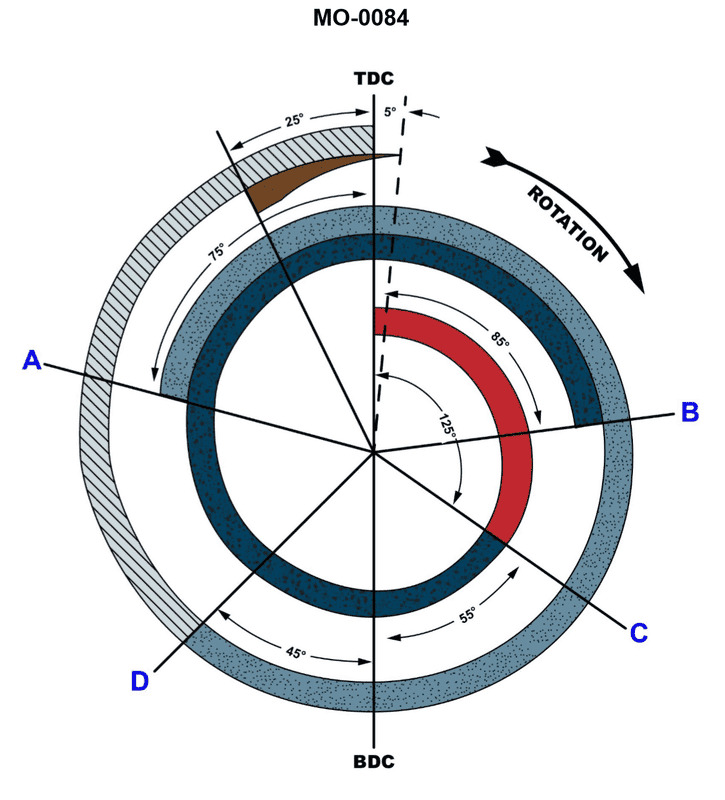
The Correct Answer is A **Explanation for Option A (Intake) being correct:** The illustration (MO-0084, which typically represents a polar timing diagram for a four-stroke or two-stroke diesel engine) shows the crank angle degrees relative to the engine cycle. Assuming the diagram represents a typical four-stroke cycle and the engine is rotating clockwise (as is standard for viewing such diagrams unless otherwise indicated, and given the progression from A to D), we can analyze the phases: 1. **Intake Phase (A to D):** The intake valves open before Top Dead Center (BTDC) or near it and remain open well past Bottom Dead Center (ABDC). In a standard four-stroke cycle, the intake stroke occurs as the piston moves down from TDC to BDC, covering approximately $180^\circ$ of crank rotation. If point "A" marks the opening of the intake valve (or the start of the piston's downward travel after TDC/near the beginning of the stroke) and point "D" marks the closing of the intake valve (or the end of the piston's downward travel at BDC/near the end of the stroke), the segment from A to D represents the downward movement of the piston drawing fresh air into the cylinder. This is the Intake stroke. **Explanation of why other options are incorrect:** * **B) Power:** The Power (or Expansion) stroke occurs immediately after injection and ignition (near TDC) and pushes the piston down toward BDC. This stroke is characterized by both the intake and exhaust valves being closed. The segment A to D, which spans a large angle of the diagram, represents a period where gas exchange is actively taking place (if A is valve opening and D is valve closing), making it inconsistent with the closed-valve Power stroke. * **C) Compression:** The Compression stroke occurs as the piston moves upward from BDC to TDC, compressing the air charge. During this $180^\circ$ period, both valves are closed. Since the segment A to D represents a period of downward piston movement or gas exchange (Intake or Exhaust), it cannot be the upward movement associated with Compression. * **D) Exhaust:** The Exhaust stroke occurs as the piston moves upward from BDC to TDC, pushing burned gases out of the cylinder. This stroke usually starts before BDC and ends after TDC. If A to D represented the Exhaust stroke, the engine would be moving upward, pushing gas out, which conflicts with the typical downward movement associated with the segment A to D (Intake) on most standard polar timing diagrams.
Pass Your Coast Guard Licensing Exams!
Study offline, track your progress, and simulate real exams with the Coast Guard Exams app