Question 35 MODE02 - Assistant MODU Engineer
The vessel to which you are assigned is fitted with a totally pneumatic propulsion control system as shown in the illustration. If propulsion control functions perfectly from the engine room control station, but will not function at all from any of the remote stations, which of the following system faults best accounts for these symptoms? Illustration MO-0168
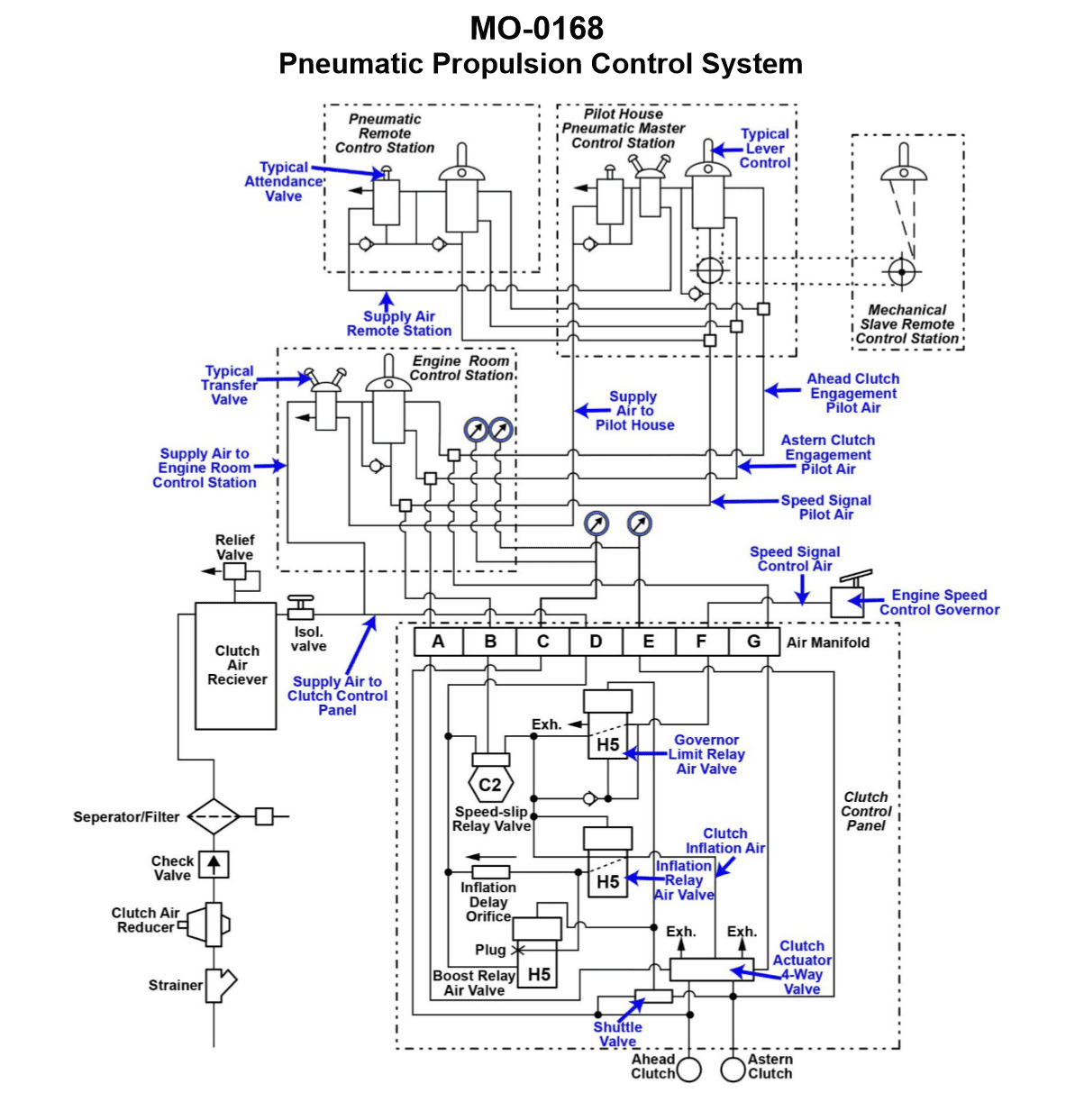
The Correct Answer is C **Why option C is correct:** The system is described as having a totally pneumatic propulsion control system. The key symptoms are: 1. Propulsion control functions **perfectly** from the Engine Room (ER) control station (Local Control). 2. Propulsion control **will not function at all** from any of the Remote stations (e.g., Bridge/Pilot House). Pneumatic control systems typically use a "Local/Remote" transfer valve in the engine room (the primary location) to switch control authority. For the remote stations to function, the ER station must be set to "Remote." When set to "Remote," the valve must allow the control signal (air pressure) originating from the remote station (Bridge) to pass through the ER station and onward to the main engine governor/actuator. If the **remote port** on the local/remote transfer valve in the ER is blocked (Option C), the following happens: * If the valve is set to "Local," the ER station can still operate the engine perfectly, confirming that the local side (engine room components) is functional. (Matches symptom 1). * If the valve is set to "Remote," the signal air coming from the Bridge/Remote station cannot pass through the blocked port in the ER valve to reach the engine. Therefore, no remote control is possible. (Matches symptom 2). This single fault perfectly isolates the remote control pathway at the critical transfer point (the ER station) while leaving the local control pathway fully operational. **Why the other options are incorrect:** * **A) The local/remote transfer valve at the engine room control station has a blocked local port.** If the local port were blocked, the engine could not be controlled from the Engine Room, even if the valve were set to "Local." Since the prompt states control functions perfectly from the ER, this is incorrect. * **B) The attendance valve at the pneumatic remote-control station has a blocked outlet port.** The "attendance valve" (or similar safety switch) is typically a component located at one specific remote station (e.g., the bridge). If only this single station's valve were blocked, control would fail only from that specific station, but other remote stations (if they exist, such as an emergency remote station) might still function. More importantly, this does not account for the total failure of *all* remote stations while Local control remains perfect, which points to a common failure point like the main ER transfer valve. * **D) The pilot house/remote transfer valve at the pilot house has a blocked remote port.** A transfer valve in the Pilot House/Bridge typically allows the operator to switch control between the Pilot House console and another designated secondary remote location (if fitted). If the remote port on the Pilot House valve were blocked, it would only prevent control from the secondary remote station being utilized via the Pilot House, but it would not prevent the Pilot House itself (the primary remote station) from sending a signal, nor would it affect other potential remote stations. Furthermore, this localized fault would not prevent the ER station from receiving the signal if it were functioning correctly, nor would it explain why the signal fails to reach the engine, as the ultimate common failure point for all remote signals is the ER transfer valve.
Pass Your Coast Guard Licensing Exams!
Study offline, track your progress, and simulate real exams with the Coast Guard Exams app