Question 35 DDE04 - Designated Duty Engineer - 1000-4000 HP
You are assigned to a tractor tug with a drive system as shown in figure "A" of the illustration. What type of propulsion drive system is illustrated? Illustration MO-0140
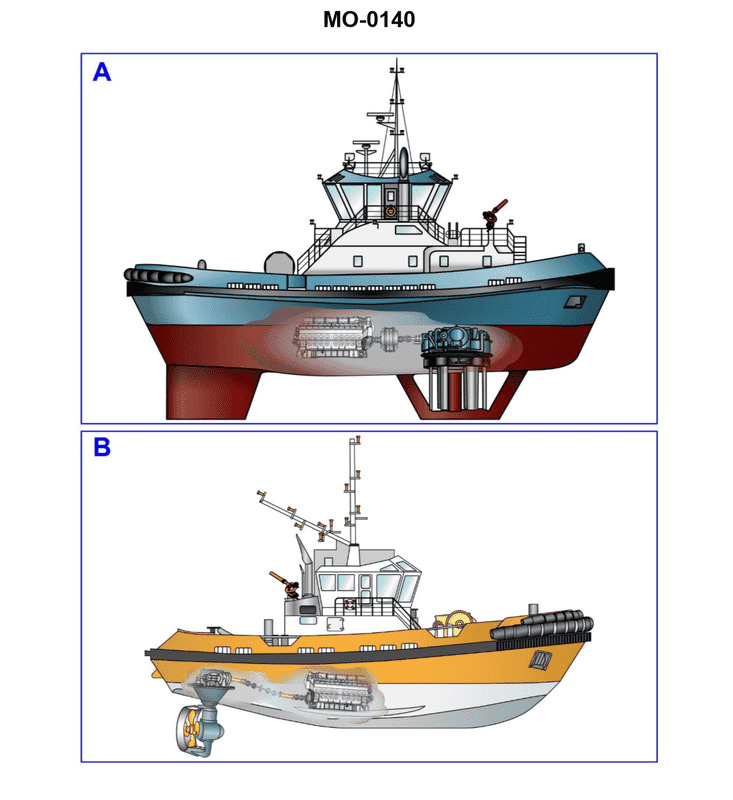
The Correct Answer is D **Explanation for D (Cycloidal propeller drive):** Figure "A" of illustration MO-0140 (which depicts a common type of modern tractor tug propulsion) shows a propulsion system where several vertically oriented, blade-like vanes are arranged in a circular pattern and mounted in a saucer-like base plate, flush with the hull bottom. These vanes rotate around a vertical axis (like a Ferris wheel turned on its side) and also oscillate or pitch simultaneously around their own vertical axis. This mechanism allows the direction and magnitude of the thrust to be changed almost instantaneously, providing exceptional maneuverability (360-degree thrust without a rudder). This specific arrangement and operating principle define the **Cycloidal propeller drive**, commonly associated with Voith Schneider Propellers (VSP). **Why the other options are incorrect:** * **A) Azimuthing propeller drive (z-drive):** An Azimuthing drive (like an ASD or Z-drive/L-drive) uses a standard fixed-pitch or CP propeller housed in a nozzle or open propeller and mounted beneath the hull on a vertical strut. The entire pod/strut assembly rotates 360 degrees around the vertical axis to direct thrust. It does not use the vertically oriented, pitching blades characteristic of the cycloidal drive shown in the figure. * **B) Controllable pitch propeller drive:** A Controllable Pitch Propeller (CPP) uses blades that are able to rotate around their own hub axis to change the pitch, allowing the propeller to maintain a constant direction of rotation while altering thrust (forward, neutral, or astern). While a CPP *can* be used in an Azimuthing system, the illustration shows a distinctly different cycloidal mechanism, not a typical hub-and-blade CP arrangement. * **C) Conventional fixed-propeller drive:** A conventional fixed-propeller drive uses a propeller with non-adjustable blades mounted on a shaft directed astern, requiring a rudder for steering and a reversal of shaft rotation (or use of clutches/gears) for astern thrust. This is the oldest and least maneuverable type and bears no resemblance to the unit shown in Figure A.
Pass Your Coast Guard Licensing Exams!
Study offline, track your progress, and simulate real exams with the Coast Guard Exams app