Question 39 DDE04 - Designated Duty Engineer - 1000-4000 HP
Suppose the generator set drive engines on your ship docking tug are fitted with hydraulic isochronous governors such as shown in the illustration. How is the speed set point conveyed from the generator control panel on the main switchboard conveyed to the governor fitted on the diesel engine? Illustration MO-0160
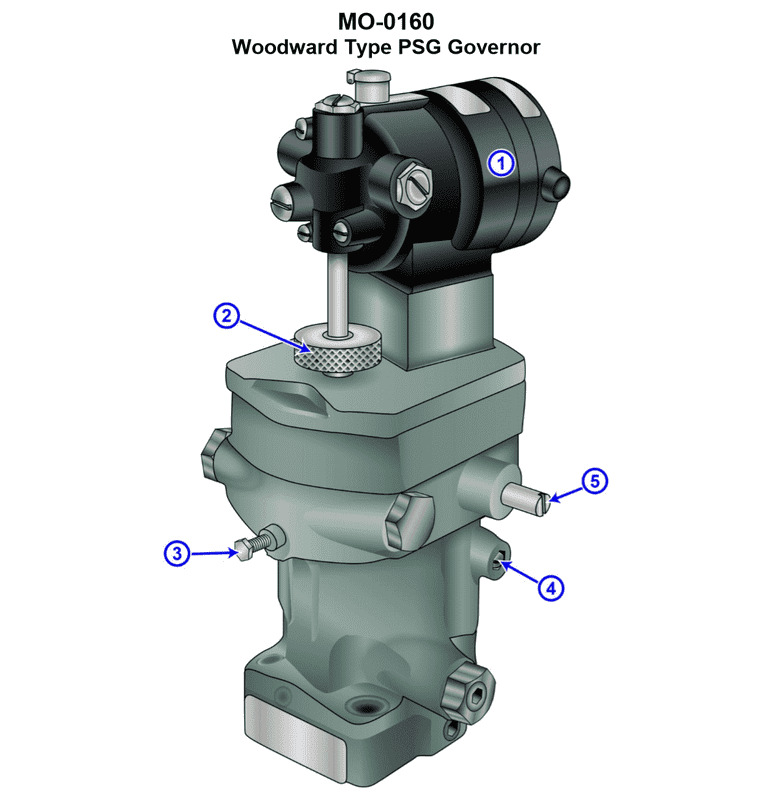
The Correct Answer is D **Explanation for Option D (Electrically via wire connections):** Hydraulic isochronous governors, especially when used in modern generator sets (gensets) on vessels like docking tugs, need a precise and rapid method for remote speed setting and synchronization. While the governor unit itself uses hydraulics to control the fuel rack, the **speed set point** (the desired RPM) is almost universally adjusted and conveyed electrically. The generator control panel (GCP) or main switchboard will have controls (e.g., potentiometers, push buttons) that generate a variable electrical signal (often 4-20mA or 0-5V DC). This signal is transmitted via simple wiring connections to an **electric actuator** or a **speed setting motor** mounted on the governor head. This actuator physically adjusts the pilot valve or speeder spring tension inside the governor to change the engine's target speed. This method is highly reliable, noise-resistant, and easily integrated with electronic speed controls and automatic synchronization equipment commonly found on ship switchboards. **Why the Other Options are Incorrect:** * **A) Pneumatically via tubing connections:** While pneumatic systems are used in marine environments (e.g., control air for clutches, large slow-speed main engine controls), they are generally too slow, bulky, and lack the precision required for fine-tuning the speed set point of modern, parallel-operating generator sets. * **B) Hydraulically via tubing connections:** Hydraulic lines are used *within* the governor to manage the power piston and fuel rack, but using external hydraulic pressure from the control panel to set the speed would be complex, messy, and impractical due to distance and the need for high-precision pressure regulation. * **C) Mechanically via cable connections:** Mechanical linkages (cables or pushrods) are cumbersome, suffer from excessive friction and slack (hysteresis) over distances, and are virtually impossible to integrate with sophisticated electronic controls (like auto-synchronizers) found on the main switchboard. Electrical signals provide a far cleaner and more precise interface.
Pass Your Coast Guard Licensing Exams!
Study offline, track your progress, and simulate real exams with the Coast Guard Exams app