Question 57 DDE01 - Designated Duty Engineer - Unlimited HP
The tractor tug to which you are assigned has main engines fitted with intake and exhaust systems as shown in the illustration. What statement best describes the configuration of the multiple turbochargers? Illustration MO-0177
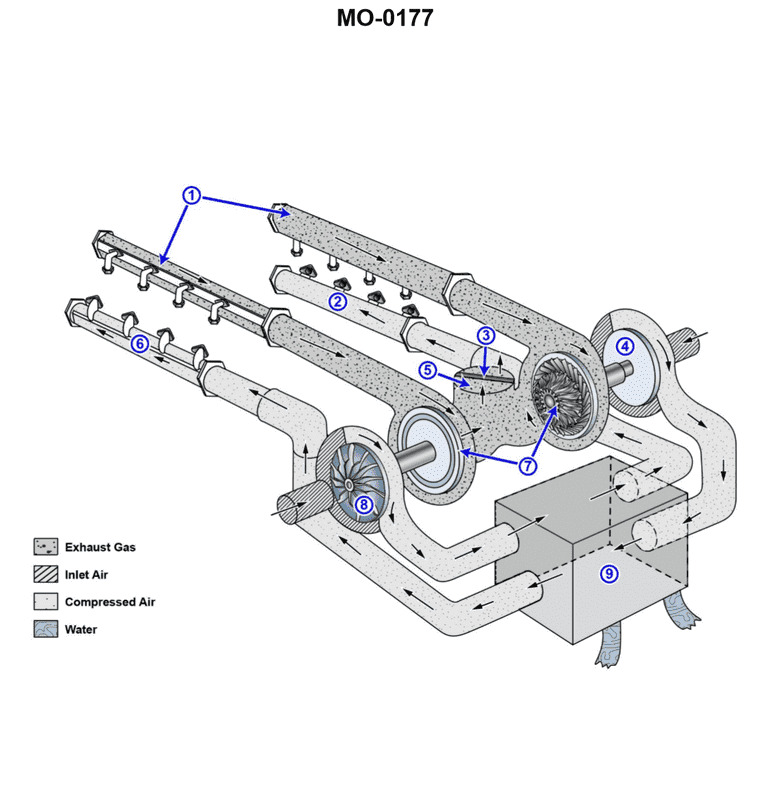
The Correct Answer is A **Explanation for Option A (Correct):** Option A is the most accurate description for a typical marine diesel engine configuration, especially one assigned to a tractor tug which likely uses a medium-speed or large high-speed diesel engine. Most modern medium-to-large marine diesel engines, particularly V-type engines (which typically have two cylinder banks), utilize a dedicated turbocharger for each bank. This configuration allows for: 1. **Optimized Exhaust Gas Flow:** By keeping the exhaust manifold runs shorter and separate, this setup maintains higher exhaust gas energy and minimizes pressure pulsations between cylinders in different banks. 2. **Reduced Exhaust Back Pressure:** Using two moderately sized turbochargers (one per bank) allows the exhaust system to handle the large volume of gas efficiently, inherently reducing back pressure compared to trying to channel all exhaust through a single large unit, or using an overly complex system. 3. **Simplicity and Efficiency:** This design is common because it balances high-performance turbocharging with structural simplicity and effective scavenging, resulting in high Mean Effective Pressure (MEP) and improved fuel efficiency. **Explanation for Incorrect Options:** **B) Four (4) turbochargers are used and configured in series for a four-staging effect to boost charge air pressure.** This is incorrect. While multi-staging (using turbochargers in series) exists, four stages (four turbochargers in series) is excessively complex and virtually unheard of in standard marine propulsion applications. Multi-staging is typically limited to two stages (e.g., HP and LP turbochargers in series) for highly specialized, extremely high boost applications. **C) Two (2) turbochargers are used and configured in series for a two-staging effect to boost charge air pressure.** This is incorrect as the primary configuration for two turbochargers on a V-engine is **parallel** (one for each bank), not series. While two-staging (series configuration) is used in some specialized marine engines, it requires specific engine design (e.g., highly optimized Miller timing) and is not the standard or most common setup for the general description provided. **D) Four (4) turbochargers are used, two for each cylinder bank, to reduce exhaust back pressure.** This is incorrect. While some very large or specialized engines may use multiple smaller turbochargers per bank (often called twin-turbo in parallel on each bank, resulting in four total), the most common and standard configuration for a V-engine in a tugboat is simply one turbocharger per bank (two total), as described in Option A. Using four separate turbochargers introduces significant complexity and cost without substantial efficiency gains over a two-turbo parallel setup on an engine of this likely size.
Pass Your Coast Guard Licensing Exams!
Study offline, track your progress, and simulate real exams with the Coast Guard Exams app