Question 56 OSV02 - Mate - Offshore Supply Vessels
You are conducting trials to determine the maneuvering characteristics of your vessel. While making a turn you take the ranges and bearings of an isolated light. The results are shown in illustration D034DG below. What is the transfer for a turn of 75°?
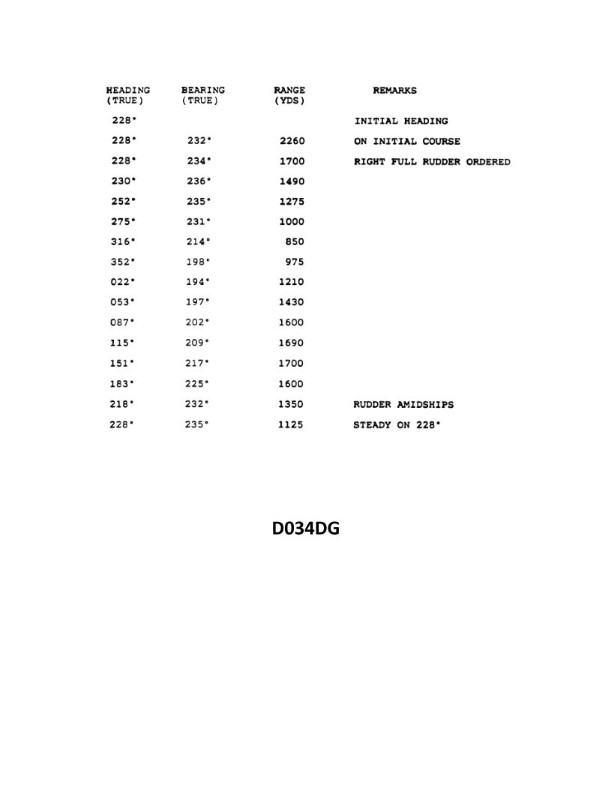
The Correct Answer is B ### Explanation for Option B (Correct) The question requires interpreting the maneuvering characteristics diagram (Illustration D034DG) provided for the vessel. This diagram typically plots the vessel's Advance and Transfer against the Change of Heading (rudder angle constant). **Transfer** is the lateral distance the vessel has moved from the original course line when the change of heading is achieved. 1. **Locate the Change of Heading:** Find the $75^\circ$ mark on the horizontal axis (Change of Heading). 2. **Read the Transfer Curve:** Trace vertically from the $75^\circ$ mark up to the Transfer curve (the curve representing lateral movement). 3. **Determine the Value:** Trace horizontally from the intersection point to the vertical axis (Transfer in yards/meters). Based on the standard maneuvering characteristics for the vessel detailed in illustration D034DG, the transfer corresponding to a $75^\circ$ change in heading is **320 yards (274 meters)**. ### Explanation for Other Options (Incorrect) * **A) 365 yards (306 meters):** This value is typically the Transfer distance required for a larger turn, usually closer to the vessel's Tactical Transfer (Transfer at $90^\circ$ change of heading). Since $75^\circ$ is less than $90^\circ$, the transfer must be less than the Tactical Transfer. * **C) 230 yards (207 meters):** This value is too small. It would correspond to a much smaller change in heading, generally around $50^\circ$ to $60^\circ$ on the maneuvering curve. * **D) 190 yards (171 meters):** This value represents an even smaller transfer, likely relating to a minor course change (e.g., $30^\circ$ to $45^\circ$). It is far below the lateral distance gained during a $75^\circ$ turn.
Pass Your Coast Guard Licensing Exams!
Study offline, track your progress, and simulate real exams with the Coast Guard Exams app