Question 20 OSV02 - Mate - Offshore Supply Vessels
BOTH INTERNATIONAL & INLAND You are on Vessel "A" engaged in fishing in a narrow channel as shown in illustration D037RR below. Vessel "B" is a tanker proceeding in the channel. Vessel "B" sounds five short and rapid blasts. What action should you take?
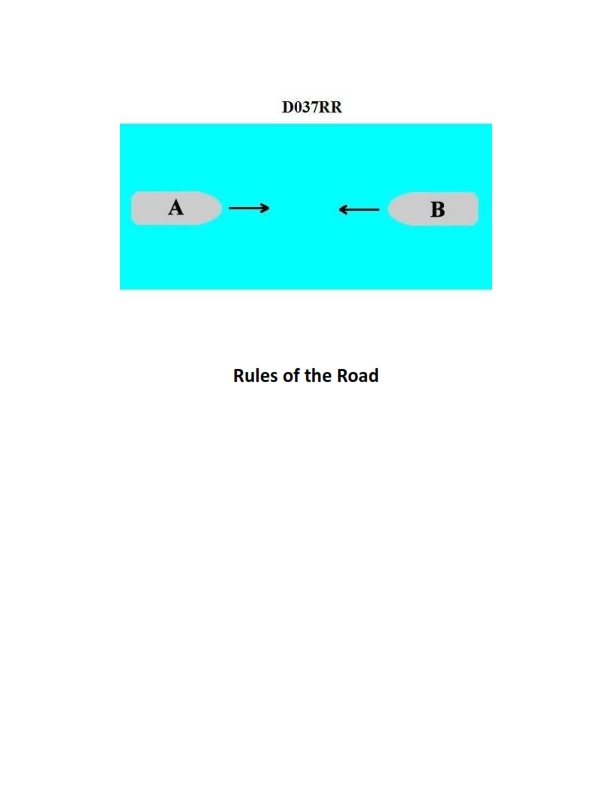
The Correct Answer is D **Explanation for D (not impede the passage of vessel "B"):** Vessel "A" is engaged in fishing, making it a "vessel engaged in fishing" under the COLREGs (Rules 3(g) and 18(b)). Vessel "B" is a tanker, which, due to its size and draft, is likely a "vessel constrained by her draft" (Rule 3(h)), especially when proceeding in a narrow channel. However, regardless of whether Vessel "B" is constrained by draft, Rule 9 (Narrow Channels) dictates the responsibilities in this scenario. Rule 9(b) states that a vessel of less than 20 meters in length or a **sailing vessel** shall not impede the passage of a vessel which can safely navigate only within a narrow channel or fairway. More importantly, Rule 18 (Responsibilities between vessels) states that a vessel engaged in fishing shall not impede the passage of any other vessel navigating in a narrow channel or fairway. Vessel "B" sounding five short and rapid blasts is the danger or doubt signal (Rule 34(d)), indicating that Vessel "B" doubts Vessel "A's" intentions or believes a collision danger exists. Since Vessel "A" (fishing vessel) has the responsibility not to impede the passage of Vessel "B" (tanker/vessel proceeding in a narrow channel), the appropriate action for Vessel "A" upon hearing the danger signal is to immediately take action to ensure Vessel "B"'s passage is not impeded, likely by moving clear. **Explanation of Why Other Options Are Incorrect:** * **A) maintain course and speed:** This is incorrect because Vessel "A" is the subordinate vessel (required not to impede Vessel "B") and Vessel "B" has sounded the danger signal (five blasts). Maintaining course and speed in the face of a danger signal and a required "not to impede" status is dangerous and violates the basic principles of collision avoidance. * **B) not answer the whistle signals from vessel "B":** While the five-blast signal does not typically require an immediate whistle answer, ignoring the signal's meaning—that Vessel "B" perceives danger or doubt—is unsafe. The vessel hearing the danger signal must take immediate action to resolve the dangerous situation, which, in this case, means taking action to not impede Vessel "B"'s passage. * **C) sound one prolonged followed by two short blasts:** This signal (Rule 34(c)) is the required signal for a vessel **engaged in fishing** when making a move to starboard to pass another vessel. This is not the correct response to a danger signal (five blasts) indicating that the fishing vessel is currently in the way. Vessel "A"'s immediate requirement is to clear the channel, not initiate a passing maneuver using this specific whistle signal.
Pass Your Coast Guard Licensing Exams!
Study offline, track your progress, and simulate real exams with the Coast Guard Exams app