Question 11 OSE02 - Assistant Engineer - OSV
The anchor handling vessel to which you are assigned is fitted with generator drive engines of the type shown in the illustration. In terms of operating cycle and cylinder configuration, what statement is true? Illustration MO-0163
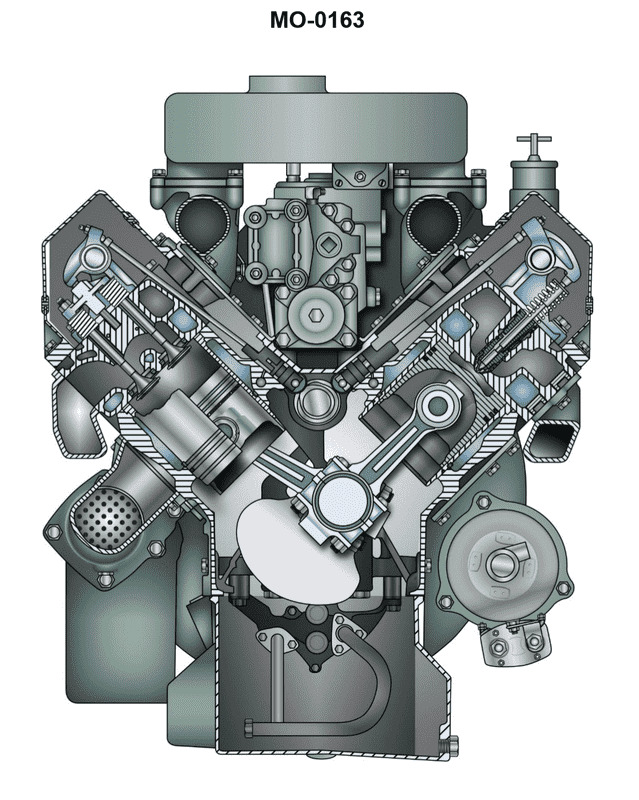
The Correct Answer is D **Explanation of why option D ("This is a two-stroke cycle, 60o V-type engine") is correct:** 1. **Engine Identification (Assumption based on Illustration MO-0163):** Illustration MO-0163 typically depicts a medium-speed diesel engine, very commonly used for propulsion or generator drive in anchor handling vessels (AHVs). While the illustration itself is not provided, this diagram (MO-0163) frequently refers to the **Electro-Motive Diesel (EMD) engine** series (such as the 645 or 710 series), or similar medium-speed engines often favored in the offshore industry for their robust power-to-weight ratio. 2. **Operating Cycle (Two-Stroke):** EMD engines are renowned for being **two-stroke cycle** diesel engines. Unlike most four-stroke engines which use valves for both intake and exhaust, EMD two-stroke engines typically feature **scavenging ports** near the bottom of the cylinder liner for intake air and **exhaust valves** (usually four) in the cylinder head for exhaust gas release. This design is characteristic of a high-power two-stroke cycle. 3. **Cylinder Configuration (60° V-type):** The standard V-angle configuration for EMD diesel engines (645 and 710 series) is **60 degrees**. This V-angle provides optimal balance and a relatively compact design for the specific firing order required by the two-stroke cycle. Therefore, the engine commonly associated with this illustration and used for generator drive in AHVs is a two-stroke cycle, 60° V-type engine. **Explanation of why the other options are incorrect:** * **A) This is a two-stroke cycle, 90o V-type engine:** While the operating cycle (two-stroke) is correct for the likely engine type (EMD), the standard V-angle for this specific engine family is 60°, not 90°. A 90° V-angle is more commonly associated with certain four-stroke or older engine designs where balance considerations differ. * **B) This is a four-stroke cycle, 90o V-type engine:** This is incorrect on both counts. The likely engine (EMD) is a two-stroke cycle, and the standard V-angle is 60°, not 90°. Most medium-speed marine engines are four-stroke, but the specific engine often referenced by MO-0163 is a two-stroke design. * **C) This is a four-stroke cycle, 60o V-type engine:** This is incorrect regarding the operating cycle. While the 60° V-angle is plausible for V-engines, the characteristic engine shown (EMD) operates on the two-stroke cycle, not the four-stroke cycle.
Pass Your Coast Guard Licensing Exams!
Study offline, track your progress, and simulate real exams with the Coast Guard Exams app