Question 44 MODU02 - Barge Supervisor
BOTH INTERNATIONAL & INLAND Two power-driven vessels are crossing as shown in illustration D042RR below. Vessel "A" sounds three short blasts on the whistle. What is the meaning of this signal?
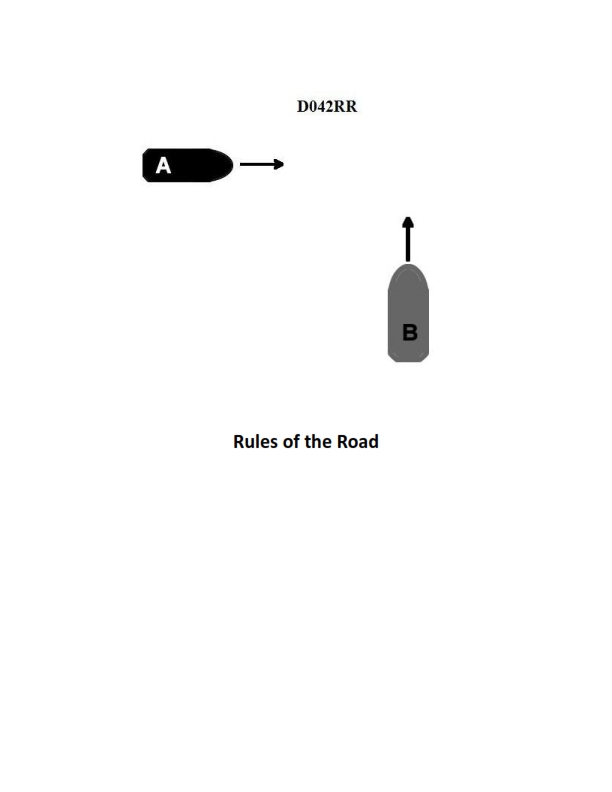
The Correct Answer is D. **Why Option D ("Vessel "A" is backing engines") is correct:** The signals described in the International Regulations for Preventing Collisions at Sea (COLREGs) and Inland Rules are standardized. Rule 34(a) governs maneuvering and warning signals. Specifically, **three short blasts** (one prolonged followed by two short is the international 'power-driven vessel leaving the berth' signal, but here we focus on the maneuvering meaning) delivered in quick succession signifies that the power-driven vessel is operating astern propulsion. In other words, the vessel is backing up or using its engines to significantly reduce forward speed or move astern. Therefore, Vessel "A" is backing engines. **Why the other options are incorrect:** * **A) Vessel "A" intends to hold course and speed:** There is no whistle signal defined in the rules solely to indicate the intention to hold course and speed. Maintaining course and speed is the responsibility of the stand-on vessel, but it is not communicated via three short blasts. * **B) Vessel "A" is sounding a signal of doubt:** A signal of doubt or disagreement (the danger signal) consists of **at least five short and rapid blasts**. Three short blasts do not convey doubt. * **C) Vessel "A" proposes to cross ahead of the other vessel:** Signals indicating intent to maneuver relative to another vessel (passing or altering course) are typically one short blast (I intend to leave you on my port side/alter course to starboard) or two short blasts (I intend to leave you on my starboard side/alter course to port). Three short blasts specifically indicates using astern propulsion, not an intent to cross ahead.
Pass Your Coast Guard Licensing Exams!
Study offline, track your progress, and simulate real exams with the Coast Guard Exams app