Question 66 MODE01 - Chief MODU Engineer
Increasing the oil pressure acting on the power piston of the hydraulic governor shown in the illustration will __________. Illustration MO-0092
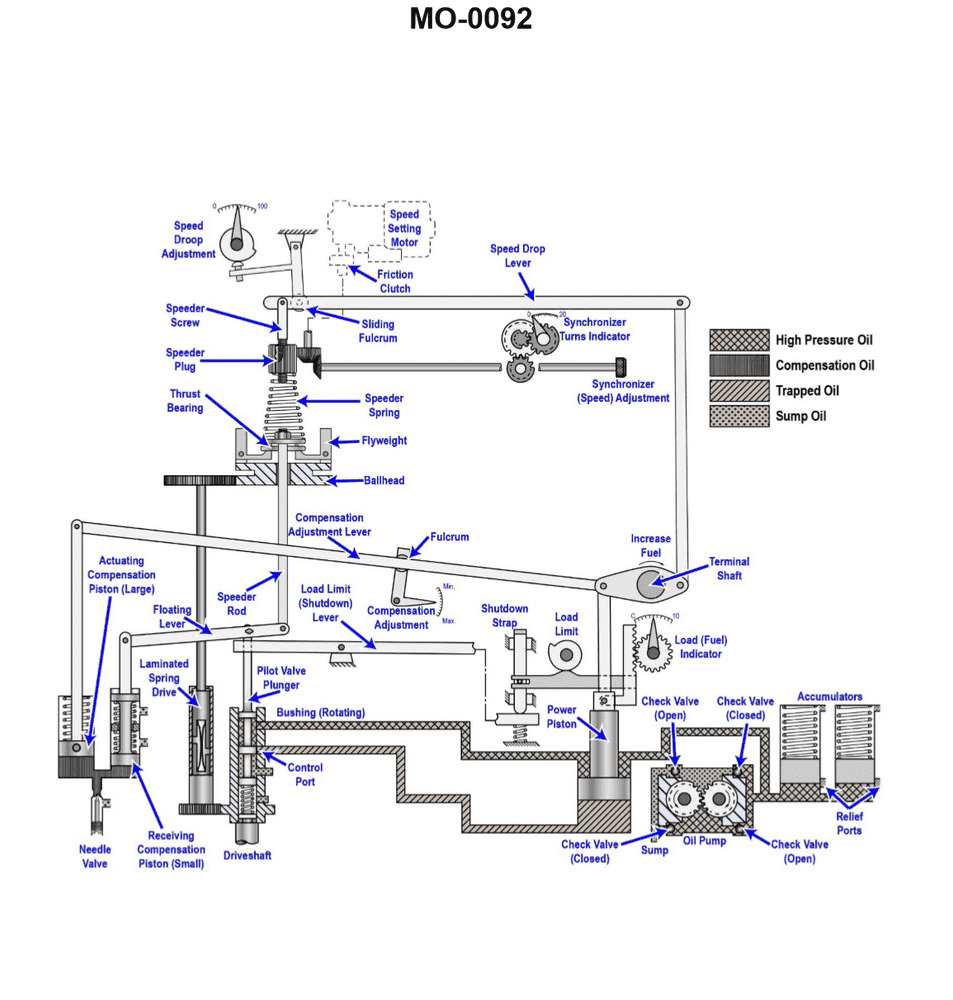
The Correct Answer is D **Explanation for Option D (increase the governor output power):** The power piston (or relay piston) in a hydraulic governor is the final actuator that moves the fuel racks, throttle linkage, or steam valve to control the prime mover's speed. The force exerted by this piston determines the governor's output power—its ability to overcome external resistance (like sticky linkages or high spring tension) to change the fuel/steam setting. The movement of the power piston is directly controlled by the differential oil pressure (the pressure acting on one side of the piston relative to the other) supplied by the pilot valve and booster pump. If the oil pressure acting on the power piston is increased (assuming this refers to increasing the maximum available supply pressure to the governor hydraulic system), it increases the maximum force the power piston can generate, thereby increasing the governor's output power. **Explanation for why other options are incorrect:** * **A) decrease the speed droop:** Speed droop is an inherent characteristic of the governor determined primarily by the mechanical linkage connecting the speeder mechanism (flyballs/ballhead) to the pilot valve and the amount of feedback provided by the compensating mechanism. Changing the hydraulic oil pressure affects the *power* available to move the control linkage, not the *relationship* between speed change and fuel adjustment (which is the definition of droop). * **B) require the overspeed trip setting to be adjusted:** The overspeed trip is a safety device separate from the normal speed-regulating hydraulic governor. Its setting is usually based on a separate mechanical or electronic sensor and is independent of the hydraulic pressure used to operate the main governor's power piston. * **C) increase the speed droop:** As explained for Option A, speed droop is a function of the mechanical feedback linkages (compensation) and the design of the speeder mechanism. Increasing hydraulic pressure only affects the force available to move the power piston, not the governor's stable operating characteristic (droop).
Pass Your Coast Guard Licensing Exams!
Study offline, track your progress, and simulate real exams with the Coast Guard Exams app