Question 65 MODE01 - Chief MODU Engineer
The governor for an emergency diesel generator is shown in the illustration. When a large change in load results in a change in engine speed, which of the parts listed will be the FIRST governor component to react to the change in load? Illustration MO-0094
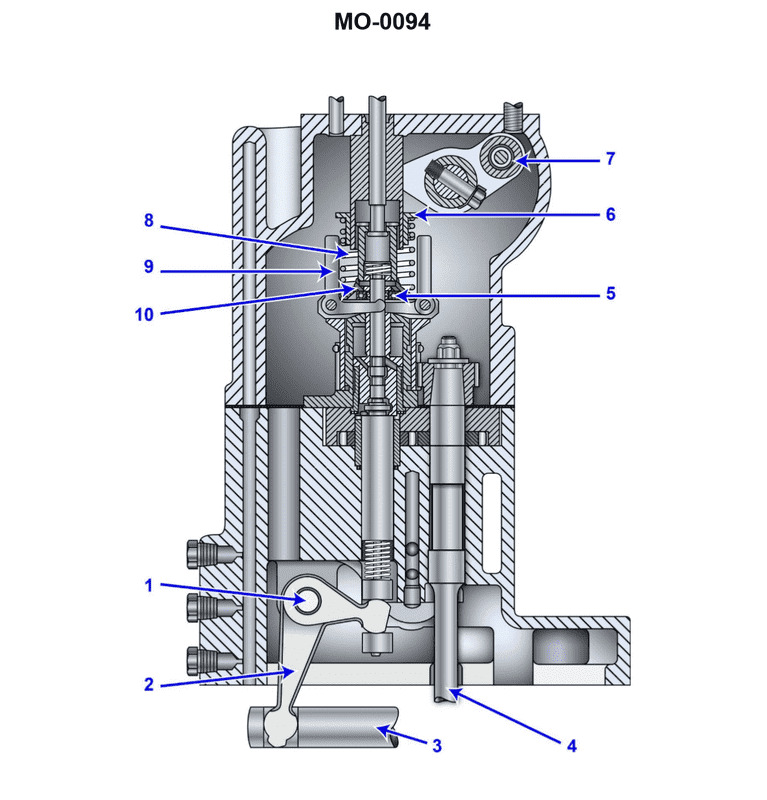
The Correct Answer is C ### Why option C ("Piece #9") is correct: Piece #9 in the typical illustration of a mechanical-hydraulic governor (like the Woodward PG or similar designs) represents the **flyweights** (or sometimes referred to as the speed sensing element). The flyweights are attached to a rotating vertical shaft driven by the engine. When the engine speed changes (due to a change in load), the centrifugal force acting on these flyweights changes almost instantaneously. If the speed increases, the flyweights move outward; if the speed decreases, they move inward. This movement is transmitted via linkages (like Piece #8) to the pilot valve (Piece #7), making the flyweights the **first component** in the governor system to physically react to the change in engine speed. ### Why the other options are incorrect: * **A) Piece #7:** Piece #7 typically represents the **pilot valve plunger**. This plunger controls the flow of pressurized oil to the power cylinder (Piece #10). It only moves *after* the flyweights (Piece #9) sense the speed change and transmit their motion through the linkages (Piece #8). Therefore, it is not the first component to react. * **B) Piece #8:** Piece #8 represents the **speeder rod, linkage, or thrust bearing**. This component acts as the intermediary mechanism, linking the movement of the flyweights (Piece #9) to the pilot valve plunger (Piece #7). While it moves simultaneously with the flyweights, the flyweights themselves are the primary speed-sensing elements generating the initial force/movement. In the sequence of causation, the flyweights react first, causing Piece #8 to move. * **D) Piece #10:** Piece #10 typically represents the **power piston (or servomotor)**, which is the output element of the hydraulic section. It physically moves the fuel rack or linkage to adjust the fuel supply. The power piston only moves *after* the pilot valve (Piece #7) directs pressurized oil to it, making it one of the last components to react in the control sequence.
Pass Your Coast Guard Licensing Exams!
Study offline, track your progress, and simulate real exams with the Coast Guard Exams app