Question 10 FCP01 - First Class Pilot
BOTH INTERNATIONAL & INLAND Vessel "A" is overtaking vessel "B" as shown in illustration D017RR below. Vessel "B" should do which of the following?
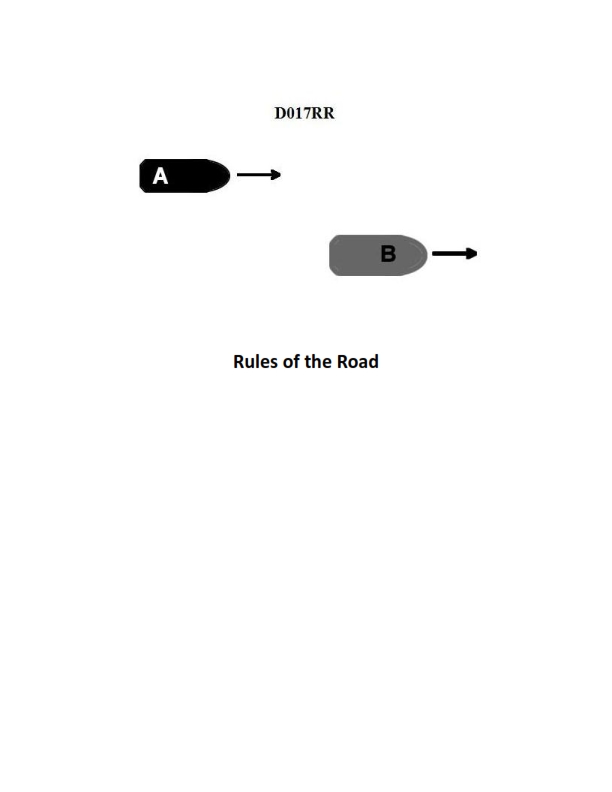
The Correct Answer is B **Why option B ("should hold her course and speed") is correct:** The scenario described (Vessel "A" overtaking Vessel "B") is governed by Rule 13 (Overtaking) and Rule 17 (Action by Stand-on Vessel) of the International Regulations for Preventing Collisions at Sea (COLREGs), which apply to both International (COLREGs) and Inland waters (US Inland Rules mirror COLREGs closely in this context). 1. **Rule 13 identifies the roles:** Vessel "A" is the Overtaking vessel (Give-way vessel), and Vessel "B" is the vessel being overtaken (Stand-on vessel). 2. **Rule 17 governs the Stand-on Vessel's action:** Rule 17(a)(i) explicitly states that where one of two vessels is required to keep out of the way, the other vessel shall **keep her course and speed**. Vessel "B" is the stand-on vessel and must maintain predictability for the give-way vessel ("A") to execute a safe passing maneuver. **Why the other options are incorrect:** * **A) should slow down until vessel "A" has passed:** This is incorrect because the stand-on vessel (B) is required to hold her speed to maintain predictability. Slowing down could complicate the overtaking maneuver for vessel A and potentially cause a collision. * **C) may steer various courses and vessel "A" must keep clear:** This is incorrect. The stand-on vessel must maintain a constant course and speed (Rule 17(a)(i)). Changing course unpredictably would violate the basic principles of collision avoidance and significantly increase the risk of collision. While vessel A must keep clear, vessel B must also adhere to her duty as the stand-on vessel. * **D) should change course to the right:** This is incorrect. Rule 17 requires the vessel being overtaken (stand-on vessel) to maintain course and speed. Changing course (left or right) is specifically prohibited unless a collision cannot be avoided by the action of the give-way vessel alone (Rule 17(b) – the "last minute" action exception), which is not indicated here.
Pass Your Coast Guard Licensing Exams!
Study offline, track your progress, and simulate real exams with the Coast Guard Exams app