Question 28 FCP01 - First Class Pilot
INLAND ONLY Vessels "A" and "B" are meeting on a river as shown in illustration D041RR below and will pass 1/4 mile apart. Which is one of the lights on vessel "B" that you will see if you are on vessel "A"?
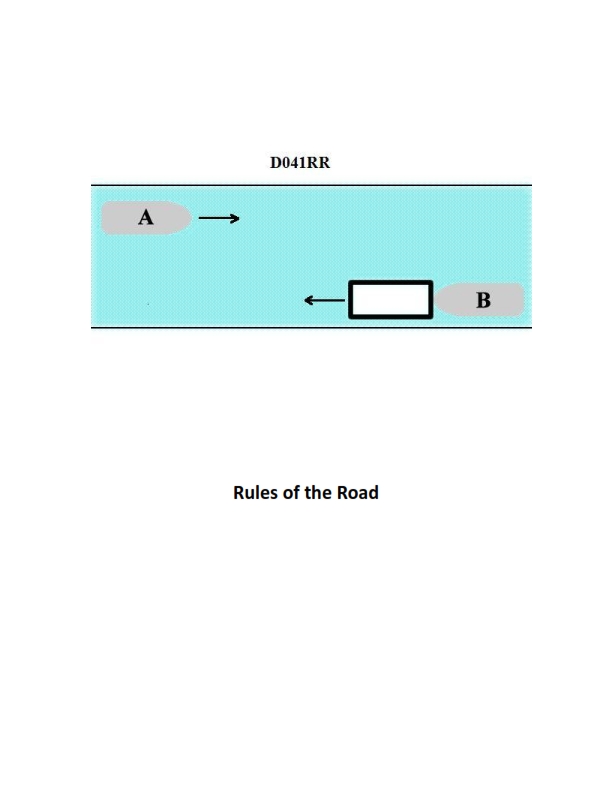
The Correct Answer is C ### Why option C ("special flashing light") is correct: Vessel "B" is shown in the illustration maneuvering to pass vessel "A" to port (left side) at 1/4 mile distance. Since the question specifies this is happening "INLAND ONLY," the relevant rules for passing and lighting on inland waters apply. The key identifier for this specific maneuver is the light used by a vessel engaged in a specific passing arrangement in a narrow channel or river. Under Inland Rules (33 CFR § 83.24(d)): A vessel engaged in meeting or overtaking and using the **"special flashing light"** signal (which flashes at a rate of 50 to 70 flashes per minute) is indicating that it is operating in a specific passing agreement (like the one shown where Vessel B is maneuvering to pass) and is restricted in its ability to deviate from the agreed course. **This light is specifically prescribed for use by the lead vessel of a tow or the vessel initiating a specific passing agreement in certain circumstances on inland waters.** Given the context of two vessels meeting on a river with a specified passing distance, the special flashing light is a mandatory light that Vessel B (the maneuvering vessel, likely the lead vessel of a tow or the one initiating the agreement) would display under Inland Rules for this situation. ### Why the other options are incorrect: * **A) yellow towing light:** A yellow towing light (which is a sternlight replacing the white sternlight) is visible from astern (135 degrees), not when meeting or passing head-on or nearly head-on as shown in the illustration. Vessel "B" would display a yellow towing light *if* it was pushing or towing alongside, but you would only see it if you were following Vessel B. When meeting head-on, you would primarily see its masthead lights and sidelights. * **B) red sidelight:** The red sidelight is positioned on the port (left) side of Vessel B and is visible from the bow to 22.5 degrees abaft the beam on that side. Since Vessel "B" is passing Vessel "A" to port (meaning Vessel B is passing on Vessel A's left side), **Vessel A would see Vessel B's green (starboard) sidelight**, not its red (port) sidelight, assuming standard visibility and proximity. If Vessel A saw the red sidelight, it would mean Vessel B was turning sharply across Vessel A's bow or that Vessel A was off to Vessel B's port side.
Pass Your Coast Guard Licensing Exams!
Study offline, track your progress, and simulate real exams with the Coast Guard Exams app