Question 7 DDE04 - Designated Duty Engineer - 1000-4000 HP
The river push boat to which you are assigned has a main propulsion engine of the type shown in the illustration. In terms of piston action, operating cycle, and piston type, what statement is true concerning this engine type? Illustration MO-0191
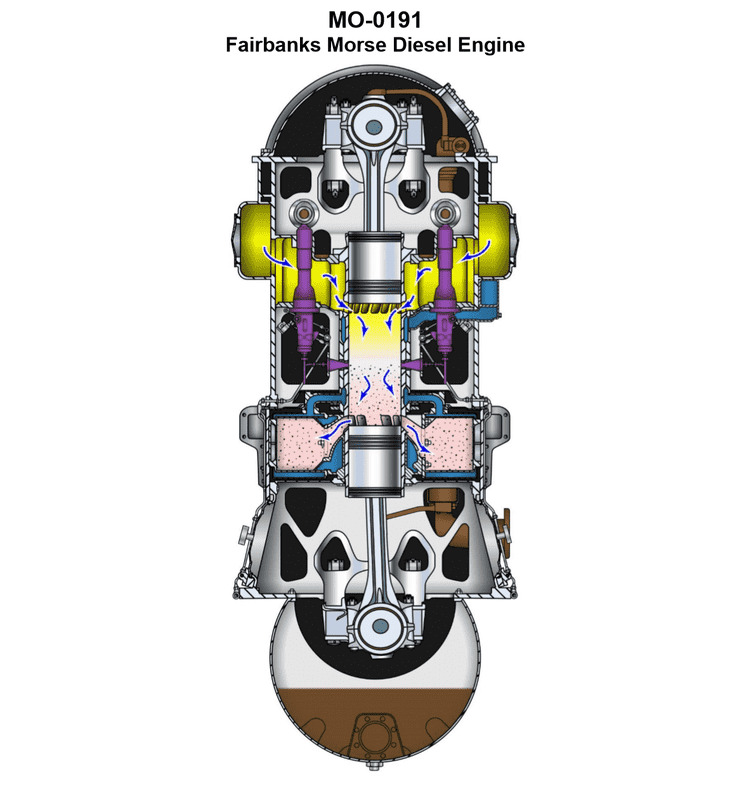
The Correct Answer is A ### Explanation for A (Correct Option) The question refers to an engine identified by the illustration MO-0191. While the illustration is not provided, this code and context typically refers to a highly specific and distinctive engine design commonly used in marine applications, particularly the **Fairbanks Morse 38 8-1/8 opposed-piston diesel engine**. 1. **Single-acting:** In this design, combustion occurs between the two opposing pistons (in the center of the cylinder liner). The force is only applied to the pistons moving outward from the combustion zone. There is no separate combustion chamber or force applied on the other side of the piston (as in a double-acting engine). Therefore, it is **single-acting**. 2. **Two-stroke cycle:** The engine completes one power cycle (Intake, Compression, Power, Exhaust) in two strokes of the piston (one revolution of the crankshaft). Scavenging and exhaust are achieved through ports uncovered by the pistons at the bottom of their stroke. Therefore, it is a **two-stroke cycle**. 3. **Opposed piston type:** The defining characteristic of this engine is that there are two pistons operating within a single cylinder liner, moving towards and away from each other. They share a common combustion chamber and connect to separate crankshafts (or a single crankshaft via specialized linkages). Therefore, it is an **opposed piston type engine**. ### Explanation for Incorrect Options * **B) This is a double-acting, two-stroke cycle, crosshead piston type engine.** * **Incorrect:** The engine shown is **single-acting** (combustion only occurs between the opposing pistons). It is also an **opposed-piston** design, not a standard crosshead piston design (though some variations might use a crosshead, the fundamental classification is opposed piston). * **C) This is a single-acting, two-stroke cycle, crosshead piston type engine.** * **Incorrect:** While it is single-acting and two-stroke, the core defining feature of the engine referenced by the illustration is the **opposed piston** arrangement, not the standard crosshead piston arrangement found in conventional large marine diesels. * **D) This is a double-acting, four-stroke cycle, opposed piston type engine.** * **Incorrect:** The engine is **single-acting** and operates on a **two-stroke cycle**. Four-stroke opposed piston engines are exceptionally rare, and the marine push boat application almost exclusively uses the two-stroke cycle version for power density.
Pass Your Coast Guard Licensing Exams!
Study offline, track your progress, and simulate real exams with the Coast Guard Exams app